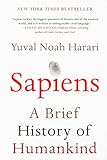
Editors Reads Verdict
A breathtaking intellectual adventure that synthesises 70,000 years of human history into one propulsive narrative. Harari's scope and ambition are unmatched — even where you disagree, the book forces you to think harder about what it means to be human.
What We Loved
- Astonishing scope — covers 70,000 years in 443 pages
- Propulsive, almost novelistic writing style
- Challenges assumptions about progress and happiness
- Essential context for understanding the modern world
Minor Drawbacks
- Some historians dispute specific interpretations
- Occasional oversimplification of complex historical debates
- The final chapters on the future feel less grounded than the history
Key Takeaways
- → Homo sapiens succeeded because of our unique ability to believe in shared fictions (money, nations, gods)
- → The Agricultural Revolution may have been history's biggest fraud — it made humans less healthy
- → The Scientific Revolution was driven by the admission of ignorance
- → Capitalism and empire co-evolved and spread European culture globally
- → Progress does not necessarily mean increased happiness
| Author | Yuval Noah Harari |
|---|---|
| Publisher | Harper Perennial |
| Pages | 443 |
| Published | February 10, 2015 |
| Language | English |
| Genre | History, Anthropology, Science |
| Difficulty | Beginner |
| Best For | Curious readers of all backgrounds who want to understand how Homo sapiens came to dominate Earth — and what that dominance has cost us and other species. |
How Sapiens Compares
Sapiens at a glance against 3 similar books readers weigh alongside it.
| Book | Author | Rating | Best for |
|---|---|---|---|
| Sapiens (this book) | Yuval Noah Harari | ★ 4.6 | Curious readers of all backgrounds who want to understand how Homo sapiens came |
| Guns, Germs, and Steel | Jared Diamond | ★ 4.5 | History readers, social scientists, anyone who has ever wondered why the |
| Homo Deus | Yuval Noah Harari | ★ 4.3 | Readers who enjoyed Sapiens and want to follow its argument into the future |
| The Dawn of Everything | David Graeber and David Wengrow | ★ 4.1 | History and anthropology readers |
The Book That Changed How We See Ourselves
When Sapiens was published in Hebrew in 2011, it was a sensation in Israel. Its English translation four years later turned Yuval Noah Harari into a global intellectual phenomenon — recommended by Barack Obama, Bill Gates, and Mark Zuckerberg. The reasons become clear on the first page.
Four Revolutions That Made Us
Harari structures his narrative around four pivotal transformations:
The Cognitive Revolution (~70,000 years ago)
Something happened to the Sapiens brain that allowed us to do something no other animal could: believe in things that don’t physically exist. Money, human rights, nations, corporations, gods — Harari calls these “shared fictions” or “imagined realities.” They allowed strangers to cooperate on a scale that overwhelmed every other species.
The Agricultural Revolution (~12,000 years ago)
Harari delivers one of history’s most provocative verdicts: farming may have been history’s biggest fraud. Agricultural humans worked longer hours, ate less varied diets, and suffered more disease than their hunter-gatherer ancestors. The revolution served wheat more than it served us — wheat went from rare grass to one of the most widespread plants on Earth.
The Unification of Humankind (~500 BCE onwards)
Three forces — money, empires, and universal religions — wove the world’s many cultures into a single, increasingly interconnected civilisation. This process, violent and unjust as it often was, created the platform for everything that came after.
The Scientific Revolution (~500 years ago)
The pivotal moment: Europeans admitted they didn’t know things. The willingness to say “we don’t know — let’s find out” unleashed the most explosive wave of discovery in history, funded by empires that understood science’s military and economic potential.
The Uncomfortable Questions
The book’s greatest achievement is making you uncomfortable with assumptions you never knew you had. Is life better now than in 1400? By what measure? Are industrial farm animals — three times as numerous as wild mammals — proof of our success or our failure? Has the last 500 years of “progress” made humans happier?
Harari’s answer to the last question is deliberately uncertain: we don’t know, and the question matters enormously.
Should You Read Sapiens?
Yes, unreservedly. Even where historians dispute the details — and some do — the framework Harari provides for thinking about human history is uniquely valuable. You will finish the book with a different sense of what you are, how your society was constructed, and what is arbitrary about the world you take for granted.
Our rating: 4.6/5 — One of the most mind-expanding books of the last decade. Essential for anyone curious about the human story.
The Power and the Risk of the Big-Picture Sweep
What makes Sapiens so readable is exactly what makes it contentious: Harari compresses the entire human story into a handful of bold, memorable arguments, and a bold argument simplifies. His central insight — that Homo sapiens conquered the planet because we alone can cooperate flexibly in huge numbers, bound together by shared fictions such as money, nations, religions, and human rights — is genuinely illuminating, and it reframes things most readers have never thought to question. The cost is that specialists in each field he crosses can point to where the sweep flattens the detail, and his more provocative claims (that the Agricultural Revolution was “history’s biggest fraud”, that happiness has not risen with progress) are arguments dressed as conclusions.
How to Read Sapiens
The right way to read it is as a brilliant provocation rather than a settled textbook — a book whose job is to make you see the water you swim in, not to give you the final word on prehistory or economics. Read that way, it is exhilarating: few books do more to loosen the assumption that the way we live now is natural or inevitable. Hold its sweeping generalisations lightly, notice where an “is” quietly becomes an “ought”, and treat the most striking lines as starting points for your own thinking. Readers who want to go deeper can follow Harari forward into his books on the future and the present, but Sapiens remains the one that does the essential work of estrangement, making the familiar strange enough to think about.
Why It Became a Global Phenomenon
It is worth pausing on why a sweeping history by an academic historian sold tens of millions of copies and was championed by readers from students to heads of state and tech founders. The answer is partly Harari’s gift for the arresting sentence and partly the moment: a generation hungry for a single story that connects biology, history, money, and meaning found it here. That hunger is exactly why the book deserves both its readers and a degree of caution — a story this satisfying can feel truer than the messy evidence warrants. Taken as the beginning of an argument rather than its conclusion, Sapiens is among the most stimulating works of popular history of its era, and the rare big-idea book that genuinely repays the time it asks. It is best read with a pen in hand and a sceptic’s eye, ready to argue back — which is, in the end, the highest compliment a book of ideas can be paid.
Reading Guides
- Sapiens vs Guns, Germs, and Steel
- Sapiens vs Homo Deus: Which to Read First
- Books Like Sapiens: 11 Mind-Expanding Reads for Big-Picture Thinkers
- Books Like Into the Wild: Escape, Nature, and the American Wilderness
- Books Like Man
- Books Like The Glass Castle: Dysfunctional Families, Resilience, and the Memoir of Escape
- Books Like The Immortal Life of Henrietta Lacks: Science, Race, and the Body as Property
- Books Like Thinking, Fast and Slow: Cognitive Science, Bias, and How We Actually Make Decisions
- 20 Best Philosophy Books: From Ancient to Contemporary
Frequently Asked Questions
What is "Sapiens" about?
From the emergence of Homo sapiens in Africa to the 21st century, Harari traces the full sweep of human history, asking why our species conquered Earth while others failed.
Who should read "Sapiens"?
Curious readers of all backgrounds who want to understand how Homo sapiens came to dominate Earth — and what that dominance has cost us and other species.
What are the key takeaways from "Sapiens"?
Homo sapiens succeeded because of our unique ability to believe in shared fictions (money, nations, gods) The Agricultural Revolution may have been history's biggest fraud — it made humans less healthy The Scientific Revolution was driven by the admission of ignorance Capitalism and empire co-evolved and spread European culture globally Progress does not necessarily mean increased happiness
Is "Sapiens" worth reading?
A breathtaking intellectual adventure that synthesises 70,000 years of human history into one propulsive narrative. Harari's scope and ambition are unmatched — even where you disagree, the book forces you to think harder about what it means to be human.
Ready to Read Sapiens?
Check the current price on Amazon.
Check Price on Amazon (paid link)Prices and availability are subject to change. See Amazon for current price.
Review last updated: