Books Like The Glass Castle: 11 Resilience Memoirs
Jeannette Walls's memoir of growing up with her brilliant, charismatic, catastrophically irresponsible parents — who moved the family constantly, never had enough food, and promised to build a glass castle — is the most-read American family memoir. These books share its mixture of love and horror, its unsentimental clear-eyedness about parents.
By Natalie Osei
Jeannette Walls’s The Glass Castle begins with one of the most arresting opening images in recent memoir: the adult Walls, riding in a taxi through Manhattan on her way to a party, spots her mother going through a dumpster outside a restaurant. She slides down in her seat to avoid being seen. She is a successful journalist. Her mother is homeless by choice. The gap between those two facts — and the complex love and grief that Walls feels in that moment — is the entire subject of the book that follows.
Published in 2005, The Glass Castle spent more than six years on the New York Times bestseller list and has sold over five million copies. Its appeal is not hard to understand: it is a story about a chaotic, nomadic childhood with parents who were simultaneously brilliant and catastrophically irresponsible, told with a directness and lack of self-pity that makes it nearly impossible to put down. Walls does not ask the reader to pity her, and she does not ask them to condemn her parents. She asks them to see clearly, and that clarity is what makes the book so affecting.
The books below were chosen for readers who responded to The Glass Castle’s distinctive combination of qualities: the dysfunctional family told with love intact, the memoir of escape that does not erase what it escaped from, and the child’s-eye view of adults who are fascinating and dangerous in equal measure. They range from the closest literary parallel to memoirs of entirely different kinds of family difficulty that share the same unsentimental compassion.
More Family Dysfunction Memoirs
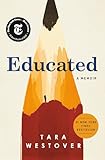
#1 — Educated by Tara Westover
Westover’s memoir of growing up in a survivalist family in the mountains of Idaho — without formal schooling, without birth records, largely cut off from the outside world by a father convinced that government and medicine were forms of tyranny — is the closest parallel to The Glass Castle in recent American memoir. Both books feature a brilliant, charismatic father with a totalizing worldview that makes ordinary life impossible; both feature a child who loves that father while being destroyed by the circumstances he creates; and both culminate in a hard-won self-education that is also a kind of rupture. Westover’s prose is more formally literary than Walls’s, and the psychological complexity of her account of how she came to see her family clearly is exceptional.
#2 — The Liar’s Club by Mary Karr
Karr’s 1995 memoir of a Texas childhood — her father a refinery worker given to dark silences and her mother a woman with a violent streak and a history she refused to explain — is the book that preceded and helped establish the confessional American family memoir as a form. The Liar’s Club covers much of the same ground as The Glass Castle: the charismatic but unreliable parent, the child navigating adults whose behavior she cannot fully understand, the retrospective account that is both accusation and elegy. Karr’s prose is more pyrotechnic than Walls’s, more consciously literary, and the book has a rawness that comes from being one of the first to do what it does. Reading it alongside The Glass Castle is to see the same territory mapped twice by writers with very different voices.
#3 — Angela’s Ashes by Frank McCourt
McCourt’s memoir of his childhood in Limerick — grinding Catholic poverty, a father who drank the family’s money, a mother who held them together by sheer force of will, and the deaths of several siblings from diseases of deprivation — is the Irish version of the American family memoir of dysfunction, and it brings the additional register of dark comedy. Where Walls maintains a kind of wondering detachment, McCourt narrates in the voice of the child he was, and the effect is to make the poverty and the suffering simultaneously more immediate and more bearable. Angela’s Ashes won the Pulitzer Prize in 1997 and was enormously influential on the memoir form; its combination of tragedy and comedy is a model that many subsequent memoirs have tried and failed to replicate.
Parents We Can’t Simply Condemn
#4 — A Long Way Gone by Ishmael Beah
Beah’s memoir of being recruited as a child soldier in Sierra Leone’s civil war is not a family memoir in the conventional sense, but it belongs on this list because it is the account of a childhood shaped by forces so far beyond any individual’s control that the question of parental responsibility barely applies. Beah’s family is destroyed by history — by a war that turns children into killers — and the memoir is partly about what it means to recover a self from that destruction. Reading it alongside The Glass Castle is to see both the specificity of Walls’s American middle-class dysfunction and the much larger category of childhoods shaped by forces that make Rex and Rose Mary Walls’s failures look small.
#5 — Beautiful Boy by David Sheff
Sheff’s account of his son Nic’s methamphetamine addiction — the descent, the recoveries, the relapses, the terror of watching a child you love disappear into a drug — is The Glass Castle from the parent’s side: the story of a family shaped by one member’s compulsion, told by someone who loves the person responsible and cannot understand how to help them. Where Walls gives us Rex’s alcoholism from the child’s perspective, Sheff gives us addiction from the parent’s, and the reversal is illuminating. Both books refuse the simplification of the addict as villain, and both are ultimately about the limits of what love can do in the face of a compulsion stronger than will.
#6 — Fun Home by Alison Bechdel
Bechdel’s graphic memoir about her father — a high school English teacher and amateur restorer of their family’s Victorian house, who was also a closeted gay man, and who died under ambiguous circumstances shortly after Bechdel came out to her parents — is the family memoir as formal and intellectual achievement as much as emotional one. The comics form allows Bechdel to layer literary allusion (the title refers to the family’s nickname for the funeral home her father ran) with visual irony in ways that prose alone cannot, and her account of loving a father whose secret life she could not fully understand until he was dead shares with The Glass Castle the sense of a child making retrospective sense of an adult who was too complicated, and too damaged, to be understood in the moment.
#7 — Hillbilly Elegy by J.D. Vance
Vance’s account of growing up in a working-class family in Middletown, Ohio — with a mother whose drug addiction and serial relationships made stable childhood impossible, and the Appalachian culture of pride and fatalism that shaped his grandparents — is the most contested book on this list, generating arguments about class, politics, and the limits of the individual-escape narrative. But as a family memoir it belongs alongside The Glass Castle: the same combination of dysfunction and love, the same question of how a child escapes a world that seemed designed to contain them, and the same refusal to make the escape feel straightforwardly triumphant.
Resilience and the Life After
#8 — The Alchemist by Paulo Coelho
Coelho’s fable is the philosophical version of the question The Glass Castle answers through memoir: what does it mean to choose your own path against all expectation, to leave the circumstances you were born into and follow something that feels true? Santiago gives up the safety of his shepherd’s life to pursue a dream; Jeannette Walls gives up the only family she has to pursue the life she can see is possible. The fable makes the choice clean and the destination golden; the memoir makes it complicated and costly and real. Reading them together illuminates what the narrative of self-determination looks like as consolation and what it looks like as biography.
#9 — I Know Why the Caged Bird Sings by Maya Angelou
Angelou’s account of her childhood in the segregated South — the rape at age eight, the years of silence that followed, the grandmother who held her together, the slow discovery of language as a source of power — is the canonical American resilience memoir, the book that established the form in which a childhood that should have been destroying becomes, through the retrospective account, an origin story of survival and self-creation. Where Walls’s resilience is presented with almost journalistic neutrality, Angelou’s is lyrical and explicitly hard-won. Both books ask what it means not to be broken by what happened to you; both answer with the fact of the book itself.
#10 — Between the World and Me by Ta-Nehisi Coates
Coates’s letter to his teenage son about the country they live in and the particular danger that the country represents to Black bodies is the family memoir as political act: a father trying to tell his child the truth about a world the child must navigate, with the love and terror that truth-telling to a child you cannot protect requires. It shares with The Glass Castle the sense of a parent’s account (here the parent’s rather than the child’s) reckoning honestly with what cannot be given and what cannot be promised, and the recognition that love is both necessary and insufficient. The book is short, dense, and devastating in a way that operates quite differently from Walls’s warm and novelistic prose.
How to Choose Your Next Read
If you want the closest parallel in recent memoir: Educated by Tara Westover — the same love and horror, a different landscape.
If you want the memoir that established the form: The Liar’s Club — the Texas predecessor, rawer and more pyrotechnic.
If you want dark comedy alongside the deprivation: Angela’s Ashes — the Irish Catholic version.
If you want the parent’s perspective: Beautiful Boy — addiction from the other side.
If you want the most formally inventive: Fun Home — Bechdel’s graphic memoir, in images and literary allusion.
For the Best Biographies and Memoirs
For the definitive guide to biography and memoir across history, politics, and science, see our Best Biographies Ever Written list.
More Memoir and Non-Fiction Guides
- Books Like Educated: Memoirs About Survival and Finding Yourself
- Books Like In Cold Blood: True Crime and Narrative Journalism
Affiliate disclosure: Links to Amazon on this page are affiliate links. We earn a small commission at no extra cost to you. This does not influence our editorial recommendations.
Frequently Asked Questions
Is The Glass Castle a true story?
Yes. Jeannette Walls published *The Glass Castle* in 2005 as a memoir — an account of her own childhood and young adulthood. Her parents, Rex and Rose Mary Walls, were real people: Rex was a brilliant, alcoholic dreamer who genuinely believed he would one day build his family a glass castle powered by solar energy; Rose Mary was an artist who prioritized her own creative work over feeding her children. Walls wrote about them with striking lack of bitterness, presenting them as complicated people who genuinely loved their children while failing them in almost every concrete way. Her parents were still alive when the book was published; her mother's reaction was to say that Jeannette should have focused more on the fun parts.
Why does Jeannette Walls not condemn her parents more harshly?
This is the question the memoir keeps generating, and Walls has addressed it in interviews. She describes her parents as people with real gifts and real love for their children, whose failures were the result of mental illness, addiction, and a genuine philosophical rejection of conventional society rather than simple cruelty or indifference. Rex Walls was an alcoholic, but he was also a man who taught his daughter to read, who took her stargazing and explained the physics of the universe to her, who genuinely believed his dreams. The memoir's refusal to flatten its subjects into villains is exactly what gives it its power and its longevity — the ambivalence feels true in a way that simple condemnation would not.
What is the glass castle in the book?
The glass castle is Rex Walls's recurring promise to his family: a house he would design and build himself, powered by solar energy and featuring glass walls that would allow the family to see the stars from inside. He drew plans for it throughout Jeannette's childhood, and the family would occasionally dig the foundation in whatever town they were currently living in before moving on. The castle was never built. It functions in the memoir as the central symbol of Rex's character: the magnificent vision, the genuine intelligence behind it, and the complete inability to translate any of it into something real. The title is Walls's most precise encapsulation of what it was to grow up with her father.