The third Bas-Lag novel — as New Crobuzon convulses with revolution, a man named Cutter travels into the wilderness to find the Iron Council: a perpetual-motion train run by the workers who took it decades ago, still running through the badlands.
A Holocaust survivor—a translator, like Kertész—explains to his unborn child why he refused to have children. The child is not born because the father cannot bring a child into a world that produced Auschwitz. A monologue addressed to an absence, Kaddish is one of the most formally intense works of Holocaust literature.
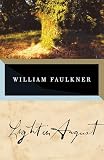
Three interlocking stories in Jefferson, Mississippi: Joe Christmas, a man who may or may not be partly Black, whose ambiguous racial identity will destroy him; Lena Grove, a pregnant young woman walking toward her lover; and Reverend Hightower, disgraced and retired, watching from his window. Faulkner's most humanely accessible major novel.
Malone lies in bed dying, telling himself stories to pass the time. He will be dead before the end of the book. The stories keep dissolving and beginning again; the characters merge; the pencil keeps getting lost. Middle volume of Beckett's great prose trilogy, and for many readers the most haunting.
Three movements: Paul Ehrenfest's suicide, John von Neumann's life and legacy, and AlphaGo's 2016 defeat of Lee Sedol — a meditation on mathematical genius, the bomb, and what artificial intelligence means for human cognition.
A dead-end alley in wartime Cairo is home to a cast of characters — a beautiful girl who dreams of escaping, a wise poet, a corrupt barber, a philosophical beggar — whose lives Mahfouz follows with the compassion and precision of a naturalist.
Seventeen linked stories set on a single street in Port of Spain, Trinidad, where the narrator grows up watching the men and women of Miguel Street construct extravagant identities to compensate for their circumstances—the failed poet, the would-be engineer, the boxer, the prostitute's pimp—before he escapes to England on a scholarship.
A private detective named Guy Roland discovers he has no past—his memory was erased, and even his name is a fiction. He begins investigating his own identity, tracing himself through prewar and wartime Paris to discover who he was before the amnesia. Winner of the Prix Goncourt. Modiano's most emblematic novel.
Lionel Essrog has Tourette's syndrome and works for a small Brooklyn detective agency run by Frank Minna. When Frank is murdered, Lionel — compelled by tics, verbal eruptions, and the inability to leave a pattern unresolved — investigates his mentor's death. A genre novel about the detective impulse as a form of neurological necessity.
Edward and Florence are married in 1962 and arrive at their hotel on the Dorset coast. The wedding night goes catastrophically wrong. In the final pages, McEwan shows the fifty years that follow from a single, irreversible misunderstanding.
Lucretius's philosophical poem expounding Epicurean atomism — the argument that the universe consists of atoms and void, that the soul dissolves at death, that the gods do not intervene in human affairs, and that therefore the fear of death is irrational. Written in Latin hexameters of great beauty, c. 60 BCE.
Four misfits in postwar suburban Australia each have visions of the chariot of God: an eccentric spinster, an Aboriginal painter, a German Jewish refugee, and a simple-minded washerwoman. The novel weaves their stories together toward a Good Friday ritual of suburban violence. White's most explicitly religious and most savage novel.
An aging Norwegian painter named Asle contemplates his paintings and his life. He has a neighbor also called Asle—a fellow painter, a drinker, his double—who may or may not represent who he could have been. Over seven parts (the complete trilogy in one volume), Fosse's prose moves in long, recursive, comma-linked sentences that spiral around identity, faith, creativity, and death.
Bradley Pearson, failed writer of 58, falls violently in love with Julian Baffin — the 20-year-old daughter of his rival Arnold. The love is absurd, overwhelming, and destroys everything. Murdoch's most formally adventurous novel includes multiple unreliable forewords and postscripts that reframe the entire narrative.
Homer Wells grows up in an orphanage in Maine run by Dr Larch, a physician who performs both deliveries and abortions. When Homer leaves for the apple orchards of the coast, he carries the doctor's skills and convictions — and must eventually decide what he believes. Irving's most political and most moving novel.
Hans Schnier, a professional clown, calls everyone he knows to borrow money after his partner and only love, Marie, has left him for a good Catholic marriage. In one evening of phone calls, Böll dissects West German Catholic bourgeois society with devastating precision. His most bitter and his funniest novel.
Inspector Grant, bedridden after an accident, investigates the murder of the Princes in the Tower — a 400-year-old cold case. Voted the greatest mystery novel of all time by the Crime Writers' Association, Tey's intellectual detective story is a meditation on history, rumour, and how received narratives harden into fact.
The novel begins: 'Neither of the Grimes sisters would have a happy life, and looking back it always seemed that the trouble began with their parents' divorce.' Emily and Sarah Grimes grow up in Depression-era New York and move through postwar America — marriages, jobs, affairs, children — in separate but parallel patterns of disappointment. Yates's most compressed novel and possibly his finest.
Naipaul lives in a cottage in the Wiltshire countryside, tenant of a decaying English manor, and watches the landscape and its people change around him over years. Part autofiction, part elegy for a rural England already passing, part meditation on what it means to arrive—from Trinidad, from England's colonial periphery—and never quite belong anywhere.
Jean-Baptiste Clamence, a former Paris lawyer who helped the poor, drinks in an Amsterdam bar and delivers a lengthy monologue to a stranger. His confession: years earlier he did nothing when a woman jumped from a bridge, and the guilt has transformed him into a 'judge-penitent' who confesses in order to accuse others. Camus's darkest and most ironically complex novel.
Set in a future utopian province dedicated to the life of the mind, the novel follows Joseph Knecht, who rises to become Magister Ludi—master of the Glass Bead Game, a synthesis of all human knowledge and art. The novel for which Hesse received the 1946 Nobel Prize.
Yasha Mazur is a traveling magician, acrobat, and womanizer in late nineteenth-century Poland. Ambitious, irreligious, unfaithful to his devoted wife, he is planning a burglary that will free him to elope with an educated Polish woman. The burglary goes wrong. What follows is one of the strangest penitential conversions in modern fiction.
1938: the aging Master of Go (the board game equivalent of chess grandmaster) plays his final match against a young challenger. The match takes six months to complete. Kawabata covered it as a journalist and transformed it into this elegy for a tradition—and for a Japan—that the match's outcome symbolically destroys.
Michael Henchard sells his wife and daughter at a country fair in a drunken rage, swears off alcohol, and through sheer willpower rises to become mayor of Casterbridge. When his wife and daughter return, and when Donald Farfrae arrives to threaten his position, the mechanism of his destruction begins.
Disclosure: Editors Reads is a participant in the Amazon Services LLC Associates Program. When you click an Amazon link and make a purchase, we may earn a commission at no additional cost to you. This helps fund our independent editorial team.
We use cookies to understand how visitors use our site (Google Analytics). No data is collected until you accept.
Privacy Policy