Books Like Lincoln in the Bardo: Grief & Afterlife
George Saunders's novel of Abraham Lincoln grieving his dead son in a graveyard full of ghosts refusing to move on won the Booker Prize and redefined what a novel can be. These books share its formal experimentation, its tenderness toward the dead, and its belief that grief is political.
By Lena Fischer

George Saunders spent over twenty years writing Lincoln in the Bardo, and it shows — not in any sense of labor or revision visible in the prose, but in the completeness of its vision. Published in 2017 and immediately awarded the Booker Prize, the novel takes as its premise a single historical night: Abraham Lincoln, bowed under the weight of the Civil War and the recent death of his eleven-year-old son Willie, enters a Georgetown cemetery vault and holds his son’s body. The ghosts already in residence — dozens of them, trapped in the bardo between death and whatever comes next — witness this and are changed by it.
The form Saunders invented for this material is unlike any other novel. The historical Lincoln is assembled from quotations drawn from contemporaneous accounts — newspapers, diaries, memoirs, some real, some invented but indistinguishable from real — and the ghosts speak in a polyphonic chorus that resembles a play, a fugue, a trial transcript, and a seance all at once. The effect is of a reality constituted entirely from fragments: nothing is authoritative, everything is partial, and grief itself is what holds the pieces together.
The books below were chosen for readers who responded to one or more of what makes Lincoln in the Bardo extraordinary: the formal experimentation that puts pressure on what a novel can be, the insistence that private grief and political history are inseparable, and the strange tenderness the book extends to the dead. They are grouped by what they share most closely with Saunders’s novel.
Grief and the Dead Who Won’t Leave
#1 — Beloved by Toni Morrison
Morrison’s 1987 novel is the closest structural parallel to Lincoln in the Bardo: a ghost returns — Sethe’s daughter, killed to save her from slavery, comes back as a young woman — and the living cannot move on from the death that occasioned her. The ghost in Beloved is not an absence but an overwhelming presence, and Morrison’s prose performs the same dissolution of stable reality that Saunders achieves through polyphony. Both novels insist that grief has a political dimension: Lincoln’s is the grief of a nation at war with itself, Sethe’s is the grief of slavery’s survivors who cannot bury what was done to them. Beloved is considerably harder and more formally demanding than Lincoln in the Bardo, but they come from the same understanding of what fiction is for.
#2 — The Midnight Library by Matt Haig
Nora Seed, at the point of ending her life, finds herself in a library between death and whatever comes next — a space where every book contains an alternate version of her existence, each choice she did not make. Haig’s library is a secular, contemporary version of Saunders’s bardo: the intermediate space where the dead (or nearly dead) are given access to what they left behind or never reached. The Midnight Library is more accessible and less formally radical than Lincoln in the Bardo, but it shares the central conviction that the space between life and death is where the most important things become visible. Readers who found Saunders’s ghostly limbo emotionally resonant will find Haig’s version affecting in a different register.
#3 — A Visit from the Goon Squad by Jennifer Egan
Egan’s 2011 Pulitzer Prize winner is not a novel about grief in any conventional sense — it is about time, rock music, and the self that exists on either side of the moments that change everything. But it belongs here because Egan, like Saunders, invented a form adequate to her material: the novel is told in radically shifting perspectives, including an entire chapter in PowerPoint slides, and the past is present throughout as a living force that presses on the characters who cannot stop carrying it. The formal ambition is comparable to Lincoln in the Bardo, and both books share the conviction that experimental structure is not decoration but the only honest way to render certain truths.
#4 — The Brief Wondrous Life of Oscar Wao by Junot Díaz
Díaz’s 2007 Pulitzer winner arrives with a dead narrator — we know from early in the novel that Oscar, an overweight Dominican-American nerd obsessed with science fiction, will not survive — and the knowledge of his death shapes every page of his life as it is reconstructed. The multigenerational family trauma, the fuku (a curse that the novel treats with deliberate seriousness), and the footnotes that make the text feel annotated and incomplete all connect to Saunders’s method: the dead narrate, the living are haunted, and grief is inseparably political. The grief here carries the weight of the Trujillo dictatorship and the Dominican diaspora — public history wearing private clothes.
Formally Experimental American Fiction
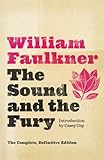
#5 — The Sound and the Fury by William Faulkner
Faulkner’s 1929 masterpiece tells the story of the Compson family’s collapse four times, from four radically different perspectives, beginning with Benjy — a man with an intellectual disability who experiences time nonlinearly, so that his dead sister Caddy is as present to him as any living person. The novel’s radical form is in service of grief: Faulkner needed a broken structure to represent a broken family and the broken South it stands for. The Sound and the Fury is the ancestor of Lincoln in the Bardo’s polyphony — the understanding that grief destroys linear time, that the dead do not stay in the past, and that a novel’s form must enact what it is saying. It is harder going than Saunders, but the rewards are proportional.
#6 — White Noise by Don DeLillo
DeLillo’s 1985 novel is about Jack Gladney, a professor of Hitler studies at a small college, and his family’s collective terror of death — a background hum that underlies every consumer transaction, every pharmaceutical, every piece of television noise. Where Lincoln in the Bardo places its characters in direct confrontation with the dead, White Noise puts them in flight from the fact of death in the quintessentially American mode: through distraction, commerce, and the management of information. Both novels are, at bottom, about how a culture deals with mortality, and DeLillo’s diagnosis of the American relationship to death illuminates what Saunders is doing with Lincoln’s grief. It is also very funny, in a way that Saunders’s novel is not, but shares its dark comic intelligence.
#7 — The Hours by Michael Cunningham
Cunningham’s 1998 Pulitzer winner braids three women across time — Virginia Woolf writing Mrs Dalloway in 1923, a housewife in 1950s Los Angeles reading it, a New York editor in 1999 living its aftermath — connected by the question of what it costs to live fully and what it means to choose not to. The formal experiment is more restrained than Saunders’s but equally intentional: each timeline illuminates the others, and the structure enacts the novel’s argument that certain deaths and certain griefs reverberate across time in ways that do not respect chronology. For readers drawn to Lincoln in the Bardo’s use of structure as meaning, The Hours offers one of the most elegant examples in recent American fiction.
History and Private Grief
#8 — The Killer Angels by Michael Shaara
Shaara’s 1974 Pulitzer winner reconstructs the Battle of Gettysburg from inside the consciousness of the officers on both sides — Joshua Lawrence Chamberlain, Robert E. Lee, James Longstreet — in the July of 1863, sixteen months after Willie Lincoln’s death. Like Lincoln in the Bardo, it insists that the Civil War is not a backdrop but a moral catastrophe that each character must find a way to live inside. The form is less radical but the intimacy is comparable: Shaara inhabits his historical figures as fully as Saunders inhabits his ghosts, and the grief that runs through the novel — for the dead, for the nation, for the world that will not survive the battle — gives it the same emotional weight.
#9 — The Known World by Edward P. Jones
Jones’s 2003 Pulitzer winner tells the story of Henry Townsend, a formerly enslaved Black man in antebellum Virginia who becomes a slaveholder himself — and of the community that must survive after his death. The moral complexity Jones pursues is the Civil War’s prehistory: how did slavery deform not just the enslaved but every human relationship inside a slave society, including those among Black Americans? The novel is formally complex — it moves freely through time, delivers its revelations out of sequence — and it carries the same political weight as Lincoln in the Bardo while pressing on questions Saunders’s novel cannot reach. The grief here is for a world so damaged that there may be no one in it who is not complicit.
#10 — The Kite Runner by Khaled Hosseini
Hosseini’s 2003 novel is more conventional in form than anything else on this list, but it belongs here because of what it shares with Lincoln in the Bardo at the level of moral argument: the grief it carries is both private and historical, and the novel insists on their inseparability. Amir’s betrayal of Hassan and the guilt he carries for twenty years is also the story of Afghanistan under the Soviet invasion and the Taliban — personal shame embedded in historical catastrophe. The dead in The Kite Runner are not ghosts, but they are not gone either: they press on the living with the same force that Saunders’s bardo spirits press on Lincoln.
How to Choose Your Next Read
If you want the closest structural parallel to the ghost that won’t let the living rest: Beloved — the founding text of this tradition.
If you want the most accessible version of the bardo concept: The Midnight Library — Haig’s contemporary take on the space between life and death.
If you want the most formally inventive American fiction: The Sound and the Fury — the ancestor of Saunders’s polyphony.
If you want historical grief with military scope: The Killer Angels — Gettysburg from inside the generals’ consciousness.
If you want grief as political and diaspora narrative: The Brief Wondrous Life of Oscar Wao — the dead narrator carrying collective trauma.
For the Best Fiction Books
For the definitive guide to fiction — the greatest novels across literary fiction, classics, and contemporary writing — see our Best Fiction Books of All Time list.
More Experimental Literary Fiction Guides
- Books Like Tomorrow and Tomorrow: Creativity and Friendship
- Books Like The Overstory: Trees, Ecology, and Human Failure
Affiliate disclosure: Links to Amazon on this page are affiliate links. We earn a small commission at no extra cost to you. This does not influence our editorial recommendations.
Frequently Asked Questions
What is the bardo in Lincoln in the Bardo?
The bardo is a concept from Tibetan Buddhist tradition referring to an intermediate state between death and rebirth — a liminal zone where the recently dead exist before moving on. Saunders uses it as the setting for his novel: the ghosts in Oak Hill Cemetery in Washington, D.C., are souls caught in this state, unable or unwilling to accept their deaths and pass through. The bardo becomes a metaphor for grief itself — the refusal to let go, the holding on after it is time to release. Abraham Lincoln's repeated visits to his son Willie's tomb, holding the body, is the living version of the same refusal.
Is Lincoln in the Bardo based on a true story?
Partly. William Wallace Lincoln — Willie — was Abraham Lincoln's third son and died of typhoid fever in February 1862, at age eleven, during the early years of the Civil War. Lincoln was devastated, and there are historical accounts suggesting he visited the Georgetown vault where Willie was temporarily interred and may have held the body. Saunders uses this documented grief as the emotional center of the novel, surrounding it with invented ghosts and sourcing the historical frame from real contemporaneous accounts — newspapers, diaries, memoirs — which he quotes directly in the book. The collision of documented history and invented supernatural gives the novel much of its power.
Why did Lincoln in the Bardo win the Booker Prize?
Lincoln in the Bardo won the 2017 Booker Prize because it achieved something genuinely rare: a formally unprecedented novel that was also emotionally overwhelming. The judges cited its inventiveness — the polyphonic structure of hundreds of voices, the blending of historical source material with invented narrative — but also its humanity. Saunders had been known as a master of the short story, and skeptics wondered whether he could sustain that intensity at novel length. The answer was that he reinvented length itself: the novel reads less like a traditional narrative than like a sustained piece of music, and the grief it carries arrives with a force that few books of any form manage.