V.E. Schwab Books in Order: Shades of Magic, Villains, and Complete Guide (2026)
The complete V.E. Schwab reading order — Shades of Magic trilogy, Villains duology, Monsters of Verity duology, and standalone novels including Addie LaRue.
V.E. Schwab has published eight novels across four separate worlds. The Shades of Magic trilogy, the Villains duology, the Monsters of Verity duology, and the standalone The Invisible Life of Addie LaRue share an author and a sensibility — morally complex characters, propulsive plots, worlds built with precision — but they share nothing else. No crossover characters, no shared continuity, no reason to read one before another. This is not a situation like a sprawling interconnected universe. The reading order question is almost entirely about where to start, not what sequence to follow.
The direct answer: start with A Darker Shade of Magic if you want the fullest, most acclaimed entry point into Schwab’s work, or start with Vicious if you prefer contemporary settings and a darker, more contained story. Both are the first books in their respective series. Both work without any prior knowledge of the author’s other work. The choice is genuine — you are not choosing between a masterwork and a lesser book; you are choosing between two very different kinds of fantasy.
Schwab publishes under two names. V.E. Schwab is used for her adult and adult-crossover fiction. Victoria Schwab was the byline for her YA work, including the Monsters of Verity duology. The distinction has blurred over time — her YA books have large adult readerships — but if you encounter both names while searching, you are looking at the same writer.
Where to Start
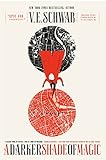
A Darker Shade of Magic is the most popular entry point to Schwab’s work, and the recommendation holds up. The world — four parallel versions of London, only one magician capable of traveling between them, magic that is slowly disappearing from most of them — is immediately distinctive. Kell is one of the last Antari, a rare kind of magician who can pass between Grey London (ours, magicless), Red London (his home, thriving with magic), White London (brutal, dying), and the forbidden Black London (destroyed by magic long ago). When he is drawn into a smuggling conspiracy, he collides with Lila Bard, a thief with her own ambitions. The series that follows is one of the more satisfying trilogies published in the 2010s — well-paced, with a world that expands convincingly across three books.
Vicious is the right entry point for readers who prefer contemporary settings and are drawn to stories where the moral lines between hero and villain are drawn by perspective rather than by action. Victor Vale and Eli Ever are former college roommates who discover how to develop superpowers — and become each other’s most dangerous enemies. The novel cuts between past and present, slowly revealing how two people who wanted the same things ended up on opposite sides. It is tighter than Shades of Magic, more interested in character psychology than world-building, and its moral ambiguity is genuine rather than cosmetic.
Both are good. Neither is a warm-up for the other. Pick based on your preference for setting and tone.
All V.E. Schwab Books at a Glance
| # | Title | Year | Series/Type |
|---|---|---|---|
| 1 | A Darker Shade of Magic | 2015 | Shades of Magic #1 |
| 2 | A Gathering of Shadows | 2016 | Shades of Magic #2 |
| 3 | A Conjuring of Light | 2017 | Shades of Magic #3 |
| 4 | Vicious | 2013 | Villains #1 |
| 5 | Vengeful | 2018 | Villains #2 |
| 6 | This Savage Song | 2016 | Monsters of Verity #1 |
| 7 | Our Dark Duet | 2017 | Monsters of Verity #2 |
| 8 | The Invisible Life of Addie LaRue | 2020 | Standalone |
Best starting point: A Darker Shade of Magic for fantasy readers; Vicious for readers who prefer contemporary settings and moral ambiguity.
Shades of Magic Reading Order
The Shades of Magic trilogy must be read in order. Each book picks up where the previous one ends, the stakes escalate significantly across all three volumes, and the final book — A Conjuring of Light — pays off setup from as far back as the first chapter of book one.
-
A Darker Shade of Magic (2015) — Kell, one of the last Antari magicians, is caught smuggling a forbidden object between parallel Londons. Lila Bard, pickpocket and aspiring pirate, steals it from him. The setup is a heist and a chase; the world-building is the achievement. This is the lightest of the three books, which is not a criticism — Schwab earns the darkness that follows by establishing the world’s rules clearly here.
-
A Gathering of Shadows (2016) — A magic tournament comes to Red London. The stakes feel smaller in the middle section — tournament preparation, new characters introduced — but Schwab uses the space to deepen Lila’s storyline and widen the cast. The final act revises the scale of the threat entirely. A middle book that does its job without being the weakest link.
-
A Conjuring of Light (2017) — The longest book in the trilogy and the most ambitious. An ancient force threatens not just Red London but all the remaining Londons. Schwab deploys everything built across the first two books and delivers a conclusion that justifies the series. This is where the trilogy earns its reputation.
Shades of Magic is Schwab’s most-read series and the entry point most fans recommend to new readers. The world-building is inventive, the main cast is well-drawn, and the pacing across three books is unusually consistent.
The Villains Series (Vicious and Vengeful)
The Villains duology should be read in order. Vengeful is a direct sequel — it continues from the end of Vicious and relies entirely on knowing what happened there.
-
Vicious (2013) — Victor Vale and Eli Ever discover during college that near-death experiences can trigger extraordinary abilities — ExtraOrdinaries, or EOs. The novel moves between their shared history and the present, where Victor has broken out of prison and is hunting Eli. What makes the book exceptional is that both men are the protagonist and the villain depending on whose chapter you’re reading. Schwab refuses to resolve this into a simple moral hierarchy. Vicious is the standout of the two books — the tighter story, the cleaner structure, the more concentrated effect.
-
Vengeful (2018) — Set ten years after Vicious, the story expands to include Marcella Riggins, a new EO with her own agenda. The scope is wider than the first book, and the cast larger. Vengeful is a good sequel — it expands the world and deepens the mythology — but it does not surpass the original. The introduction of Marcella is the book’s strongest element; she is more interesting than the plot circumstances that surround her.
These are adult novels, darker in tone than Shades of Magic. The moral ambiguity is not atmospheric decoration; it is the actual subject of the books. Neither Victor nor Eli is meant to be sympathised with unconditionally, and Schwab is disciplined about not letting either off the hook.
Monsters of Verity
Monsters of Verity is Schwab’s most underrated series. It was originally published under the Victoria Schwab byline and has a YA classification, but the themes — violence as a generative force, complicity, what it costs to survive a system designed to kill you — are not softened for younger readers. Both books must be read in order, and they should be read together: the duology forms a single complete story.
-
This Savage Song (2016) — The city of Verity is divided between two territories: the north, controlled by Kate Harker’s father through a policy of brutal enforcement, and the south, protected by the Flynn family through a different kind of control. Monsters in this world are not metaphors — they are literal creatures born from acts of violence. August Flynn is one of them. Kate Harker has spent years trying to be as ruthless as her father. The first book is about what happens when these two characters meet, and it is largely about the costs of the identities they’ve been forced into.
-
Our Dark Duet (2017) — The conclusion. Darker than the first book, more willing to pay the full cost of what it set up. Schwab does not flinch from the implications of her premise, and the ending earns its weight. Reading this immediately after This Savage Song is the correct approach.
The two-book structure is ideal. Nothing is padded; nothing is withheld to manufacture a sequel. This is a story that knew what it was doing from the beginning.
The Invisible Life of Addie LaRue
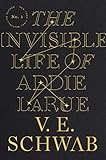
The Invisible Life of Addie LaRue (2020) is a standalone. It requires no knowledge of any of Schwab’s other work and is complete on its own.
Addie LaRue is born in 18th-century France and, desperate to escape the life mapped out for her, makes a deal with a dark entity at the crossroads. She is granted immortality — but cursed to be forgotten by every person she meets, the moment she leaves their sight. No one can remember her. She cannot leave a mark on the world. She exists entirely without record. The novel moves between her centuries of wandering and a present-day encounter in a New York bookshop, where a young man named Henry remembers her — which should be impossible.
Addie LaRue is Schwab’s most mainstream crossover success. It reached audiences that had not read her fantasy series and functions well as a standalone entry point for new readers. The premise is tight, the execution is patient, and the emotional logic — what it means to exist without being known — holds up across the full length of the novel.
V.E. Schwab vs Victoria Schwab — What’s the Difference?
Schwab published her early work under both names: Victoria Schwab for YA, V.E. Schwab for adult fiction. The Monsters of Verity duology was originally published as Victoria Schwab. Shades of Magic, Vicious, and Addie LaRue were published as V.E. Schwab.
The distinction reflects the original intended audience rather than any meaningful difference in content. Monsters of Verity has dark themes and morally serious stakes; it was marketed to young adults but has always had a substantial adult readership. As Schwab’s career developed, the pen name split became less significant — many of her newer readers encounter both names and are briefly confused about whether they’re looking at the same writer.
They are. If you find a book listed under either name, you are reading V.E. Schwab. The Victoria Schwab byline appears on older editions of the Monsters of Verity books; newer printings and ebook editions often carry the V.E. Schwab name instead.
What to Read After V.E. Schwab
Readers who loved the parallel-worlds architecture of Shades of Magic often move toward Leigh Bardugo’s Six of Crows duology — similarly propulsive, similarly interested in morally complex ensemble casts operating in a richly built world. For the moral ambiguity and contemporary setting of Vicious, V.E. Schwab herself has named Richard K. Morgan’s Altered Carbon and early Warren Ellis comics as influences, and readers drawn to the superhero mythology of the Villains series often find those satisfying next steps.
For the Best Fantasy Books
For the definitive guide to fantasy fiction — from Tolkien and Le Guin to Brandon Sanderson and George R.R. Martin — see our Best Fantasy Books of All Time list.
More Fantasy Series Reading Guides
- Leigh Bardugo Books in Order: Complete Grishaverse Guide
- Cassandra Clare Books in Order: Complete Shadowhunters Guide
Affiliate disclosure: Links on this site are affiliate links. We earn a small commission at no extra cost to you. This does not influence our editorial recommendations.
Frequently Asked Questions
What is the best V.E. Schwab book to start with?
Start with either A Darker Shade of Magic (Shades of Magic #1) or Vicious (Villains #1) — both are excellent entry points and neither requires knowledge of the other. A Darker Shade of Magic is the most popular starting point; Vicious is the better standalone if you prefer contemporary settings.
Do V.E. Schwab's series share a universe?
No. The Shades of Magic trilogy, Villains duology, and Monsters of Verity duology are set in separate worlds with no shared continuity. Addie LaRue is also a standalone. You can read any series without having read the others.
Is Shades of Magic complete?
The original Shades of Magic trilogy (A Darker Shade of Magic, A Gathering of Shadows, A Conjuring of Light) is complete. Schwab has indicated interest in returning to the world but no additional main-series books are published.
What is The Invisible Life of Addie LaRue about?
Addie LaRue follows a young woman in 18th-century France who makes a deal with the devil to live forever — but is cursed to be forgotten by everyone she meets. Centuries later, she meets a man in a New York bookshop who remembers her. It is a standalone novel, separate from all of Schwab's series.
What order should I read the Villains series?
Read Vicious first, then Vengeful. The duology should be read in order — Vengeful continues directly from Vicious and depends entirely on the first book's events and reveals.