Books Like Brave New World: Dystopian Classics
Huxley's vision of a world engineered for contentment — where suffering has been eliminated along with meaning — is the other great dystopia. These books share its dark irony, its warning about comfort, and the question of what we lose when we trade freedom for happiness.
Aldous Huxley published Brave New World in 1932, nine years after Yevgeny Zamyatin’s We and seventeen years before Orwell’s 1984, and it sits between them in the tradition as the most ironic and in some ways the most prophetic of the three. The World State Huxley imagined is not held together by violence — it does not need to be. Humans are decanted rather than born, predestined by genetic engineering to occupy one of five castes, conditioned by hypnopedia and Pavlovian training to love their allotted place in the machinery. Soma — a perfect happiness drug with no side effects — handles the rest. The system is stable because no one wants anything it cannot provide.
What makes Brave New World different from the other great dystopias is its tone. Orwell is horrified; Huxley is sardonic. The World State is not presented as a nightmare from the outside but as a success story from the inside — and the comedy of that success, the gleaming efficiency, the sexual freedom, the relentless cheerfulness, is the novel’s sharpest instrument. The Controller Mustapha Mond can quote Shakespeare; he knows exactly what has been sacrificed and considers it worth it. The Savage’s demand for the right to be unhappy — for God, for poetry, for danger, for freedom, for sin — is the novel’s only counterargument, and it is not presented as a winning one.
The books below were chosen for readers who want to stay in the intellectual territory Brave New World opens: the other great dystopias and their different diagnoses; novels about humanity engineered away from itself; and the satirical tradition that uses dark comedy to say what realism cannot. They range from Huxley’s direct predecessors to novels written in the century since that are still in conversation with him.
The Great Dystopias
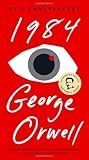
#1 — 1984 by George Orwell
Orwell published 1984 in 1949, having read Brave New World and written Huxley a letter explaining that he thought power would more likely consolidate through fear than pleasure. His novel is the proof of that argument: Oceania is a totalitarian state held together by the Party’s total control of language, memory, history, and pain. Big Brother watches; the Thought Police detect; Room 101 waits. Where Huxley’s society is stable because its citizens are happy, Orwell’s is stable because its citizens are terrified. The two novels are the essential poles of the dystopian tradition — read together, they map almost every authoritarian strategy that the twentieth century actually deployed.
#2 — The Handmaid’s Tale by Margaret Atwood
Atwood’s 1985 novel imagines a theocratic American future — the Republic of Gilead — in which environmental catastrophe has caused widespread infertility, and fertile women have been reduced to reproductive instruments of the state. Offred, the narrator, is a Handmaid assigned to a Commander and his wife; her only function is to bear a child. Where Brave New World eliminates reproduction as a source of meaning, The Handmaid’s Tale makes reproduction the only meaning permitted. Atwood’s dystopia is constructed from historical fact — she noted that every horror in the novel had already happened somewhere — which gives it a different quality of dread from Huxley’s more speculative vision.
#3 — Fahrenheit 451 by Ray Bradbury
Bradbury’s 1953 novel is set in a future America where firemen start fires rather than stop them — specifically fires of books, which have been banned. But what makes it a companion to Brave New World rather than to 1984 is Bradbury’s diagnosis of how the ban came about: not through government decree but through social preference. People stopped reading because they preferred the parlor walls — enormous interactive screens — to the difficulty and discomfort of literature. The books were banned because no one wanted them anymore. This is Huxley’s argument in a different key: the threat is not the tyrant who takes your freedom but the comfort that makes you give it up willingly.
Engineered Humanity and Loss of Selfhood
#4 — Never Let Me Go by Kazuo Ishiguro
Ishiguro’s 2005 novel is the most quietly devastating dystopia since Huxley and Orwell. Kathy, Tommy, and Ruth grow up at Hailsham, a peculiar English boarding school, and gradually — with the novel’s information parceled out as carefully as Huxley parcels out the World State’s history — the reader understands what they are and what they are for. Where Brave New World’s citizens are conditioned to accept their lives with enthusiasm, Ishiguro’s characters accept theirs with a kind of gentle passivity that is more disturbing for being so recognizably human. There is no revolt, no Savage, no demand for the right to be unhappy. There is only the quiet, terrible adjustment to what cannot be changed.
#5 — We by Yevgeny Zamyatin
Written in 1921 and suppressed by Soviet censors, We is the ur-text of the dystopian tradition — the novel that Huxley had read before writing Brave New World and that Orwell reviewed and was influenced by before writing 1984. D-503, a mathematician in the One State, lives in a glass-enclosed city where all life is scheduled, privacy has been eliminated, and the highest virtue is mathematical conformity. When a woman introduces him to doubt and desire, his crisis is both personal and political. We is slimmer and more compressed than the novels it spawned, and its prose carries the marks of the Russian avant-garde. It is essential reading for anyone who wants to understand where the whole tradition comes from.
#6 — A Clockwork Orange by Anthony Burgess
Alex, a teenage gang leader in near-future Britain, is convicted of murder and subjected to the Ludovico Technique — a conditioning process that makes violence physically sickening to him. Burgess’s 1962 novel asks whether a person rendered incapable of evil has been freed or destroyed. The answer it proposes — that the capacity for evil is inseparable from the capacity for genuine moral choice — is exactly the argument the Savage makes to Mustapha Mond. Written in a constructed slang called Nadsat that the reader absorbs gradually, A Clockwork Orange is the most formally adventurous book on this list and the most direct philosophical engagement with Brave New World’s central problem: what is the value of freedom if it includes the freedom to suffer and to harm?
#7 — The Giver by Lois Lowry
Lois Lowry’s 1993 novel for young adults is philosophically more rigorous than its classification suggests. Jonas lives in a Community that has achieved Sameness — no color, no music, no memory, no pain, and very little genuine love. When he is selected as the Receiver of Memory, the old man who holds all the community’s past, he begins to understand what has been sacrificed for the stability around him. The Giver covers Huxley’s territory with exceptional compression: the world from which suffering has been eliminated, the young person who receives enough knowledge to understand the cost, and the impossible choice between comfortable ignorance and painful freedom. It has been taught alongside Brave New World for decades with good reason.
Satire and the Uses of Comedy in Dark Futures
#8 — Animal Farm by George Orwell
Orwell’s 1945 allegorical novella — in which the animals of Manor Farm overthrow their human farmer and establish their own society, which gradually becomes indistinguishable from the tyranny it replaced — is the political satire of the twentieth century reduced to its most concentrated form. Where Brave New World uses irony to expose the seductions of the engineered society, Animal Farm uses fable to expose the mechanics of how revolutionary ideals corrupt into power. The two novels together — Huxley’s pleasure-state and Orwell’s farm — map the two routes by which the promise of a better world becomes its opposite.
#9 — Cat’s Cradle by Kurt Vonnegut
Vonnegut’s 1963 novel follows a narrator investigating the life of the scientist who helped build the atomic bomb, and eventually arriving at an island nation whose population has been pacified by a religion called Bokononism — a faith its founder invented and whose sacred texts acknowledge that everything in them is lies. Cat’s Cradle is the absurdist version of Brave New World: soma replaced by Bokononism, the World State replaced by a banana republic, the irony turned up to the point where the reader cannot be sure whether the religion is contemptible or necessary. Vonnegut’s argument — that humanity requires comforting fictions to function and that this is both sad and reasonable — is Huxley’s argument delivered with a wider grin.
#10 — The Hitchhiker’s Guide to the Galaxy by Douglas Adams
Adams’s 1979 comic science fiction novel follows Arthur Dent, the last surviving human after Earth is demolished to make way for a hyperspace bypass, through a universe that is revealed to be entirely indifferent to human significance. The Guide itself — a book that has “Don’t Panic” on the cover and treats all of existence with cheerful irreverence — is the comic version of Huxley’s soma: a device for managing the anxiety of being a small, mortal creature in an incomprehensible universe. Adams is funnier than Huxley, less burdened by the urgency of warning, and his novel is the most purely enjoyable on this list. But the philosophical undertow — the question of whether happiness that is achieved by not thinking too hard counts as happiness — is the same.
How to Choose Your Next Read
If you want the essential companion dystopia: 1984 — the fear-and-pain pole to Huxley’s pleasure-and-conditioning pole.
If you want the original source text: We — the novel that created the tradition Huxley and Orwell worked in.
If you want the most emotionally devastating modern version: Never Let Me Go — quiet, precise, and unbearable.
If you want the most philosophical: A Clockwork Orange — free will, conditioning, and the cost of eliminating evil.
If you want the most compressed political satire: Animal Farm — the essential companion, thirty pages that contain multitudes.
1984 vs Brave New World
For a direct comparison of Orwell and Huxley’s two foundational dystopias — what each predicts, which is more relevant, and which to read first — see our 1984 vs Brave New World guide.
For the Best Dystopian Novels
For the definitive guide to dystopian fiction — from 1984 and Brave New World to contemporary dystopia — see our Best Dystopian Novels list.
For the Best Fiction Books
For the definitive guide to fiction — the greatest novels across literary fiction, classics, and contemporary writing — see our Best Fiction Books of All Time list.
More Dystopian Fiction Reading Guides
Affiliate disclosure: Links to Amazon on this page are affiliate links. We earn a small commission at no extra cost to you. This does not influence our editorial recommendations.
Frequently Asked Questions
What is the central argument of Brave New World?
Brave New World argues that the greatest threat to human freedom is not pain but pleasure — not a boot stamping on a human face, but a society so comfortable that no one wants to resist it. Huxley imagined a World State in which humans are genetically engineered and chemically conditioned from birth, where unhappiness is treated with a drug called soma, where sex is casual and obligatory and love is forbidden, and where Shakespeare is banned not because he is subversive but because he is incomprehensible to people who have never suffered. The Savage, brought from a reservation where old-fashioned human misery still exists, is the novel's outsider conscience — and his demand for the right to be unhappy is its most quoted moment. Huxley's argument is that a life without struggle, depth, or genuine meaning is not really a human life at all.
How does Brave New World differ from 1984?
The two novels are complementary warnings about different kinds of totalitarianism. Orwell's 1984 describes a society held together by fear, pain, constant surveillance, and the violent enforcement of conformity — the boot on the face, the memory hole, Room 101. Huxley's Brave New World describes a society held together by pleasure, comfort, and the engineering away of desire for anything more. In 1984, people want freedom and are prevented from having it. In Brave New World, people have been conditioned not to want freedom at all. Neil Postman's argument in Amusing Ourselves to Death — that Huxley's vision has proven more prophetic than Orwell's — remains the most cited framework for reading the two novels together.
What should I read after Brave New World if I want something more recent?
Readers who want a contemporary novel that extends Huxley's central argument — the engineering of human contentment as a form of control — should go directly to Never Let Me Go by Kazuo Ishiguro, which is the most quietly devastating dystopia written since Huxley and Orwell. For readers interested in the conditioning and loss-of-selfhood angle, A Clockwork Orange by Anthony Burgess is the essential text: a violent young man subjected to aversion therapy that removes his capacity for evil, and the philosophical argument about whether that removal makes him less than human. Both novels share Huxley's core question: if we design out the capacity for suffering, what do we design out along with it?