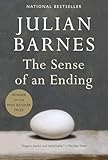
Editors Reads Verdict
Julian Barnes's Booker winner is a precision instrument — a short, devastating meditation on the unreliability of memory and the self-serving nature of all retrospective narrative, whose ending recalibrates everything that came before with elegant, quiet brutality.
What We Loved
- The architecture is flawless — every detail placed in part one pays off in part two with the precision of a sprung trap
- Tony's narrative voice is convincing as a self-deceived narrator precisely because Barnes makes his self-satisfaction feel recognisable rather than extreme
- At 163 pages, it wastes nothing — every sentence is doing work
- The ending genuinely recontextualises the whole novel, which is rare
- The meditation on memory and time is rigorous without being academic — it is argued through character and story
Minor Drawbacks
- Some readers find Tony so self-serving as to be difficult to spend time with
- The revelation in the final pages requires careful re-reading to fully understand, and some readers find it obscure rather than subtle
- The novel's formal perfection can feel cold — it is a book you admire more than you love
Key Takeaways
- → Memory is not a recording but a reconstruction, and reconstruction is inevitably shaped by what we need to have been true about ourselves
- → The stories we tell about our own lives are inevitably self-serving, and the self-service is usually invisible to us
- → Passivity is not innocence — not doing something can be as consequential as doing it
- → The gap between who we were and who we believe we were is one of the defining mysteries of adult life
- → The past does not change, but our access to it does — and what we discover there can undo the version of ourselves we have been living as
| Author | Julian Barnes |
|---|---|
| Publisher | Vintage |
| Pages | 163 |
| Published | October 2, 2012 |
| Language | English |
| Genre | Literary Fiction, Psychological Fiction |
| Difficulty | Beginner |
| Best For | Readers who enjoy tightly constructed literary fiction with an unreliable narrator, those interested in fiction about memory and time, and anyone who appreciates a short novel that uses every one of its 163 pages. |
How The Sense of an Ending Compares
The Sense of an Ending at a glance against 3 similar books readers weigh alongside it.
| Book | Author | Rating | Best for |
|---|---|---|---|
| The Sense of an Ending (this book) | Julian Barnes | ★ 4.0 | Readers who enjoy tightly constructed literary fiction with an unreliable |
| Atonement | Ian McEwan | ★ 4.2 | Literary fiction readers who value formal ambition and philosophical |
| Never Let Me Go | Kazuo Ishiguro | ★ 4.2 | Literary fiction readers drawn to Ishiguro's distinctive voice and the |
| Stoner | John Williams | ★ 4.5 | Literary fiction readers |
The First Part
The novel’s opening section establishes Tony Webster as a particular kind of English bourgeois — self-aware enough to seem reasonable, unreflective enough to be comfortable. He tells us about his school friendship with Adrian Finn, a brilliant, philosophically serious boy who joins their group and immediately raises the intellectual temperature of their conversations about history, time, and what it means to narrate a life. These discussions are not mere background: Barnes is loading the novel’s themes into the dialogue of its teenage characters with the precision of a watchmaker. Adrian’s proposition — that history is the lies of the victors, then the self-delusions of the defeated — will turn out to be the novel’s thesis, applied to the smallest possible scale: a single unremarkable life.
Tony’s first serious relationship is with Veronica Ford, whom he meets at university. She is cooler than he is, more assured, from a family that intimidates him. They visit her parents for a weekend; her mother, Sarah, is unexpectedly warm to Tony while Veronica is distant. The relationship ends unhappily, and Tony writes Veronica a letter whose existence he has half-forgotten. He moves on: a relationship with another woman, a marriage, a daughter, a divorce, a quietly contented middle age in which he congratulates himself occasionally on having come through with his equanimity intact. Then Adrian, who had begun seeing Veronica after Tony’s relationship with her ended, kills himself. Tony remembers this as a tragedy that had nothing to do with him.
The first part of the novel ends in this settled, comfortable account of the past. Tony is a reliable narrator of his own contentment. Part two will demonstrate, methodically and without mercy, that he is not.
The Letter
The bequest is small and strange: Sarah Ford has left Tony a small amount of money and, apparently, Adrian’s diary. Tony cannot receive the diary, because Veronica has it and refuses to give it up. What follows is Tony’s attempt to recover the diary — or at least to understand why he has been included in a will he had no reason to expect — and his resumption of contact with Veronica after forty years.
What Tony discovers, gradually and through Veronica’s deliberate obstruction, is that his memory of himself as a passive, essentially harmless figure in the story of Adrian’s suicide is wrong in a specific and terrible way. The letter he half-remembered writing — the bitter, wishing-ill letter he sent to Adrian after learning that Adrian was seeing Veronica — was not the mild thing he had filed away in his mind. It was cruel. It was specific. It said things whose consequences, if traced forward carefully, connect to Adrian’s death in a way that Tony has spent forty years not knowing.
Barnes’s management of this revelation is the novel’s technical masterpiece. He does not spell it out. He gives Tony — and the reader — enough information to understand what happened without ever stating it directly, because Tony is still, even at the moment of revelation, finding ways to process what he is learning that protect him from full responsibility. The ending, which many readers have to read twice to fully parse, is a moment of genuine self-confrontation for Tony, and it arrives with the force of something that has been building for 150 pages without our knowing it was building at all.
Memory and Self-Knowledge
Barnes is making a specific and somewhat bleak argument. Not merely that memory is unreliable — that is commonplace — but that the unreliability of memory is not random. We do not misremember in arbitrary ways. We misremember in ways that protect us: that preserve our sense of ourselves as reasonable people, that minimize our responsibility, that turn our worst moments into something more manageable. Tony has spent forty years believing he behaved, on balance, decently — that the failures of his youth were minor, that he was the kind of person who passes through life without causing serious harm. The novel’s purpose is to demonstrate that this comfortable self-portrait is a lie Tony has told himself so many times that it has become, for him, the truth.
The structure of the novel performs this argument. Part one gives us Tony’s version of the past — coherent, self-exculpatory, plausible. Part two dismantles it — not through a single dramatic revelation but through the accumulation of small discrepancies, the discovery of things Tony says he did not know that it turns out he did know, the recovery of his own words in the letter that reveal a person quite different from the one he remembers being. The novel’s form is its thesis: the structure of the story itself is the unreliable narrator problem made visible.
This is what makes the book more than a psychological thriller with literary pretensions. Barnes is not interested in fooling us. He is interested in demonstrating, at the level of sentence and structure, how the stories we tell about ourselves work — how they smooth, edit, and finally falsify the record in ways that feel entirely like telling the truth.
Our rating: 4.0/5 — A precision instrument of a novel — short, devastating, and structurally perfect, whose ending recalibrates everything that came before it with quiet, elegant brutality.
Memory and Its Distortions
Julian Barnes’s Booker Prize-winning The Sense of an Ending is a short, subtle, and deeply unsettling novel about memory, regret, and the stories we tell ourselves about our own pasts. Tony Webster, a retired man looking back on his life, believes he has settled into a comfortable understanding of his youth — until a sudden bequest forces him to confront the gap between what he remembers and what actually happened. As the truth emerges, the comfortable narrative he has constructed collapses, and with it his sense of who he has been.
The Unreliability of the Self
The novel’s power lies in its quiet, precise interrogation of memory as a self-serving fiction. Barnes shows how we edit our pasts to protect ourselves, smoothing away our cruelties and evasions until we no longer recognise them, and how a single revelation can expose the whole comfortable structure as a lie. Tony is an unreliable narrator not because he sets out to deceive but because, like all of us, he has rewritten his own history, and the slow revelation of what he has forgotten or suppressed gives the book the tension of a mystery and the weight of a moral reckoning. Compact, elegant, and resonant, The Sense of an Ending rewards careful reading and rereading, and it lingers in the mind as a meditation on responsibility, the elusiveness of truth, and the disquieting realisation that we may never fully know even ourselves.
Frequently Asked Questions
What is "The Sense of an Ending" about?
Tony Webster, a comfortably divorced man in late middle age, receives a small bequest from the mother of his first serious girlfriend that forces him to re-examine the version of his youth he has been living with for forty years — and to confront the gap between what he remembers and what he actually did.
Who should read "The Sense of an Ending"?
Readers who enjoy tightly constructed literary fiction with an unreliable narrator, those interested in fiction about memory and time, and anyone who appreciates a short novel that uses every one of its 163 pages.
What are the key takeaways from "The Sense of an Ending"?
Memory is not a recording but a reconstruction, and reconstruction is inevitably shaped by what we need to have been true about ourselves The stories we tell about our own lives are inevitably self-serving, and the self-service is usually invisible to us Passivity is not innocence — not doing something can be as consequential as doing it The gap between who we were and who we believe we were is one of the defining mysteries of adult life The past does not change, but our access to it does — and what we discover there can undo the version of ourselves we have been living as
Is "The Sense of an Ending" worth reading?
Julian Barnes's Booker winner is a precision instrument — a short, devastating meditation on the unreliability of memory and the self-serving nature of all retrospective narrative, whose ending recalibrates everything that came before with elegant, quiet brutality.
Ready to Read The Sense of an Ending?
Check the current price on Amazon.
Check Price on Amazon (paid link)Prices and availability are subject to change. See Amazon for current price.
Review last updated: