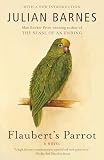
Editors Reads Verdict
Barnes's formally inventive third novel established him as a major literary talent — part literary biography, part meditation on knowledge and loss, part novel, and entirely its own thing, told with the dry wit of a man who knows that all obsessions are ultimately about something else.
What We Loved
- The formal inventiveness — chapters structured as chronologies, bestiaries, exam papers — never feels gimmicky because it is always in service of the argument
- Geoffrey's narrative voice is one of the great achievements of Barnes's career: dry, erudite, and quietly heartbroken
- The meditation on what biography can and cannot do is genuinely rigorous and expressed with great wit
- The personal material, when it finally surfaces, arrives with unexpected emotional force
- For readers who love Flaubert, the book is an extended act of love and exegesis; for those who don't, it is a sufficient introduction
Minor Drawbacks
- The novel makes significant demands of readers who come to it without knowledge of Flaubert's life and work
- The personal material about Geoffrey's wife is so carefully submerged that some readers miss it entirely
- The episodic structure means the novel lacks the momentum of conventional narrative
Key Takeaways
- → Biography is not the recovery of a life but the construction of a narrative from fragments, and different narratives are always possible from the same fragments
- → Obsession with a historical figure is often a displaced form of personal grief or loss — the intellectual passion is real but it is not the whole story
- → The impossibility of fully knowing another person applies to great writers as much as to the people in our own lives
- → Flaubert's life and work suggest that the pursuit of artistic perfection and the pursuit of a liveable personal life are in fundamental tension
- → What survives of a writer after death — the letters, the drafts, the reported conversations — is fragmentary enough to support almost any interpretation we bring to it
| Author | Julian Barnes |
|---|---|
| Publisher | Vintage |
| Pages | 190 |
| Published | May 1, 1990 |
| Language | English |
| Genre | Literary Fiction, Metafiction, Biographical Fiction |
| Difficulty | Intermediate |
| Best For | Readers who enjoy formally inventive literary fiction, those interested in Flaubert and nineteenth-century French literature, and anyone who appreciates a novel that is simultaneously playful and serious about questions of knowledge, loss, and obsession. |
How Flaubert's Parrot Compares
Flaubert's Parrot at a glance against 3 similar books readers weigh alongside it.
| Book | Author | Rating | Best for |
|---|---|---|---|
| Flaubert's Parrot (this book) | Julian Barnes | ★ 4.1 | Readers who enjoy formally inventive literary fiction, those interested in |
| Foucault's Pendulum | Umberto Eco | ★ 4.2 | Intellectually adventurous readers with an interest in the history of secret |
| The Name of the Rose | Umberto Eco | ★ 4.2 | Patient literary readers |
| The New York Trilogy | Paul Auster | ★ 4.4 | Readers of postmodern and experimental literary fiction |
Geoffrey and Flaubert
Geoffrey Braithwaite is introduced to us via his obsession before he is introduced to us as a person, and Barnes is deliberate about this ordering. Geoffrey is a retired English doctor making a pilgrimage through Flaubert’s Normandy, visiting the places the writer lived and worked, hunting down the relics of his life. The specific object of his inquiry is a stuffed parrot: Flaubert kept one on his desk while writing Un Coeur Simple, whose central figure is a servant woman who becomes devotedly attached to a parrot named Loulou. Two French museums each claim to possess the original parrot. Geoffrey wants to know which one it actually was.
This is, on its face, a comically minor question — the kind of pedantic biographical puzzle that serious scholars generally ignore in favour of the larger questions of influence and meaning. But Barnes is using the parrot question to ask what any act of literary scholarship is really about. When we pursue the details of a writer’s life with the intensity that Geoffrey pursues Flaubert’s, what do we think we will find? That the right parrot, established with certainty, will bring us closer to Flaubert himself? That the real man, recovered from beneath the legend, will explain the work? Geoffrey is intelligent enough to know that these hopes are probably misguided, and the self-awareness about the futility of his obsession is part of what makes his voice so compelling.
Flaubert himself, as reconstructed through Geoffrey’s research, is a vivid and somewhat alarming figure: a writer of exacting perfectionism, a man of considerable sexual appetite, a correspondent of extraordinary energy, and a figure whose famous contempt for the bourgeoisie sat somewhat uneasily alongside his thoroughly bourgeois life in the family house at Croisset. Barnes’s Flaubert is never hagiographic — he is presented with the kind of clear-eyed appreciation that knows exactly what is wrong with its subject.
The Structure
The formal ingenuity of Flaubert’s Parrot is what distinguished it immediately from the literary fiction of its moment. Barnes builds the novel out of chapters that operate by completely different rules: there are two chronologies of Flaubert’s life — one presenting only the happy events, one only the disasters — that together demonstrate how chronology is itself a form of argument, capable of producing entirely different portraits of the same person depending on what is selected and what is omitted. There is a chapter structured as a bestiary, examining all the animal comparisons Flaubert used in his letters. There is a chapter presented as an examination paper on Flaubert, with questions that range from the scholarly to the absurd, all of which are unanswerable with any confidence.
What this accumulation of approaches demonstrates is the central argument of the book: that the methods of biography — the timeline, the thematic analysis, the critical evaluation, the comparison — are all insufficient to recover the actual person. Each method produces a partial portrait. The portraits contradict each other. No synthesis is available. We are left not with Flaubert but with the evidence of Flaubert, which is a very different thing — and the gap between them is where Geoffrey’s obsession, and Barnes’s novel, lives.
This is a meditation on the limits of knowledge, conducted with enormous wit and genuine learning. Barnes is not making a counsel of despair — he is not arguing that we should stop trying to understand Flaubert or anyone else. He is arguing that we should be honest about what the attempt can achieve, and clear-eyed about the way our methods shape our conclusions. The novel form, which can hold contradiction without resolving it, is his answer to the inadequacy of any single scholarly method.
What Geoffrey is Really Looking For
The personal material in Flaubert’s Parrot is so carefully submerged that many readers on first encounter miss it almost entirely. Geoffrey mentions his wife, Ellen, occasionally and in passing — she has died, some time before the novel’s events, in circumstances that Geoffrey initially does not detail. As the novel proceeds, and as Geoffrey’s scholarly obsessions gradually give way to something more exposed, the story of Ellen emerges in fragments: that she had affairs, that she was unhappy, that her death was possibly or probably a suicide, that Geoffrey does not know whether to blame her or himself or neither.
This is the thing that Flaubert is deflecting from. Geoffrey’s pursuit of the real Flaubert — his insistence that behind the letters and the manuscripts and the reports of those who knew him there is a true man that can be recovered if only the right evidence can be found — is the same pursuit he is conducting with his wife. If he can establish what Ellen was really like, what she really felt, why she made the choices she made, then perhaps he can understand what happened and what, if anything, he was responsible for. The problem is the same: the evidence is fragmentary, the interpretations are multiple, and the person he is trying to recover is gone.
Barnes places this revelation so quietly, and with so little insistence on its significance, that it functions as an undertow rather than a wave — you feel its pull more than you see it. On re-reading, it reorganises everything: Geoffrey’s obsessive precision about Flaubert, his careful management of tone, his occasional moments of unguarded pain. The parrot question was never really about the parrot.
Our rating: 4.1/5 — Formally inventive and genuinely funny, with a quiet heartbreak running underneath that only becomes fully visible once you know to look for it — one of Barnes’s most accomplished and distinctive works.
Frequently Asked Questions
What is "Flaubert's Parrot" about?
Geoffrey Braithwaite, a retired English doctor, is obsessed with Gustave Flaubert — particularly with establishing which of the two stuffed parrots in French museums was actually the one that sat on his desk while he wrote Un Coeur Simple. What follows is a novel about scholarship, obsession, and the impossibility of knowing anything.
Who should read "Flaubert's Parrot"?
Readers who enjoy formally inventive literary fiction, those interested in Flaubert and nineteenth-century French literature, and anyone who appreciates a novel that is simultaneously playful and serious about questions of knowledge, loss, and obsession.
What are the key takeaways from "Flaubert's Parrot"?
Biography is not the recovery of a life but the construction of a narrative from fragments, and different narratives are always possible from the same fragments Obsession with a historical figure is often a displaced form of personal grief or loss — the intellectual passion is real but it is not the whole story The impossibility of fully knowing another person applies to great writers as much as to the people in our own lives Flaubert's life and work suggest that the pursuit of artistic perfection and the pursuit of a liveable personal life are in fundamental tension What survives of a writer after death — the letters, the drafts, the reported conversations — is fragmentary enough to support almost any interpretation we bring to it
Is "Flaubert's Parrot" worth reading?
Barnes's formally inventive third novel established him as a major literary talent — part literary biography, part meditation on knowledge and loss, part novel, and entirely its own thing, told with the dry wit of a man who knows that all obsessions are ultimately about something else.
Ready to Read Flaubert's Parrot?
Check the current price on Amazon.
Check Price on Amazon (paid link)Prices and availability are subject to change. See Amazon for current price.
Review last updated: