Books Like The New York Trilogy: 11 Novels
If Paul Auster's New York Trilogy left you unsettled and exhilarated by fiction that uses detective conventions to dismantle the self, these novels pursue the same unsettling questions.
Paul Auster’s The New York Trilogy takes the detective — the figure who believes meaning can be decoded from clues — and uses him to demonstrate that meaning cannot be decoded at all. The three novellas in sequence, City of Glass, Ghosts, and The Locked Room, each stage a different version of the same experiment: a person who agrees to observe another person, and who loses himself in the act of watching. Surveillance changes the observer. Identity becomes fluid under the pressure of sustained attention. Language fails at exactly the moments when it is most needed. The investigator, the genre’s great promise of resolution, finds himself dissolving into the case rather than closing it.
What distinguishes the trilogy from other postmodern experiments is the way Auster’s formal concerns are identical to his thematic ones: the novel about a man who loses his identity is a novel that refuses to behave like a novel. The books below have been chosen because they share this essential quality — form and content are inseparable, genre conventions are subverted from within, and the reader leaves feeling that something foundational has been examined.
Labyrinths and Infinite Regress
#1 — Ficciones by Jorge Luis Borges
Borges is Auster’s most direct predecessor — the writer who first demonstrated that short fiction could contain a philosophical proposition in its very structure rather than in its argument, that the shape of a story could enact what the story was about. Ficciones is the book that makes this clearest. The Library of Babel is the ultimate surveillance-without-meaning metaphor: a library that contains every possible book, and therefore no book has special authority, and therefore the act of reading produces not knowledge but infinite regress. Pierre Menard, Author of the Quixote — in which a twentieth-century Frenchman rewrites Cervantes word for word without copying him — is the direct precursor to The New York Trilogy’s questions about authorship and identity. If Pierre Menard’s Quixote is not the same text as Cervantes’s Quixote, even though they are word for word identical, what is the self that persists through time and observation? Borges asks this question in eight pages; Auster takes a trilogy. The formal precision both writers share is remarkable: nothing is wasted, every detail is functional, the surface is as smooth as the depths are disturbing. Readers who have not encountered Borges before will find Ficciones one of the strangest and most rewarding reading experiences in twentieth-century literature.
#2 — The Name of the Rose by Umberto Eco
Eco’s medieval monastery murder mystery shares Auster’s interest in the detective as epistemological figure — a person whose entire identity is organised around the belief that the world is legible, that the right method applied rigorously will yield the truth. William of Baskerville is an excellent detective. He arrives at a true solution by a completely wrong method, and the novel’s central argument is that this is how knowledge always works: the right answer reached through inadequate tools, by processes that cannot bear scrutiny. The labyrinthine library at the monastery’s heart — a building designed as a maze, its holdings known only to the librarian who controls access — is a cousin to Borges’s Library of Babel and to Auster’s New York, a space that promises to contain meaning and withholds it systematically. The book-within-a-book structure, the question of what knowledge once destroyed can be recovered, and the figure of a scholar-investigator whose learning becomes a liability rather than an asset all mark this as the European literary novel most deeply engaged with the same questions The New York Trilogy asks. Eco wears his erudition more visibly than Auster, but both writers are interested in the gap between interpretation and truth.
Identity Under Pressure
#3 — Piranesi by Susanna Clarke
The narrator of Piranesi lives in a house of infinite halls, marble statues, and tidal seas. He keeps meticulous journals of his observations — the positions of statues, the movements of tides, the visits of the only other person he has ever met — with the care of a scientist and the devotion of a believer. He does not know how he came to live in the house, or how long he has been there, or who he was before. Clarke’s novel shares The New York Trilogy’s central mechanism: a narrator engaged in systematic observation who gradually discovers that the self doing the observing is not who he thought he was. The investigation into the house turns out to be an investigation into the investigator. Clarke’s house is a version of Auster’s New York: both are spaces that seem fully mappable, that have been partially mapped, and that nonetheless remain fundamentally unmappable, yielding new corridors and new meanings with every passage through them. The novel is formally gentler than Auster — Clarke’s warmth prevents the coldness that Auster sometimes permits himself — but the vertigo it produces is recognisably the same vertigo. The mystery whose solution turns out to be about identity rather than crime is The New York Trilogy’s mystery precisely.
#4 — The Magus by John Fowles
Fowles’s novel is the fullest treatment available in English-language literary fiction of the experience The New York Trilogy generates in its reader: a protagonist caught inside a performance whose rules he cannot discover, unable to determine what is real and what is staged for his benefit, with an investigative instinct that the situation is specifically designed to defeat. Nicholas Urfe, a young Englishman teaching on a remote Greek island, encounters the wealthy and enigmatic Maurice Conchis, and finds himself drawn into an increasingly elaborate and inexplicable “godgame” — a series of theatrical events, historical reconstructions, and psychological provocations whose purpose Urfe cannot determine. His attempts to understand what is happening, to find the rational explanation, to identify the person behind the performance, are the same attempts Daniel Quinn makes in City of Glass following Stillman through the streets of New York. Both novels refuse to fully explain themselves. Fowles is more interested in the erotic and social dimensions of his protagonist’s predicament than Auster; but the formal experience — the reader positioned alongside a protagonist who cannot achieve the knowledge the detective genre promises — is the same. The Magus is longer and more melodramatic, but no less disorienting.
#5 — The Secret History by Donna Tartt
The Secret History is a detective novel running backwards. The reader knows from the first page who was killed, who killed him, and approximately why. The investigation that follows is not toward revelation but away from it — or rather, into a different kind of revelation: not who did it, but what it cost the people who did it, and what kind of world makes something like this possible. Tartt’s inversion of the detective novel structure is related to Auster’s inversion of it in the trilogy: both writers understand that the genre’s promise of resolution is what needs to be dismantled, and both dismantle it from within by fulfilling the genre’s formal requirements while refusing the emotional satisfaction those requirements are supposed to deliver. The Vermont campus where Richard Papen arrives as a scholarship student is a self-enclosed world, like Auster’s New York, in which a small group of people have constructed a reality — aesthetic, moral, linguistic — that the rest of the world cannot see or enter. What happens inside that world is what the novel is about; that the rest of the world cannot adjudicate it is part of the horror.
Cities as Labyrinths
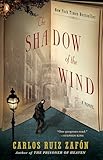
#6 — The Shadow of the Wind by Carlos Ruiz Zafón
Zafón’s Barcelona is another version of Auster’s New York: a city that contains, within its physical geography, a hidden layer of meaning that the protagonist discovers through a book. Daniel Sempere, the son of a bookseller, finds a novel by the mysterious Julián Carax in the Cemetery of Forgotten Books and spends years trying to decode the mystery of who Carax was and what happened to him. The investigation leads through the city’s architecture, through its history, through a network of people who knew Carax and are damaged by that knowledge. The Cemetery of Forgotten Books — a vast, labyrinthine repository of forgotten literature maintained by a secret society of bibliophiles — is Zafón’s version of Auster’s sense that the city contains all possible stories, that beneath the legible surface there is an infinite library. The mystery of Carax’s identity and disappearance parallels City of Glass’s mystery precisely: both are investigations into a person who has apparently ceased to exist, who has become a name without a body, a text without an author. The novel is more plot-driven than Auster, and more Gothic, but shares his conviction that the city is a text that promises more than it yields.
#7 — White Noise by Don DeLillo
DeLillo’s novel is the American postmodern work most directly adjacent to Auster’s project. Jack Gladney, Professor of Hitler Studies at a Midwestern college, lives in a world saturated with media, consumer goods, and information that generates no knowledge and provides no comfort — a world in which the surface is all, and the surface means nothing. The supermarket aisles, the television sets that murmur in every room, the brand names that recur like incantations — all of this constitutes the white noise of the title: signal that has become indistinguishable from static. The Airborne Toxic Event — a chemical spill that forces the Gladney family to evacuate their home and join a column of displaced people — is Auster’s wrong-number phone call scaled to catastrophe: an event whose meaning cannot be decoded, whose threat cannot be measured, whose source cannot be assigned responsibility. DeLillo and Auster are the two most significant American postmodernist novelists of the late twentieth century, working in related but distinct modes. DeLillo’s concern is with systems — media, consumerism, death as ideology — where Auster’s is with the self. But both are interested in the failure of meaning-making, the gap between the tools of interpretation and the world they are applied to.
Mysteries That Resist Resolution
#8 — Never Let Me Go by Kazuo Ishiguro
Ishiguro’s novel is a mystery in which all the important information is withheld from the narrator not by the plot but by her own psychological defences. Kathy H. tells the story of her childhood at Hailsham, a boarding school unlike any other, and of her relationships with Ruth and Tommy — and she tells it in a register of careful, controlled recall that gradually reveals what she cannot quite look at directly. The revelation, when it comes, is both complete and somehow beside the point: we know what the Hailsham students are, what they were made for, why they have never questioned the life arranged for them. But knowing does not explain why they do not run. Kathy’s narrative voice, like Quinn’s in City of Glass, is the voice of someone telling a story about themselves that they cannot quite see clearly — the first-person narrator whose blind spots are the novel’s real subject. The resolution that doesn’t resolve, the investigation that uncovers a truth that changes nothing, is The New York Trilogy’s central formal gesture, and Ishiguro performs it with tremendous restraint.
#9 — Cloud Atlas by David Mitchell
Mitchell’s nested narrative structure — six stories, each interrupted at its midpoint, the collection descending to the innermost story before returning, each story containing a text from one of the earlier stories — is an extension of Auster’s interest in texts that contain other texts that comment on the first. The question of whether there is a pattern connecting the six narratives, whether the souls are truly reincarnated across centuries or whether the connections are coincidental, is Auster’s question from City of Glass scaled to a planetary and temporal scope. Mitchell’s protagonists each receive a text from the narrative before theirs and each read it differently, use it differently, are changed by it differently — which is to say that the novel is about the way reading produces not knowledge but transformation, and that the transformation cannot be predicted or controlled. The investigation generates more questions than it resolves. The shape of the book is an argument: nested structures that return you to where you started are structures that insist you are not in the same place you were when you began.
#10 — The Trial by Franz Kafka
Kafka is Auster’s other principal ancestor — the writer who first demonstrated that a bureaucratic investigation could be the vehicle for a complete epistemological nightmare, that the institutions designed to produce knowledge and justice could be organised specifically to prevent both. Josef K. is arrested one morning without being told what he is charged with. His attempts to understand the charges, to navigate the court system, to find someone who can explain the rules — all are met with the system’s systematic refusal to make itself legible. The tools he brings to the problem — reason, argument, the assumption that institutions operate according to discoverable principles — are inadequate to the problem, and the novel is structured to make this inadequacy feel like a law of nature. The difference between Kafka and Auster is in register: Kafka’s nightmare is social and bureaucratic, inflicted by an external system, while Auster’s is linguistic and personal, generated from within the act of investigation. But both share the fundamental conviction that the tools of investigation — reason, observation, language — are inadequate to the mystery they are applied to, and that recognising this inadequacy is not the beginning of wisdom but only of a deeper disorientation.
#11 — Invisible Man by Ralph Ellison
Ellison’s novel is a portrait of a self that cannot be seen — a Black man in America whose individuality is systematically rendered invisible by the society that surrounds him. The unnamed narrator moves through a series of institutions and ideologies, each of which promises to see him and each of which, on closer examination, sees only the category it has already decided he belongs to. The connection to Auster is oblique but structurally precise: both are about the failure of observation to produce understanding, about the way the observer’s assumptions determine what they see before they look. The New York Trilogy is about investigators who cannot see clearly because they are looking for the wrong thing; Invisible Man is about a protagonist who cannot be seen because the people looking at him are looking for something else. The investigator and the investigated, in both books, are trapped in the same epistemological failure. Both novels end in underground spaces — basements, catacombs — where narrators who have stopped moving finally begin to speak. The parallel is not coincidental: both Auster and Ellison are interested in the moment when the subject of observation steps outside the frame of the observer’s expectations and begins to exist on their own terms.
How to Choose Your Next Read
If you want philosophical short fiction that works like poetry: Ficciones.
If you want a gothic mystery where the form is the mystery: The Name of the Rose or The Shadow of the Wind.
If you want the most disorientating single reading experience: The Magus or Piranesi.
If you want American postmodernism’s other great practitioner: White Noise.
If you want a resolved mystery that still feels unresolved: Never Let Me Go or The Secret History.
If you want the direct ancestors of Auster’s project: Ficciones and The Trial.
For the Best Fiction Books
For the definitive guide to fiction — the greatest novels across literary fiction, classics, and contemporary writing — see our Best Fiction Books of All Time list.
More Postmodern Fiction Reading Guides
- Paul Auster Books in Order: Complete Reading Guide
- Books Like Moon Palace: Wandering, Chance, and American Identity
Affiliate disclosure: Links to Amazon on this page are affiliate links. We earn a small commission at no extra cost to you. This does not influence our editorial recommendations.
Frequently Asked Questions
Is The New York Trilogy a trilogy you need to read in order?
The three novellas (City of Glass, Ghosts, The Locked Room) are best read in the order presented — each builds on the concerns of the previous one, and the trilogy functions as a single extended meditation on identity, surveillance, and language. They can each be read as standalones, but the cumulative effect of the three together is what makes the book significant.
Is The New York Trilogy actually a detective novel?
It uses detective fiction's conventions — surveillance, investigation, the search for meaning in clues — but systematically dismantles them. The mysteries are never solved in any satisfying sense; the investigators lose themselves in the investigation; the genre's promise of resolution is explicitly refused. It is better described as a philosophical novel that uses detective fiction as its formal apparatus.
What other books has Paul Auster written that are similar to The New York Trilogy?
Oracle Night shares the nested narrative structure and the theme of writing generating reality. Ghosts (within the trilogy itself) is the most extreme formal experiment. The Book of Illusions uses obsession with a fictional artist's work as its central mystery. Among Auster's later novels, Invisible comes closest to the trilogy's interest in multiple, incompatible accounts of the same events.
What kind of reader loves The New York Trilogy?
Readers who are drawn to fiction that is self-aware without being smug, that uses genre conventions to question genre conventions, and that treats questions of identity and language as genuinely urgent rather than merely fashionable. The trilogy rewards readers who are comfortable with ambiguity and unresolved endings — and who find the dissolution of expectation more interesting than its fulfilment.