Best Irish Literature: Essential Novels and Books from Ireland
The best Irish literature — from Joyce and Beckett to Sally Rooney and Claire Keegan. Essential novels from Ireland across the twentieth and twenty-first centuries.

Irish literature — from the Dublin of James Joyce and the County Wexford of Claire Keegan to the university Dublin of Sally Rooney — constitutes one of the richest national literary traditions in the world, disproportionate to Ireland’s size. The tradition encompasses the most formally ambitious novels in the English language (Ulysses, Finnegans Wake), some of its finest short fiction (Dubliners), and the most internationally celebrated contemporary literary fiction of the past decade (Sally Rooney’s trilogy).
The Irish tradition is marked by its engagement with history — British colonialism, the Famine, partition, the Troubles, the Catholic Church’s dominance of Irish social life — but its greatest writers transcend the local: Joyce and Beckett are foundational to the entire Western literary tradition.
The Essential List
Ulysses — James Joyce (1922)
The most important novel in English of the twentieth century. A single day in Dublin — 16 June 1904 — narrated through Leopold Bloom, Stephen Dedalus, and Molly Bloom in eighteen episodes, each using a different formal technique. Joyce maps Homer’s Odyssey onto Dublin without making the parallel explicit; the result is a novel about ordinary life that is also a meditation on consciousness, language, Irish identity, and what it means to be fully human. Difficult, yes — but nothing else in English does what it does.
Normal People — Sally Rooney (2018)
The defining Irish novel of the 2010s and Rooney’s breakthrough. Connell and Marianne’s relationship — from their final year at school in Carricklea to their years at Trinity College Dublin — is told in Rooney’s stripped-down, psychologically precise prose. The novel is about class (Connell’s mother cleans Marianne’s house), about power and its reversals (Connell is popular at school, Marianne is not; at Trinity, the positions reverse), and about the particular difficulty of two people who love each other but cannot communicate that love.
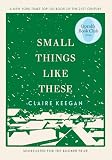
Small Things Like These — Claire Keegan (2021)
The most concentrated and morally serious Irish fiction of recent years. Bill Furlong’s discovery that the local convent is running a Magdalene Laundry — and his decision about what to do — takes fewer than 120 pages. Keegan’s prose is as spare as Chekhov’s; every word carries weight. The novella addresses a specific and under-discussed Irish crime (the Magdalene Laundries operated until 1996) through a single ordinary man’s crisis of conscience.
Dubliners — James Joyce (1914)
The most accessible Joyce and the best starting point for readers intimidated by Ulysses. Fifteen stories about Dublin life — a boy at a bazaar who discovers disillusion; a woman who cannot bring herself to leave; a pair of men drinking their way through the city; the famous last story, ‘The Dead,’ which ends with Gabriel Conroy’s vision of snow falling across Ireland. The stories are not difficult; they are among the finest in the language.
The Country Girls — Edna O’Brien (1960)
O’Brien’s debut and the first volume of her trilogy. Caithleen and Baba, two girls from rural County Clare, escape their constricted lives to Dublin and, eventually, London — seeking experience, freedom, and men who will either liberate or disappoint them. The novel was banned in Ireland on publication; O’Brien’s frank treatment of female desire and the Church’s grip on Irish women’s lives was considered obscene. Now recognised as a foundational work of Irish women’s literature.
Waiting for Godot — Samuel Beckett (1952)
Beckett’s masterpiece and the most important play of the twentieth century. Vladimir and Estragon wait for Godot — who does not come — in a play that is simultaneously a comedy and a meditation on time, hope, habit, and the impossibility of certainty. Beckett was Irish but wrote primarily in French, translating his own work into English; the play belongs to both literatures. Nothing else demonstrates as efficiently that nothing needs to happen in a play for it to be total theatre.
Conversations with Friends — Sally Rooney (2017)
Rooney’s debut and the best starting point for readers new to her work — more contained than Normal People, with the same psychological precision. Frances and Bobbi, two Dublin students who perform poetry together, meet Nick and Melissa, an older married couple; Frances begins an affair with Nick. The novel is about complicity, self-knowledge, and the specific texture of being young and certain of your own sophistication.
Beautiful World, Where Are You — Sally Rooney (2021)
Rooney’s most formally ambitious novel — two pairs of friends, Alice and Felix, Eileen and Simon, whose relationships are conducted partly through long email exchanges about literature, meaning, and the state of the world. The novel is explicitly concerned with the question of whether fiction can still justify itself in a world of political emergency; Rooney’s answer is provisional and honest.
Foster — Claire Keegan (2010)
An earlier Keegan novella — a girl sent to stay with relations for the summer, and the slow accumulation of understanding that forms the novel’s emotional centre. At sixty pages, it is even more compressed than Small Things Like These; it is the finest demonstration of what can be achieved in very small space.
Why These Books
Irish literature’s central subject is the gap between aspiration and reality — the country that was supposed to emerge from British colonialism, the Catholic Church’s promised spiritual community, the educated urban life that was supposed to follow from sacrifice. The best Irish novels are about what happens when that gap becomes visible: when a man sees what is happening in the convent, when two young people cannot say what they feel, when a writer wonders whether she is doing anything useful. The tradition’s formal ambitions, from Joyce’s linguistic experiments to Keegan’s spare precision, are responses to the same problem: how to say something true about a country that prefers not to be told.
Frequently Asked Questions
What is the best Irish novel to start with?
Normal People (2018) by Sally Rooney is the most accessible starting point for readers new to Irish literature — Connell and Marianne's relationship across their last year of school and their university years in Dublin, told with Rooney's characteristic precision and emotional intelligence. Dubliners (1914) by James Joyce is the other starting point: fifteen stories about Dublin life that are more accessible than his novels and contain some of the finest short fiction in the English language. Both books can be read by anyone.
Is Ulysses worth reading?
Ulysses (1922) is the most important novel in English of the twentieth century, and it is genuinely difficult — Joyce uses a different formal technique in nearly every chapter, and the novel requires active engagement rather than passive reading. It rewards multiple readings and benefits from a guide (Don Gifford's Ulysses Annotated is the standard companion). Start with Dubliners and A Portrait of the Artist as a Young Man, which are much more accessible and will prepare you for Joyce's ambitions. Then attempt Ulysses when you're ready. It is worth the effort.
What is Small Things Like These about?
Small Things Like These (2021) by Claire Keegan is a novella set in a small Irish town in 1985. Bill Furlong, a coal merchant, discovers that a local convent run by the Good Shepherd Sisters is operating as a Magdalene Laundry — imprisoning young women who have had children outside marriage. The novella is about moral courage: whether an ordinary man, with a family to protect and a livelihood that depends on the town's goodwill, can bring himself to do what is right. At under 120 pages, it is the most concentrated and powerful Irish fiction of recent years.
What is the best contemporary Irish novel?
Small Things Like These (2021) by Claire Keegan is the best contemporary Irish novel by impact per page — a novella that addresses the Magdalene Laundries with the compression and moral precision of a parable. Normal People (2018) by Sally Rooney is the most internationally celebrated Irish novel of the decade and the one that most clearly establishes her as the defining Irish novelist of her generation. Beautiful World, Where Are You (2021), Rooney's third novel, is her most formally ambitious. Conversations with Friends (2017) is the accessible entry point into Rooney's work.