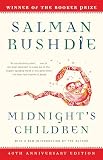
Editors Reads Verdict
Rushdie's Booker of Bookers winner is one of the great maximalist novels of the twentieth century — a book that uses the life of one man born at the stroke of Indian independence to argue that history and biography are inseparable, told in prose of staggering ambition and verbal exuberance.
What We Loved
- The central conceit — a man whose life mirrors his nation's history — is executed with total commitment
- Rushdie's prose is among the most inventive and linguistically alive of the postcolonial tradition
- The magical realism is historically grounded in a way that illuminates rather than decorates
- The portrayal of partition, independence, and the Emergency is politically serious without being didactic
- The novel rewards rereading — the structural ironies only become fully visible once you know where everything ends
Minor Drawbacks
- The prose density and digressive structure are genuinely demanding — this is not a novel that reads quickly
- Readers without background knowledge of Indian history will miss significant layers of meaning
- The middle section sags as the catalog of midnight's children becomes overwhelming before Rushdie deploys it
- Saleem is an unreliable narrator in ways the novel signals but does not always clearly distinguish from straight narration
Key Takeaways
- → National history and personal history are not separate — they shape and contaminate each other
- → The unreliable narrator is not a trick but a philosophical position: memory is always revision
- → Magical realism can carry specific political content that realist prose cannot reach
- → The oral digressive voice is itself an argument about what kind of stories matter and who gets to tell them
- → Independence is not liberation — what follows colonialism is its own set of betrayals
| Author | Salman Rushdie |
|---|---|
| Publisher | Random House |
| Pages | 533 |
| Published | January 1, 1981 |
| Language | English |
| Genre | Literary Fiction, Magical Realism, Historical Fiction |
| Difficulty | Advanced |
| Best For | Readers prepared for a demanding, maximalist literary experience who want to understand both the postcolonial novel as a form and the specific history of India's first decades of independence. |
How Midnight's Children Compares
Midnight's Children at a glance against 3 similar books readers weigh alongside it.
| Book | Author | Rating | Best for |
|---|---|---|---|
| Midnight's Children (this book) | Salman Rushdie | ★ 4.5 | Readers prepared for a demanding, maximalist literary experience who want to |
| A Fine Balance | Rohinton Mistry | ★ 4.7 | Readers of serious literary fiction with stamina for emotionally demanding |
| One Hundred Years of Solitude | Gabriel García Márquez | ★ 4.6 | Readers of literary fiction interested in the most celebrated novel in Spanish, |
| The God of Small Things | Arundhati Roy | ★ 4.4 | Readers of literary fiction drawn to formally ambitious prose, family sagas |
A Birth at Midnight
Midnight’s Children opens with one of the most precisely engineered premises in twentieth-century fiction. Saleem Sinai is born at the exact stroke of midnight on August 15, 1947 — the moment India becomes independent. He discovers that all 1,001 children born in the first hour of independent India have been granted supernatural gifts, and that he, as the first-born, can hear all of their voices in his head. History and biography have been fused at the genetic level.
Rushdie’s argument — sustained across 533 pages — is that this is not merely a conceit but a truth: that to be born into a nation is to have that nation’s history written into your life whether you choose it or not. Saleem does not seek his connection to India’s fate. It happens to him. His nose bleeds when the nation is wounded. His life fragments when the country does. The novel insists that the personal and the historical are not separate registers but the same thing experienced from different distances.
What makes this more than a clever structural metaphor is the specificity of the history Rushdie is tracking. The novel spans from Saleem’s grandfather’s generation in Kashmir before colonialism through partition, independence, the India-Pakistan wars, and — most critically — Indira Gandhi’s Emergency of 1975-77, during which Gandhi suspended civil liberties, imprisoned political opponents, and ran a forced sterilization program. The midnight’s children, with their inconvenient supernatural abilities, are eventually hunted and destroyed by the state. The allegory is not subtle, and it is not meant to be.
The Magical Realism and What It Is For
Rushdie is often grouped with García Márquez under the magical realism label, and the comparison is instructive precisely because of where it breaks down. One Hundred Years of Solitude uses magic to create a mythic-timeless atmosphere — the impossible events float free of historical specificity and contribute to a dream-logic that feels universal. Rushdie’s magic is different in kind. It is pointedly, insistently political.
Saleem’s telepathy, his enemies’ abilities (to travel through time, to make plants grow, to change sex), and the whole apparatus of the midnight’s children are not decorations on the historical narrative. They are the historical narrative expressed in a register that realism cannot access. The Emergency’s forced sterilizations appear in the novel as a literal attempt to destroy the midnight’s children — to cut out the magical generation that represents the unfulfilled promise of independence. The magic allows Rushdie to show what the historical record shows more obliquely: that the Indian state, in the Emergency, was trying to eliminate the future it had promised in 1947.
This is why the magical realism in Midnight’s Children feels more claustrophobic than in García Márquez. The magic is not liberatory. It is a burden, a target, and ultimately a tragedy. The children born with gifts at midnight are not a blessing on the nation — they are its victims.
The History You Need
Readers coming to Midnight’s Children without background in Indian history will follow the plot but miss much of its weight. The essential context is this: British India was partitioned in 1947 into two independent nations — India (majority Hindu) and Pakistan (majority Muslim). The partition was accompanied by one of the largest forced migrations in human history and communal violence that killed between 200,000 and two million people, with estimates varying widely. Families were divided, regions were cut in half, and the violence has shaped South Asian geopolitics ever since.
Rushdie’s own family history runs through this partition — he was born in Bombay in 1947, and Midnight’s Children is in part an autobiographical meditation on what it means to grow up in the generation that inherited independence and watched it curdle. The novel’s Saleem is not Rushdie, but the emotional architecture is borrowed from life.
The Emergency (1975-77) that forms the novel’s climax was declared by Prime Minister Indira Gandhi after the Allahabad High Court found her guilty of electoral fraud. For twenty-one months, Gandhi governed by decree, censored the press, imprisoned opposition leaders, and — through her son Sanjay Gandhi’s program — ran forced sterilizations targeting poor men, often Muslim and lower-caste. The Emergency ended in 1977 when Gandhi, apparently believing she retained popular support, called elections and lost. For Rushdie, writing in the immediate aftermath, it was the defining betrayal of the independence generation — the moment when the promise of midnight became undeniable failure.
How to Read It
The prose is the primary obstacle for most readers, and it helps to know what you are dealing with before you begin. Rushdie writes in a voice derived from oral storytelling — specifically from the tradition of the dastan, the extended Persian-Urdu narrative form — and he translates its conventions directly into prose. This means: digression is structural, not a failure of discipline. Sentences interrupt themselves. The narrator second-guesses his own memories in real time. Chronology is constantly violated and then restored. A paragraph will announce it is about to tell you one thing and then tell you another.
This is not experimental difficulty for its own sake. It is an argument about the nature of memory and narration. Saleem is an unreliable narrator, and the novel is honest about this — he catches himself in errors, contradicts himself, fills in gaps with admitted guesswork. The implication is that all historical narration works this way. The official history of India’s independence is also a constructed story told by interested parties who misremember, revise, and confabulate. Saleem’s visible unreliability mirrors the invisible unreliability of the historical record itself.
The practical advice for readers: the first 150 pages are the hardest. Rushdie is establishing the family history across multiple generations, and the density of character and event is at its highest before the novel’s central conceit fully activates. If you are struggling in the first third, persist. The novel opens up substantially once Saleem is born and his own consciousness becomes the organizing principle. Where readers most commonly abandon the book — the catalog sections listing the midnight’s children and their abilities — are also genuinely the least interesting passages. Read them for overview rather than detail and keep moving.
Our rating: 4.5/5 — One of the indispensable novels of the twentieth century: a book that transformed what the English-language novel could do with history, voice, and political grief, and that has not been superseded in the four decades since.
Frequently Asked Questions
What is "Midnight's Children" about?
Born at the exact moment of Indian independence, Saleem Sinai discovers he is telepathically connected to the 1,001 children born in the first hour of a free India — and that his own life is fatally, inextricably entwined with the history of his nation.
Who should read "Midnight's Children"?
Readers prepared for a demanding, maximalist literary experience who want to understand both the postcolonial novel as a form and the specific history of India's first decades of independence.
What are the key takeaways from "Midnight's Children"?
National history and personal history are not separate — they shape and contaminate each other The unreliable narrator is not a trick but a philosophical position: memory is always revision Magical realism can carry specific political content that realist prose cannot reach The oral digressive voice is itself an argument about what kind of stories matter and who gets to tell them Independence is not liberation — what follows colonialism is its own set of betrayals
Is "Midnight's Children" worth reading?
Rushdie's Booker of Bookers winner is one of the great maximalist novels of the twentieth century — a book that uses the life of one man born at the stroke of Indian independence to argue that history and biography are inseparable, told in prose of staggering ambition and verbal exuberance.
Ready to Read Midnight's Children?
Check the current price on Amazon.
Check Price on Amazon (paid link)Prices and availability are subject to change. See Amazon for current price.
Review last updated: