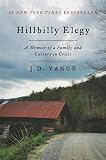
Editors Reads Verdict
As personal narrative, Hillbilly Elegy is vivid and often affecting — Vance writes about his grandmother, his mother's addiction, and his own adolescent instability with genuine honesty. Where the book becomes contested is in its analysis: its argument that cultural dysfunction is a primary driver of working-class decline has been challenged by critics who argue it understates structural and economic forces. Both the book's value and its limits are real.
What We Loved
- The personal narrative is specific and unsparing — Vance does not romanticize his childhood or present himself as a simple victim
- The portrait of his grandmother, Mamaw, is one of the more memorable figures in recent memoir
- The book captures the texture of Appalachian working-class life with the credibility of someone who lived it
- It arrived at a moment when mainstream American discourse was largely ignoring this population, and it filled a genuine gap
Minor Drawbacks
- The analysis leans heavily on cultural explanations while giving comparatively little weight to deindustrialization, policy failures, and structural economic change
- Vance's personal trajectory — Marines, Yale Law School, venture capital — can make the implicit argument feel like a bootstrap narrative rather than a structural diagnosis
- The book is now inseparable from Vance's political career, which shapes how readers receive its arguments about government, culture, and responsibility
Key Takeaways
- → Family instability compounds economic hardship in ways that are difficult to separate from poverty itself
- → Social capital — knowing how to navigate institutions, how to dress for an interview, how to behave in a law firm — is unevenly distributed and rarely discussed
- → Intergenerational trauma shapes behavior in ways that are real even if they are not destiny
- → The working class is not a monolith — Vance's account is specific to a particular Scots-Irish Appalachian culture with its own distinct norms and history
- → Individual escape from a difficult background does not by itself explain the conditions that make escape necessary
| Author | J.D. Vance |
|---|---|
| Publisher | HarperCollins |
| Pages | 264 |
| Published | June 28, 2016 |
| Language | English |
| Genre | Memoir, Social Commentary, Nonfiction |
| Difficulty | Beginner |
| Best For | Readers interested in American class and regional culture, particularly those who want a first-person account of Appalachian working-class life rather than a sociological survey. |
How Hillbilly Elegy Compares
Hillbilly Elegy at a glance against 3 similar books readers weigh alongside it.
| Book | Author | Rating | Best for |
|---|---|---|---|
| Hillbilly Elegy (this book) | J.D. Vance | ★ 3.5 | Readers interested in American class and regional culture, particularly those |
| Becoming | Michelle Obama | ★ 4.8 | Anyone interested in American political history, the Obama era, or memoir as a |
| Between the World and Me | Ta-Nehisi Coates | ★ 4.5 | Readers who want to understand anti-Black racism in America through literary |
| Born a Crime | Trevor Noah | ★ 4.8 | Anyone interested in apartheid South Africa, memoir as a form, questions of |
The Personal Story
J.D. Vance grew up in Middletown, Ohio, a Rust Belt town where his family had migrated from the hills of eastern Kentucky. His memoir is primarily the story of that family: a mother who cycled through relationships and addictions, a largely absent father, and a grandmother — “Mamaw” — who provided the most reliable stability in his early life. Vance’s account of childhood is fractured in the way unstable households actually are: moving between relatives, watching his mother deteriorate, learning to anticipate violence while also normalizing it.
The second half of the book follows his path out: the Marines, which Vance credits with teaching him discipline and baseline adult functioning he had not acquired at home, and then Ohio State and Yale Law School, where he encountered a social world whose unspoken rules he had to learn from scratch. These sections are among the most readable, partly because Vance is unusually candid about the specific gaps in his preparation — he did not know how to eat at a formal dinner, how to negotiate a salary, or how to manage a checking account. The book is good on the mechanics of class mobility in a way that most memoirs are not.
A Cultural Document of 2016
When Hillbilly Elegy was published in June 2016, it landed in the middle of a political season in which Donald Trump’s support among white working-class voters was confounding commentators who had little framework for understanding that demographic. The book became, for a significant portion of the media and reading public, an explanatory text — a way of accessing a world that had become suddenly politically relevant.
That reception carried its own distortions. Vance was treated as a spokesperson for a population of roughly 60 million people on the basis of his specific experience in one family in one town. The book was read as sociology when it was, in form and intent, memoir. These are distinct genres with different epistemic obligations, and much of the subsequent criticism of the book was really criticism of how it was received and used rather than of what it actually said. That distinction is worth preserving when reading it.
The Culture vs. Structure Debate
The book’s most contested claim is implicit rather than stated outright: that the struggles of Appalachian working-class communities are substantially self-generated, rooted in a culture of learned helplessness, distrust of education, and a code of honor that valorizes resentment over effort. Vance does not ignore economic forces entirely, but they appear in the background of a narrative whose foreground is almost entirely behavioral and familial.
Critics, including sociologists and economists who study the region, have argued this framing is inverted — that the cultural patterns Vance describes are better understood as responses to deindustrialization, the collapse of unionized labor, and the withdrawal of public investment rather than as independent causes of poverty. Robert Wuthnow, Arlie Hochschild, and others writing about working-class America in the same period arrived at more structurally oriented explanations using different methods. Neither account is obviously complete, and a reader will get the most from Vance’s book by reading it alongside rather than instead of more structural analyses.
What the book does well — and what the structural critiques cannot fully replace — is the phenomenology of the experience: what it feels like from the inside, what choices look like when you are making them from inside these conditions, and how the emotional logic of a chaotic household shapes a person’s assumptions about the world. This is not nothing. It is, in fact, what memoir is for.
Reading It Now
Any honest assessment of this book in 2026 has to acknowledge the context Vance’s subsequent career creates. He entered Republican politics, became a senator from Ohio, and was elected Vice President of the United States in 2024. His public positions on a range of issues — including some that bear directly on the communities he wrote about — are now part of the public record.
This creates a genuine interpretive problem for readers. The memoir predates his political career and should not be retroactively read as a policy document. At the same time, it is not unreasonable to read an author’s later choices as evidence about what they actually believed when writing. Readers will navigate this differently depending on their own views, and neither pretending the political career does not exist nor allowing it to completely override the book’s content seems fully adequate. The most honest approach is probably to read the memoir on its own terms while remaining aware that the author’s subsequent trajectory is relevant information.
Our rating: 3.5/5 — A genuinely affecting memoir that works best as personal narrative and least well as cultural diagnosis, now complicated by an author whose career invites skepticism about some of the book’s quieter arguments.
A Memoir of Class and Place
Hillbilly Elegy is J.D. Vance’s personal account of growing up in a working-class family with roots in Appalachian Kentucky and the struggling industrial towns of Ohio, and his improbable journey to an elite law school. The memoir interweaves his own story, marked by family instability, addiction, and hardship, with broader reflections on the culture, values, and troubles of the white working class. Its vivid personal narrative and its arrival at a moment of intense national interest in the economic and cultural divides of America made it a major bestseller and a widely discussed book.
A Contested Reception
Readers should approach Hillbilly Elegy aware that it became a lightning rod for debate. Admirers praised it as an empathetic, firsthand window into a community often overlooked, while critics argued that its emphasis on personal responsibility and cultural explanation oversimplified or unfairly characterized the structural and economic forces shaping the region. The book’s interpretations have been sharply contested by scholars and people from the communities it describes, and Vance’s later political career has further colored its reception. It is best read as one person’s perspective and argument rather than a definitive account.
Why It Sparked Conversation
Whatever one makes of its conclusions, Hillbilly Elegy succeeded in bringing questions of class, place, and opportunity in America into wide public conversation. Its power lies in the specificity and honesty of Vance’s personal story, the love and dysfunction of his family, the role of his grandmother in his survival, and the difficulty of escaping the circumstances of one’s upbringing. Read critically and alongside other perspectives, it remains a compelling and provocative memoir that illuminates one experience of the American class divide and the debates surrounding it.
Reading Guides
Frequently Asked Questions
What is "Hillbilly Elegy" about?
J.D. Vance traces his chaotic Appalachian upbringing — a drug-addicted mother, a stabilizing grandmother, a stint in the Marines — and his unlikely path to Yale Law School, offering a ground-level account of white working-class decline in America.
Who should read "Hillbilly Elegy"?
Readers interested in American class and regional culture, particularly those who want a first-person account of Appalachian working-class life rather than a sociological survey.
What are the key takeaways from "Hillbilly Elegy"?
Family instability compounds economic hardship in ways that are difficult to separate from poverty itself Social capital — knowing how to navigate institutions, how to dress for an interview, how to behave in a law firm — is unevenly distributed and rarely discussed Intergenerational trauma shapes behavior in ways that are real even if they are not destiny The working class is not a monolith — Vance's account is specific to a particular Scots-Irish Appalachian culture with its own distinct norms and history Individual escape from a difficult background does not by itself explain the conditions that make escape necessary
Is "Hillbilly Elegy" worth reading?
As personal narrative, Hillbilly Elegy is vivid and often affecting — Vance writes about his grandmother, his mother's addiction, and his own adolescent instability with genuine honesty. Where the book becomes contested is in its analysis: its argument that cultural dysfunction is a primary driver of working-class decline has been challenged by critics who argue it understates structural and economic forces. Both the book's value and its limits are real.
Ready to Read Hillbilly Elegy?
Check the current price on Amazon.
Check Price on Amazon (paid link)Prices and availability are subject to change. See Amazon for current price.
Review last updated: