15 Books Like The Women by Kristin Hannah
Loved The Women? These 15 novels share Kristin Hannah's combination of wartime courage, women's forgotten history, emotional sweep, and the question of what a society owes those who served it.

Kristin Hannah’s The Women (2024) tells the story of Frances “Frankie” McGrath, a young woman who enlists as an Army nurse in Vietnam and returns to an America that has no framework for what she experienced. The novel is about courage, service, and the specific erasure suffered by women who fought in a war that America was not able to celebrate — the question at its centre is not whether Frankie was brave but why no one seemed to notice.
Hannah writes historical fiction with an emotional directness that other authors in the genre often avoid. Her novels are structured to be felt, not merely appreciated, and The Women follows this pattern: the Vietnam sequences are specific and physically vivid, the homecoming is desolating, and the gradual reclamation of identity in the novel’s final section is earned rather than assumed.
The books below share some or all of these qualities: women in war, forgotten histories, the emotional aftermath of conflict, and the kind of historical fiction that treats its subjects as fully human rather than as vehicles for period detail.
Quick answer: Start with The Nightingale (Hannah’s own most celebrated novel) or All the Light We Cannot See (the Pulitzer winner). For more Hannah, our Kristin Hannah books in order guide covers her full catalogue.
More Kristin Hannah
The Nightingale by Kristin Hannah
The obvious first choice after The Women is Hannah’s own most celebrated novel. Two French sisters — Vianne and Isabelle — find different forms of courage under Nazi occupation: Vianne by protecting Jewish children in her village, Isabelle by joining the French Resistance and guiding Allied airmen across the Pyrenees. The Nightingale has the same emotional architecture as The Women — women doing extraordinary things in circumstances that make no provision for them — but its World War II setting and its specific focus on the female cost of survival make it both complement and contrast. The structure, ending with a revelation that reframes the entire novel, is one of Hannah’s most effective.
The Four Winds by Kristin Hannah
Hannah’s Dust Bowl novel. Elsa Martinelli, a Texas farmer watching her land turn to dust, must decide whether to stay or take her children west to California with the thousands of other Okies displaced by the Depression. The Four Winds shares The Women’s interest in women whose endurance goes unacknowledged by history and whose suffering is structural rather than individual — this is as much a novel about systems (agricultural policy, labour exploitation, the myth of opportunity) as it is about Elsa. Less studied than The Nightingale but equally moving.
Women in War: Historical Fiction
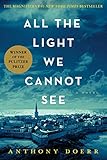
All the Light We Cannot See by Anthony Doerr
A blind French girl and a German orphan boy converge in occupied France during the Second World War. Doerr’s Pulitzer Prize-winning novel is the most literary book on this list — the prose is more carefully crafted than Hannah’s, the structure more formally intricate — but it shares The Women’s commitment to the interior experience of war over its exterior spectacle. The science of radio transmission and optics runs through the novel as both metaphor and plot mechanism. The ending is devastating and earned.
The Book Thief by Markus Zusak
Nazi Germany, narrated by Death. Liesel Meminger, a foster child in a small German town, steals books and discovers the power of words during a period designed to destroy them. Zusak’s novel is more lyrical and formally experimental than Hannah’s work, and its perspective — the war seen from the German civilian interior rather than from Allied resistance — gives it a different moral texture. Among the finest YA/crossover novels of the past twenty years.
The Alice Network by Kate Quinn
Two timelines: a female spy network in WWI France and a young American woman searching for her missing cousin in 1947. Quinn’s thriller approach to historical fiction gives the novel more momentum than the purely literary alternatives — this is a page-turner as well as a serious novel about women in war — and her research on the real Alice Network (a British spy ring) is meticulous. For readers who want the same subject matter as The Women with more thriller mechanics.
The Huntress by Kate Quinn
A team of Nazi hunters pursues a female war criminal through post-war America and Europe. Quinn’s second appearance on this list reflects her particular skill at historical fiction that centres on women who are simultaneously perpetrators, victims, and investigators of wartime violence. The dual timeline structure — 1946 Boston and wartime Russia — generates strong momentum. One of the best narrative novels about the aftermath of war.
The Rose Code by Kate Quinn
Three women codebreakers at Bletchley Park during WWII, their friendship, and the betrayal that fractures it — revealed ten years later at Elizabeth II’s coronation. Quinn’s third appearance reflects the range of her output: each of her historical novels centres women whose war contributions were classified, overlooked, or erased, which maps directly onto The Women’s central preoccupation.
Beyond World War Two
A Thousand Splendid Suns by Khaled Hosseini
Two Afghan women — Mariam and Laila — connected by the same man across thirty years of war. Hosseini’s novel covers the Soviet invasion, the civil war, the Taliban, and the aftermath of American intervention, always from the perspective of women who have the least power in each of these systems and the most to lose. The parallels with The Women are structural: both novels are about women in wars that are not, officially, their wars, and about what those women carry home. One of the most emotionally devastating novels of the past twenty years.
The Kite Runner by Khaled Hosseini
Afghanistan again, but from a male perspective — a companion to A Thousand Splendid Suns rather than a repetition of it. Hosseini’s first novel is about guilt, cowardice, and the possibility of redemption across three decades of his country’s destruction. For readers who want to understand the historical context of A Thousand Splendid Suns, reading The Kite Runner alongside it gives the fuller picture.
Pachinko by Min Jin Lee
A Korean family across four generations of life in Japan, facing discrimination, displacement, and the gradual transformation of what identity means under sustained external pressure. Lee’s multigenerational saga shares The Women’s interest in how history shapes individual bodies and minds in ways that official narrative never records. The pachinko parlour that gives the novel its title is one of the finest structural metaphors in recent literary fiction — a machine designed to look like chance while being systematically rigged.
What to Read After This List
For more historical fiction at this level, our best historical fiction books guide covers the essential titles across periods and geographies. For the full Kristin Hannah back catalogue, our Kristin Hannah books in order guide covers every novel.
Kristin Hannah Books in Order
For every Kristin Hannah novel in order — from The Nightingale to The Women and beyond — see our Kristin Hannah Books in Order guide.
Affiliate disclosure: Links on this site are affiliate links. We earn a small commission at no extra cost to you. This does not influence our editorial recommendations.
Frequently Asked Questions
What should I read after The Women by Kristin Hannah?
The most natural next reads after The Women are The Nightingale (Hannah's own most celebrated novel, set in Nazi-occupied France), All the Light We Cannot See (Doerr's Pulitzer-winning WWII novel), and A Thousand Splendid Suns (Hosseini's account of Afghan women across three decades of war). All three share Hannah's combination of wartime setting, female perspective, and emotional depth.
Is The Women based on a true story?
The Women is fiction, but it is grounded in the real history of female Vietnam War nurses — a group whose service was long underacknowledged. Hannah researched the experiences of Army nurses extensively, and the novel's account of women returning from Vietnam to a society that did not know how to receive them is historically accurate in its broad strokes.
How does The Women compare to The Nightingale?
Both novels follow women navigating war in societies that undervalue their sacrifice, but they are structurally and tonally different. The Nightingale is set in Nazi-occupied France and focuses on resistance and survival; The Women is set in Vietnam and focuses on service, homecoming, and the treatment of veterans. The Nightingale is more tightly plotted; The Women has a longer emotional arc.
What other Kristin Hannah books are similar to The Women?
Kristin Hannah's closest novels to The Women are The Nightingale (her most celebrated; French resistance in WWII) and The Four Winds (Dust Bowl era; a woman's survival and displacement). Both share Hannah's interest in women in extreme historical circumstances and her commitment to the emotional consequences rather than just the events.
Is The Women appropriate for all readers?
The Women contains graphic depictions of combat medicine, scenes of sexual assault, and extended treatment of PTSD and its effects. It is intended for adult readers. The subject matter — the Vietnam War and its aftermath — is handled with care and historical accuracy, but it is not a comfortable read.