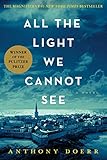
Books Like All the Light We Cannot See: WWII Reads
Anthony Doerr's Pulitzer Prize-winning novel follows a blind French girl and a German orphan whose paths converge in Saint-Malo as the war ends. These books share its dual-protagonist structure, its moral complexity about war, and its prose that makes catastrophe luminous.
By Oliver Kane

Anthony Doerr spent ten years writing All the Light We Cannot See, and the patience shows on every page. The novel follows two children across the years of the Second World War: Marie-Laure LeBlanc, blind since age six, who flees Paris with her father and a possibly cursed diamond to the walled city of Saint-Malo on the Brittany coast; and Werner Pfennig, a white-haired German orphan whose gift for radio electronics lifts him out of the Ruhr coal mines into the Wehrmacht’s signal corps. The structure is non-linear, moving between their childhoods and the single week in August 1944 when Allied bombing collapses the city around them, and their paths finally cross.
What distinguished the novel from other WWII fiction when it appeared in 2014 — and what earned it the Pulitzer Prize the following year — is its refusal to organize the war into moral categories that its characters can inhabit comfortably. Werner is not a Nazi, but he does what the Nazis require, and the novel insists that this distinction matters less than he would like it to. Marie-Laure is not a victim but a person, and the novel insists on that too. Doerr’s prose is the most formally beautiful of any war novelist writing in English today: every sentence is calibrated, every image earns its place, and the restraint makes the grief, when it arrives, almost unbearable.
The books below were chosen for readers who responded to one or more of what makes this novel exceptional: the dual-protagonist structure in which two lives move toward each other across history, the moral complexity that refuses to let the German characters off the hook or reduce the French ones to symbols, the non-linear time that treats the past as present, and the prose that finds beauty not despite the subject matter but inside it.
WWII Historical Fiction
#1 — The Nightingale by Kristin Hannah
Two French sisters — Vianne and Isabelle — navigate the same occupied France that surrounds Marie-Laure, in the same years, with the same impossible choices between survival and resistance. Hannah’s novel is less formally ambitious than Doerr’s and more emotionally explicit, but it covers the moral terrain from a different angle: what women did during the war that the official record did not preserve, and the specific costs of both accommodation and defiance. The title refers to Isabelle’s code name as a Resistance operative. For readers who want the same period explored with more attention to what women experienced and less attention to luminous prose, this is the natural companion novel.
#2 — Suite Française by Irène Némirovsky
Némirovsky began writing Suite Française in 1940, while she was living through the German occupation of France she was describing. She was arrested and deported to Auschwitz in 1942, where she died, and the manuscript was not discovered and published until 2004. What she finished — two of a planned five movements — is extraordinary: a panorama of the French under occupation, their collaboration and cowardice and occasional courage, written with a novelistic clarity that only direct observation can produce. Reading it alongside All the Light We Cannot See is an education in the difference between imagination and testimony, and in what a book can do when its author knows it may be her last.
#3 — The Reader by Bernhard Schlink
A fifteen-year-old German boy named Michael Berg has an affair with a thirty-six-year-old tram conductor named Hanna Schmitz. Years later, as a law student, he watches her trial for war crimes and discovers the secret she was hiding throughout their relationship. Schlink’s slim, devastating novel forces the question that All the Light We Cannot See raises through Werner and declines to answer directly: what is the moral weight of ordinary complicity? What do we owe to people we have loved who have done terrible things? And what does it mean to inherit, as a German, the crimes of the previous generation? Werner asks these questions silently. The Reader makes them the whole subject.
#4 — The Tin Drum by Günter Grass
Oskar Matzerath, who refuses to grow after age three and witnesses the entire arc of the Nazi era from child’s height, is the most demanding literary treatment of the same events Doerr renders luminous. Grass’s grotesque, baroque, formally extreme novel gives the German civilian experience of the Nazi rise and fall a very different aesthetic from Doerr’s controlled beauty — and that difference is precisely the point. Both novels ask what it meant to be German during those years and neither lets its central character escape with clean hands. The Tin Drum is harder, longer, and more rewarding for readers who want to know what the literary tradition says about the world Doerr has illuminated.
Dual Narratives and Converging Lives
#5 — A Gentleman in Moscow by Amor Towles
Count Alexander Rostov, sentenced to permanent house arrest in Moscow’s Metropol Hotel in 1922, lives out the entire Soviet era within its walls, his life quietly deepening while history convulses outside. Towles’s novel does not use a dual-protagonist structure, but it shares with All the Light We Cannot See the formal elegance — the prose that is always precisely controlled — and the central argument that an individual life can be lived with full meaning inside severe historical constraint. Both novels are ultimately about the ways people preserve their essential selves through catastrophe. Towles’s is the more optimistic answer; Doerr’s is the more honest one.
#6 — One Hundred Years of Solitude by Gabriel García Márquez
García Márquez’s multi-generational saga traces the Buendía family across a century of Colombian history, with lives that echo and repeat across generations in patterns no individual character can see. The novel’s non-linear, prophetic structure — we know from the first page that the town will eventually be destroyed — creates exactly the kind of dramatic irony that Doerr builds into his non-linear timeline. Reading both, you feel the same thing: grief not for what is lost but for what was always going to be lost, the people who loved each other inside a history that was bigger than they could hold.
#7 — The Hours by Michael Cunningham
Three women across three different decades — Virginia Woolf writing Mrs Dalloway in 1923, Laura Brown reading it in 1949 Los Angeles, Clarissa Vaughan living a contemporary version of its plot in 1990s New York — live their separate days in chapters that alternate and rhyme. Cunningham’s novel does not touch on war, but it shares with All the Light We Cannot See the structural conceit of lives that parallel and illuminate each other without touching, and the prose precision that treats an ordinary day as worthy of the most careful attention. For readers drawn to the formal architecture of Doerr’s novel — the way two lives can be woven into a single argument — The Hours is the clearest parallel.
Moral Complexity and the Cost of War
#8 — Never Let Me Go by Kazuo Ishiguro
Three friends who grew up together in a boarding school called Hailsham learn gradually what their lives are for in a world that has made a catastrophic moral choice and decided to live with it. Ishiguro’s novel, like Doerr’s, is about people who are inside a system they did not choose and cannot fully escape, finding ways to love each other anyway. Werner’s situation — born into the wrong country at the wrong time, shaped by a war he did not start — is structurally identical to Kathy’s and Tommy’s. Both novels ask whether the quality of a life can be measured by what it contains rather than by what surrounds it.
#9 — One Day in the Life of Ivan Denisovich by Alexander Solzhenitsyn
A single day in the life of a Soviet prisoner, compressed into 160 pages that contain everything: the cold, the hunger, the social hierarchies of the camp, the small victories that constitute survival. Solzhenitsyn’s novella is the counter-argument to Doerr’s luminous prose — no beauty here, only the relentless accumulation of hours. But both books are about the same thing: what it costs to remain a person inside a system designed to erase you. Ivan Denisovich’s strategies for dignity are Werner’s strategies for dignity, without the poetry.
#10 — A Gentleman in Moscow by Amor Towles
Towles’s novel earns its second mention here because it answers the book’s central question from the other side. Werner loses his moral bearings progressively, by small degrees, each compromise enabling the next. The Count, facing an equally total constraint, maintains his without drama or heroism — through wit, attention, and the discipline of caring about small things. Reading both novels together is an argument about what character actually is: not what you do in crisis but what you practice in the years before the crisis arrives.
How to Choose Your Next Read
If you want the same period from the French civilian inside: Suite Française — written during the occupation it describes.
If you want the moral question pushed to its limit: The Reader — complicity, love, and inheritance.
If you want the formal elegance applied to a different history: A Gentleman in Moscow — the same controlled prose, a different catastrophe.
If you want the dual-narrative structure in a non-war context: The Hours — three lives rhyming across decades.
If you want the most uncompromising German literary treatment: The Tin Drum — Grass where Doerr is beautiful.
For the Best Historical Fiction
For the definitive guide to historical fiction — from Ken Follett and Hilary Mantel to Kristin Hannah and Anthony Doerr — see our Best Historical Fiction Books list.
For the Best Fiction Books
For the definitive guide to fiction — the greatest novels across literary fiction, classics, and contemporary writing — see our Best Fiction Books of All Time list.
More WWII Fiction Reading Guides
- Books Like The Nightingale: WWII Novels You Need to Read
- Books Like The Book Thief: WWII, Childhood, and Story
Affiliate disclosure: Links to Amazon on this page are affiliate links. We earn a small commission at no extra cost to you. This does not influence our editorial recommendations.
Frequently Asked Questions
Did All the Light We Cannot See win the Pulitzer Prize?
Yes. All the Light We Cannot See won the Pulitzer Prize for Fiction in 2015. It also won the Andrew Carnegie Medal for Excellence in Fiction. Anthony Doerr spent ten years writing the novel, and the Pulitzer citation praised it for combining 'the intimacy of a family saga with the sweep of epic history.' The book sold millions of copies and was adapted into a Netflix miniseries in 2023. The prize was not without controversy — some critics found the novel's beauty at odds with its subject matter — but it remains one of the most widely read American novels of the twenty-first century.
What does the title All the Light We Cannot See mean?
The title operates on several levels. Most literally, it refers to radio waves — the invisible light that Werner transmits and that connects him to Marie-Laure across the war. More broadly, it refers to everything in the novel that is invisible to the people living through events: the consequences of choices not yet made, the lives of the enemy, the moral weight of complicity accumulated quietly over years. Marie-Laure is literally blind and navigates the world through other senses; Werner sees clearly but often chooses not to look. The title asks what we refuse to see and what we cannot see, and whether the difference matters.
What are the best books like All the Light We Cannot See for readers who want more moral complexity?
Readers who want the moral complexity of All the Light We Cannot See pushed further should try The Reader by Bernhard Schlink, which forces the question of complicity more directly — a German boy discovers the woman he loved was a concentration camp guard. The Tin Drum by Günter Grass gives the same period the most grotesque and uncompromising literary treatment. For readers who want the dual-narrative structure applied to a different period, A Gentleman in Moscow uses two timelines with the same formal elegance. And Never Let Me Go by Kazuo Ishiguro asks similar questions about people who live inside a catastrophic system and find small ways to love each other anyway.