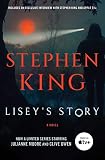
Editors Reads Verdict
King calls Lisey's Story his finest work, and it is his most intimate: a widow's grief grafted onto a tale of a secret world called Boo'ya Moon. A meditation on marriage, language, and loss that blends literary fiction with creeping dark fantasy.
What We Loved
- King's most personal and emotionally resonant novel
- A profound, tender portrait of a long marriage and its private language
- Boo'ya Moon is a uniquely beautiful and frightening invention
- Rich, ambitious prose that rewards careful reading
Minor Drawbacks
- The invented intimate vocabulary alienates some readers
- A slow, non-linear structure that demands patience
Key Takeaways
- → Lisey's Story is reportedly King's own favorite among his novels
- → It is his most personal work, drawing on his marriage and a brush with death
- → Grief and a long marriage are the true subjects, with dark fantasy as the frame
- → It won the Bram Stoker Award for Best Novel in 2006
| Author | Stephen King |
|---|---|
| Publisher | Scribner |
| Pages | 544 |
| Published | June 1, 2021 |
| Language | English |
| Genre | Horror, Thriller, Fiction |
| Difficulty | Advanced |
| Best For | Readers who value emotionally rich, literary horror and King's more ambitious, character-focused dark fantasy. |
How Lisey's Story Compares
Lisey's Story at a glance against 3 similar books readers weigh alongside it.
| Book | Author | Rating | Best for |
|---|---|---|---|
| Lisey's Story (this book) | Stephen King | ★ 4.0 | Readers who value emotionally rich, literary horror and King's more ambitious, |
| 11/22/63 | Stephen King | ★ 4.5 | King fans ready for his most ambitious work, history buffs interested in the |
| Bag of Bones | Stephen King | ★ 4.1 | Readers who love atmospheric gothic ghost stories and King's more literary, |
| The Shining | Stephen King | ★ 4.5 | Horror fans and general literary readers interested in psychological fiction |
Of all the novels in Stephen King’s enormous bibliography, Lisey’s Story (2006, in print from Scribner) is the one he has repeatedly named as his personal favorite — and it is easy to understand why. This is King’s most intimate book, written in the aftermath of his own near-fatal 1999 accident and shaped by decades of marriage. It is a ghost story, a dark-fantasy quest, and above all an aching meditation on grief, love, and the secret languages that bind two people together. Readers expecting a conventional scare-machine may be surprised; what they will find instead is something deeper, stranger, and more personal.
A widow and her husband’s secret world
The Lisey of the title is Lisey Landon, the widow of Scott Landon, a wildly successful and acclaimed novelist who died two years before the story opens. Now Lisey must finally face the daunting task of clearing out Scott’s study and study-barn, sorting through the papers and unpublished work that scholars and hangers-on are desperate to get their hands on. But the deeper she digs, the more she is forced to remember — and to reckon with a truth she has long half-suppressed.
Scott, it emerges, had access in life to another place: a world he called Boo’ya Moon, a realm of impossible beauty and lurking horror that he could reach through an act of will. It was a source of his inspiration and a refuge from a brutal childhood, but it was also stalked by a monstrous presence Scott called “the long boy.” As Lisey reconstructs her late husband’s relationship with this place, she discovers that Boo’ya Moon is real, that she can reach it too, and that doing so may be the only way to survive a present-day threat: a deranged fan who will stop at nothing to seize Scott’s papers.
Grief as the true subject
For all its dark-fantasy machinery, Lisey’s Story is fundamentally a novel about a marriage and its aftermath. King renders the texture of a long partnership with extraordinary precision — the private jokes, the wounds and forgivenesses, and above all the secret vocabulary couples invent. Lisey and Scott shared a whole language of pet words and shorthand phrases, and King foregrounds this invented intimate dialect throughout the book. It is one of his boldest stylistic gambles: the made-up words (“smucking,” “bool,” “blood-bool,” “strap it on”) immerse the reader in the couple’s private world, but they also alienate some readers who find the coinages precious or off-putting.
Beneath that language lies real emotional weight. The novel is a study of mourning — of the way grief makes us archaeologists of a shared past, sifting memory for meaning — and it is impossible not to read it in light of King’s brush with death and his long marriage to the writer Tabitha King. The tenderness is genuine and hard-won, and the portrait of Lisey as she moves from passive widow to active heroine, reclaiming her own strength, is one of King’s most satisfying character arcs.
Boo’ya Moon and the dark fantasy
The invented world at the novel’s heart is among King’s most evocative creations: a moonlit landscape of sweet-smelling trees and a healing pool, shadowed by the ever-present menace of the long boy. It belongs to the same imaginative family as the Territories of The Talisman and the wider multiverse of King’s fiction — a parallel place that is both balm and threat. King uses Boo’ya Moon to externalize the way Scott’s creativity and trauma were intertwined, and to literalize the idea that the places we go for inspiration are also the places that can devour us.
For readers who loved the haunted-grief gothic of Bag of Bones, the parallel-world wonder of The Talisman, or the emotional realism of 11/22/63, Lisey’s Story will resonate strongly. It blends all three impulses into something singular.
The novel also contains some of King’s most harrowing material about childhood trauma. Through Lisey’s recovered memories of Scott’s stories, we learn of the abuse and madness that haunted his family, and of the desperate measures he and his brother took to survive their father. These passages are difficult and unflinching, and they explain why Boo’ya Moon meant so much to Scott — it was the place a frightened boy fled to in order to endure the unendurable. King ties the fantastical and the autobiographical together so tightly that the reader comes to feel how, for some people, imagination is not an escape from reality but the only way to survive it.
Where it sits in the canon
Lisey’s Story won the Bram Stoker Award for Best Novel and stands as one of King’s most critically ambitious works. It is also one of his most demanding: the structure is non-linear, looping through memory and the present in a way that asks for patience, and the invented language requires the reader to surrender to its rhythms. These are not flaws so much as the cost of admission to a deeply personal vision.
This is not the book to hand someone who wants the propulsive terror of It or the small-town menace of ‘Salem’s Lot. It is slower, sadder, and more interior. But for readers willing to meet it on its own terms, Lisey’s Story offers something rare: a horror novel that is really about love, and a fantasy that is really about the work of mourning. It is King at his most vulnerable and, by his own reckoning, his best.
Our rating: 4.0/5 — King’s most personal and emotionally ambitious novel; the invented language and slow structure demand patience, but the portrait of marriage, grief, and a secret world is profoundly moving.
Frequently Asked Questions
What is "Lisey's Story" about?
Two years after her famous-novelist husband's death, Lisey Landon must sort through his papers — and confront the secret, otherworldly place he visited in life, where wonder and horror wait side by side. Stephen King's most personal novel, and his own favorite.
Who should read "Lisey's Story"?
Readers who value emotionally rich, literary horror and King's more ambitious, character-focused dark fantasy.
What are the key takeaways from "Lisey's Story"?
Lisey's Story is reportedly King's own favorite among his novels It is his most personal work, drawing on his marriage and a brush with death Grief and a long marriage are the true subjects, with dark fantasy as the frame It won the Bram Stoker Award for Best Novel in 2006
Is "Lisey's Story" worth reading?
King calls Lisey's Story his finest work, and it is his most intimate: a widow's grief grafted onto a tale of a secret world called Boo'ya Moon. A meditation on marriage, language, and loss that blends literary fiction with creeping dark fantasy.
Ready to Read Lisey's Story?
Check the current price on Amazon.
Check Price on Amazon (paid link)Prices and availability are subject to change. See Amazon for current price.
Review last updated: