Where to Start with Terry Pratchett and Neil Gaiman: A Reading Guide
Where to start with Terry Pratchett and Neil Gaiman's collaboration — Good Omens, the funniest fantasy novel ever written. A complete reading guide to their unique co-authored work.
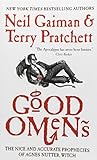
Terry Pratchett (1948–2015) was the British author of the Discworld series, one of the longest-running and most beloved comedy fantasy series in the world. Neil Gaiman (born 1960) is the British-American author of Sandman, American Gods, and Coraline. Good Omens: The Nice and Accurate Prophecies of Agnes Nutter, Witch was written in 1990 in a burst of collaboration between the two authors — a process both described as productive, chaotic, and impossible to fully attribute in retrospect. It remains the only co-authored novel either man has produced and is widely regarded as among the finest British comedy novels ever written.
Where to Start: Good Omens (1990)
The essential Pratchett-Gaiman collaboration — and the funniest fantasy novel ever written. Good Omens begins with a premise that combines cosmic stakes with perfectly calibrated absurdism: the Apocalypse is scheduled for this Saturday. An angel named Aziraphale and a demon named Crowley — who have spent six thousand years on Earth and have independently arrived at the same inconvenient conclusion (that they would rather it didn’t happen) — have misplaced the Antichrist.
The Antichrist turns out to be Adam Young, an eleven-year-old boy from Tadfield, Oxfordshire. He has been accidentally raised by the wrong family — a perfectly ordinary family who named him Adam because they thought it was a nice name — and has consequently developed into a perfectly ordinary child who quite likes his friends, his dog, and the village pond. He has enormous supernatural powers that he has been exercising unconsciously in ways that have made Tadfield one of the most pleasant places in England. He does not know he is the Antichrist.
Aziraphale is a bookshop owner in Soho who collects rare volumes, enjoys the best restaurants in London, and has been performing minor miracles for six thousand years out of a genuine fondness for humanity. He is ineffably good in a very comfortable, well-upholstered way. Crowley drives a 1926 Bentley that has absorbed ambient rock and roll because every tape placed in it eventually becomes a Queen compilation, wears sunglasses at all times to conceal his serpent eyes, and maintains a flat populated with plants that grow in terror of their owner. He has been performing minor acts of temptation for six thousand years but has found that modern civilisation makes it largely unnecessary — humanity is quite capable of tempting itself.
Their friendship — acknowledged only gradually, eventually undeniable — is the emotional centre of the novel. They have spent six thousand years doing each other’s jobs because it saved on paperwork, and they have developed a mutual fondness that neither Heaven nor Hell anticipated when they designed their opposing functions. Both of them, independently and without admitting it to each other, want the world to continue. This is both the source of the comedy and, in its accumulation over 432 pages, unexpectedly moving.
The comedy operates on multiple levels simultaneously. The footnotes — a Pratchett signature — are digressions that are frequently funnier than the main text and that illuminate it by contrast. The Witchfinder Army (two people, including the magnificently indignant Sergeant Shadwell, and including a Newton Pulsifer whose ancestors have always had bad luck with witches) is perfect satirical construction. The Four Horsepersons of the Apocalypse argue about their names and meet a fifth Horseperson called Death.
Beneath all of this is a genuine philosophical position about good and evil. The book’s understanding of Aziraphale and Crowley — as mutually constituting, co-dependent figures who cannot exist without each other and who have both become something more interesting than their original designs intended — is a real theological argument. The world worth saving is the same world that contains both of them: specific, surprising, and irreducibly strange.
Why Good Omens Is the Essential First Book
For a reader new to the collaboration of Terry Pratchett and Neil Gaiman, Good Omens is the essential first book because it is their famous joint novel and the fullest expression of their combined gifts, the wit, the inventiveness, and the warm, comic, and humane imagination of two beloved authors. Good Omens tells the story of an angel and a demon who team up to prevent the apocalypse, having grown rather fond of life on Earth, in a hilarious, inventive, and warm-hearted comic fantasy. As an entry point it is both natural and essential, for it is their single, celebrated collaboration and a perfect example of their combined comic and imaginative gifts. It welcomes the newcomer with its hilarious premise, its inventive comedy, and its warmth, drawing the reader into their delightful collaboration. It is their joint masterwork, so the new reader encounters Pratchett and Gaiman together at their most characteristic. For the newcomer, then, Good Omens is the natural and essential starting point.
What to Expect as a New Reader
As a new reader, you can expect Good Omens to be a hilarious, inventive, and warm-hearted comic fantasy. You can expect a hilarious premise, for an angel and a demon team up to prevent the apocalypse, having grown fond of life on Earth. You can expect wit, for the novel is genuinely funny, full of clever jokes, footnotes, and comic invention. You can expect inventiveness, for the book overflows with imaginative ideas and memorable characters. You can expect warmth, for beneath the comedy lies a humane, affectionate vision of humanity. You can expect the combined gifts of two beloved authors, Pratchett’s comic genius and Gaiman’s imaginative flair. You can expect a delightful, comic, and good-hearted read. Expect, in short, a hilarious, inventive, and warm-hearted comic fantasy, the essential introduction to this beloved collaboration.
Going Deeper After Your First Book
Once Good Omens has introduced you to their combined gifts, the natural next step is to explore the solo work of each of these beloved authors. Terry Pratchett’s vast Discworld series is one of the funniest and most inventive achievements in fantasy, a sprawling comic universe rich with wit, satire, and humanity, while Neil Gaiman’s imaginative fiction, including his beloved fantasy novels, his celebrated graphic novels, and his stories for children and adults, displays his distinctive mythic imagination and storytelling flair. Reading their solo work after Good Omens deepens your appreciation of the gifts each brought to their collaboration, Pratchett’s comic genius and Gaiman’s imaginative flair. Both authors offer rich, rewarding bodies of work to explore. Building your reading journey from Good Omens is a matter of branching into Pratchett’s Discworld and Gaiman’s fiction. The reader who begins here will discover two of the most beloved and imaginative authors of modern fantasy to follow.
Reading Pratchett and Gaiman
Good Omens is their only collaboration. It is the ideal entry point for readers new to either author and stands completely alone.
For the full Terry Pratchett and Neil Gaiman bibliography, reviews, and biography, visit the Terry Pratchett and Neil Gaiman author page on Editors Reads.
Affiliate disclosure: Links to Amazon on this page are affiliate links. We earn a small commission at no extra cost to you.
Frequently Asked Questions
Where should I start with the Pratchett and Gaiman collaboration?
Good Omens: The Nice and Accurate Prophecies of Agnes Nutter, Witch (1990) is their only collaboration and one of the great comedy fantasy novels. An angel and a demon who have grown rather fond of Earth team up to prevent the Apocalypse — which has been accidentally complicated by the misplacement of the Antichrist. The funniest fantasy novel ever written, with genuine warmth and philosophical depth beneath the comedy.
What is Good Omens about?
Good Omens follows Aziraphale (an angel) and Crowley (a demon) who have spent six thousand years on Earth and have grown alarmingly attached to it. The Apocalypse is scheduled for Saturday. They have independently decided they'd rather it didn't happen. The problem: the Antichrist has been accidentally raised as an ordinary eleven-year-old boy in Tadfield, and he doesn't know what he is. The book follows the chaos that results from these facts colliding.
Do I need to read Pratchett's Discworld or Gaiman's Sandman first?
Good Omens requires no prior knowledge of Discworld or Sandman. It is a completely standalone novel that stands entirely on its own. Familiarity with Pratchett's comic style and Gaiman's mythological sensibility enriches the reading, but first-time readers of either author find the collaboration the most accessible and funny entry point. The novel's comedy, plot, and characters are self-contained.
What should I read after Good Omens?
After Good Omens, read both authors independently. Gaiman's American Gods covers mythology in contemporary America with comparable ambition and darker tone. Pratchett's Guards! Guards! is the recommended entry point to Discworld and shares Good Omens' comic intelligence and satirical warmth. Douglas Adams's The Hitchhiker's Guide to the Galaxy covers the end of the world with similar absurdist philosophy.