Where to Start with Stephen Crane: A Reading Guide
Where to start with Stephen Crane — how to approach The Red Badge of Courage, his landmark psychological war novel written before he ever witnessed battle and still the most honest American war fiction. A complete reading guide.
Stephen Crane (1871–1900) was an American writer who published The Red Badge of Courage at age twenty-two, before he had witnessed any battle. He had researched the Civil War through accounts by veterans, photographs of the battlefields, and Matthew Brady’s photographs of the dead, and from this research produced a novel of combat psychology so accurate that veterans who read it assumed he must have served. He did not encounter war himself until he worked as a war correspondent in Cuba and Greece in 1897, by which time The Red Badge of Courage had already been praised by established writers on both sides of the Atlantic as the most honest war fiction yet written by an American.
Where to Start: The Red Badge of Courage (1895)
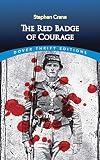
The essential Stephen Crane — and the most psychologically honest war novel in the American tradition. The Red Badge of Courage begins where war fiction usually ends: with a soldier running away. Henry Fleming, a young Union private in the Civil War, has enlisted imagining himself a hero in the tradition of the classical stories he has absorbed. In his first battle, he panics and flees. The novel’s subject — its only real subject, pursued with merciless precision across 112 pages — is what Henry tells himself about this act over the course of the day that follows.
Crane was not primarily interested in the mechanics of combat. He was interested in self-deception — the extraordinary speed and ingenuity with which a frightened young man reframes his cowardice as wisdom, his flight as rational self-preservation, his desertion of comrades as justified individualism. Within hours of running, Henry has constructed a narrative in which his behaviour was in fact the response of a superior intelligence to a situation the other soldiers — who did not flee — were too limited to understand. Crane watches his protagonist produce these self-justifications with the detachment of a naturalist observing an adaptation, noting each distortion without comment.
The psychological realism of this portrait is what convinced veterans. Crane had never seen combat, but he understood, with uncanny precision, the machinery by which human beings avoid confronting their own failures. The specific quality of Henry’s rationalisation — confident on the surface, increasingly desperate in its elaborations — is a portrait of a universal mechanism rather than a period-specific character study.
The prose style was unlike anything in American fiction at the time and would not be fully absorbed into the tradition until Hemingway and Dos Passos took it up in the 1920s. Crane writes in jolts of colour and sensation: the “red sun pasted in the sky like a wafer,” the corpses with blue faces, the woods that seem to sway and close. The effect is not descriptive so much as experiential — the reader receives the battle as a series of sensory impressions rather than as an ordered sequence of events, which is precisely how combat is experienced by those in it. Crane understood this before he had experienced it.
The structure is built around a single day’s events. Henry flees. He observes a column of wounded soldiers. He desperately wants the wound that would prove he was in the fighting — the red badge of courage of the title. He acquires one accidentally, struck by a rifle butt in the chaos, and returns to his regiment. The novel’s final section, in which Henry fights heroically, is deliberately ambiguous. Crane does not confirm that Henry has earned his confidence — the same self-deceptive machinery is running, producing the same self-serving narrative. The ending is an irony available to readers who notice it and invisible to those who take it at face value.
At 112 pages, the novel is one of American literature’s great achievements in compression. No sentence wastes space. Every scene advances the psychological portrait. The novel’s formal efficiency is itself a statement: this is how much space you need to say something true about war and human nature, if you have nothing false to add.
Why The Red Badge of Courage Is the Ideal First Book
For a reader new to Stephen Crane, The Red Badge of Courage is the ideal first book because it is his masterpiece, a landmark of American literature, and the fullest expression of his distinctive gifts, the vivid, impressionistic prose, the psychological realism, and the unflinching depiction of war and fear. The Red Badge of Courage follows a young Union soldier in the American Civil War through his fear, flight, and search for courage, in a powerful, innovative, and psychologically penetrating war novel. As an entry point it is ideal, for it is his most celebrated work and a perfect example of his vivid, psychologically realistic fiction. It welcomes the newcomer with its powerful story, its vivid prose, and its psychological depth, drawing the reader into his distinctive vision. It is his masterpiece and the one that best represents his gifts, so the new reader encounters Crane at his finest. For the newcomer, then, The Red Badge of Courage is the natural and ideal starting point.
What to Expect as a New Reader
As a new reader, you can expect The Red Badge of Courage to be a vivid, innovative, and psychologically penetrating war novel. You can expect a powerful story, for the novel follows a young Union soldier through his fear, flight, and search for courage in the American Civil War. You can expect vivid, impressionistic prose, for Crane writes with striking, image-rich, often impressionistic language. You can expect psychological realism, for the novel probes the soldier’s fear, shame, and shifting inner states with unusual depth. You can expect an unflinching depiction of war, for Crane renders the chaos, terror, and reality of battle. You can expect a focus on the inner experience of war rather than grand strategy. You can expect a short, powerful, and innovative novel. Expect, in short, a vivid, innovative, and psychologically penetrating war novel, a superb introduction to Crane’s gifts.
Going Deeper After Your First Book
Once The Red Badge of Courage has introduced you to Crane’s gifts, the reader who wishes to go deeper can explore his other work, which continues his vivid, impressionistic prose, his psychological realism, and his unflinching vision, across fiction and poetry, despite his short life. His acclaimed short stories, including his powerful tale of shipwrecked men at sea and his stories of the American West, are among the finest in American literature, while his early novel of urban poverty and his innovative, spare poetry reveal the range of his gifts. Reading these after The Red Badge of Courage deepens your appreciation of Crane’s distinctive gifts, the vivid prose, the psychological realism, and the unflinching vision. His characteristic qualities run through his work. Building your reading journey through Crane is a matter of following his writing from The Red Badge of Courage into his short stories and poetry. The reader who begins here and continues will encounter one of the most innovative and influential of early American writers.
Reading Stephen Crane
The Red Badge of Courage is Crane’s essential novel. It stands alone and requires no prior knowledge of the Civil War or of Crane’s biography.
For the full Stephen Crane bibliography, reviews, and biography, visit the Stephen Crane author page on Editors Reads.
Affiliate disclosure: Links to Amazon on this page are affiliate links. We earn a small commission at no extra cost to you.
Frequently Asked Questions
Where should I start with Stephen Crane?
The Red Badge of Courage (1895) is Crane's essential novel — a 112-page psychological war fiction that strips away every romantic illusion about combat and replaces it with something truer and more terrifying: the interior chaos of a young man who has run away from his first battle and cannot stop lying to himself about what he did. Written by a 22-year-old who had never witnessed combat, it convinced Civil War veterans that the author must have fought. Still the most psychologically honest war novel in the American tradition.
What is The Red Badge of Courage about?
The Red Badge of Courage follows Henry Fleming, a young Union soldier who enlists dreaming of glory and flees in panic from his first battle. The novel traces the long afternoon and night that follow — Henry's desperate self-justifications, his encounter with a dying soldier, his witnessing of heroism, his accidental acquisition of a head wound (the 'red badge' of the title) that lets him return to his regiment as a hero. Crane is not interested in whether Henry becomes brave; he is interested in how Henry lies to himself, moment by moment, about what he is.
Is The Red Badge of Courage still relevant to read today?
The Red Badge of Courage is as relevant today as in 1895 because its subject is not specifically the Civil War but self-deception under pressure — a universal human condition that Crane renders with psychological precision that feels modern rather than Victorian. The impressionistic prose style anticipated literary modernism by decades. The novel reads quickly (it is 112 pages) and repays the reading in insights about the gap between how people present themselves and what they are actually experiencing.
What should I read after The Red Badge of Courage?
After The Red Badge of Courage, Ernest Hemingway's A Farewell to Arms covers World War I with the influence of Crane's prose style made explicit — Hemingway acknowledged the debt. Erich Maria Remarque's All Quiet on the Western Front provides the WWI equivalent of Crane's psychological honesty, from the German side. Tim O'Brien's The Things They Carried is the Vietnam-era heir to the tradition Crane founded: war fiction interested in how soldiers narrate their own experience.