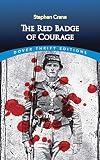
American novelist and poet whose war novel The Red Badge of Courage pioneered literary naturalism and psychological realism in American fiction.
Stephen Crane was an American novelist, poet, and journalist who produced some of the most significant works of literary naturalism in the late nineteenth century before dying of tuberculosis at the age of twenty-eight. In a career of barely a decade, he wrote novels, short stories, and journalism that placed him alongside his contemporaries as a pioneer of American realism, and his influence on later writers — Ernest Hemingway particularly acknowledged his debt — has been profound.
The Red Badge of Courage, published in 1895, is his masterpiece and one of the most studied novels in American literature. Remarkably, Crane had never witnessed war when he wrote it: his account of a young Union soldier’s experience of battle during the Civil War, including his cowardice, his growth, and his confrontation with fear and death, was based on accounts he had read and on a fierce imaginative sympathy. The novel’s psychological realism and impressionistic prose style were startlingly modern for their time.
Crane later worked as a war correspondent in the Greco-Turkish War and the Spanish-American War, experiences that informed later fiction including Wounds in the Rain. His short story “The Open Boat,” based on his survival of a shipwreck, is a masterclass of American short fiction. Despite his tragically short life, Crane’s work remains a cornerstone of American literary history, studied in universities and admired by writers for its unflinching honesty and technical innovation.
Reading Guides