Red Rising Books in Order: Pierce Brown's Complete Reading Guide (2026)
The complete Red Rising saga reading order — all 6 Pierce Brown novels across both trilogies, with start recommendations and a guide to the color-caste system.
Red Rising is one of the defining SF series of the 21st century, and it arrived almost by accident. Pierce Brown’s debut was published in 2014 without the marketing apparatus that typically launches a major franchise. It spread through word of mouth — through Reddit threads, through readers pressing copies on friends, through online communities that formed around a series that had no Hollywood adaptation, no prestige TV backing, no brand recognition. By the time the sequel trilogy launched, the readership was enormous and fiercely loyal. It is now one of the most passionately followed series in science fiction.
The reading order is publication order, without exception. This is a single continuous story told across six novels and two trilogies. The second trilogy assumes complete knowledge of the first. There is no sensible entry point other than Book 1, and no reason to look for one.
Quick answer: Read all six books in this order: Red Rising → Golden Son → Morning Star → Iron Gold → Dark Age → Light Bringer. Do not read Dark Age without Light Bringer immediately available — it ends on a devastating cliffhanger.
A seventh book, Red God, has been announced as the saga’s conclusion but was not yet published as of 2026.
Red Rising Books Ranked
| Rank | Book | Notes |
|---|---|---|
| #1 | Morning Star | The original trilogy’s climax — the revolution lands, the operatic scale is fully justified, and the emotional payoff is enormous |
| #2 | Light Bringer | The best-written book in the saga — tighter, more emotionally resolved than what came before; the wait since Dark Age was worth it |
| #3 | Golden Son | Where the series announces what it truly is — the Roman political epic becomes unmistakable, the scope explodes |
| #4 | Red Rising | Essential starting point; the Institute sequence is brilliant even if it’s the most YA-adjacent part of the saga |
| #5 | Iron Gold | Slower and denser than the original trilogy, but the multi-POV structure and Lysander’s introduction add genuine complexity |
| #6 | Dark Age | Deliberately brutal, structurally demanding, and not a satisfying standalone — but the saga cannot exist without it |
All Red Rising Books at a Glance
| # | Title | Year | Series/Type |
|---|---|---|---|
| 1 | Red Rising | 2014 | Original Trilogy #1 |
| 2 | Golden Son | 2015 | Original Trilogy #2 |
| 3 | Morning Star | 2016 | Original Trilogy #3 |
| 4 | Iron Gold | 2018 | Lycia Saga #1 |
| 5 | Dark Age | 2019 | Lycia Saga #2 |
| 6 | Light Bringer | 2023 | Lycia Saga #3 |
Best starting point: Red Rising — always Book 1; there is no other entry point into the saga.
Start With Red Rising
Darrow is a Red — a miner living and working deep beneath the surface of Mars, drilling the rock and breathing the processed air of a civilization in progress. He and his people believe they are helium-3 miners preparing Mars for future colonization: sacrificing themselves so that generations to come can inherit a terraformed world. The work is brutal. People die young. Darrow’s wife is executed for singing a banned song.
Then Darrow learns the truth. The surface of Mars has been populated for centuries. The terraforming is complete. Reds are not pioneers; they are slaves, kept underground and kept ignorant by the Society, the rigid color-caste civilization that governs the solar system. Golds rule. Reds exist to be used.
A resistance organization called the Sons of Ares captures Darrow, surgically transforms him into a Gold, and sends him to infiltrate the ruling class from within. The goal is revolution. The method is deception at a level so total it requires Darrow to become, in almost every way, the thing he was born to destroy.
Book 1 spends most of its time at the Institute — a brutal war game in which Gold children hunt and conquer each other across a vast terrain, divided into Roman-styled houses, using each other as slaves. It is where Darrow must prove himself. The comparison to The Hunger Games is frequently made, and it is not inaccurate for this portion of the book. What the comparison misses is what the series becomes. By Morning Star, the Institute is a memory and the story has expanded into a solar-system-spanning revolution. The YA scaffolding of Book 1 is a foundation, not a ceiling.
The Original Trilogy
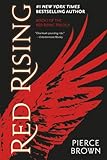
Red Rising (2014) establishes Darrow’s origin, the Institute sequence, and the fundamental injustice the series is built around. It is the most contained book of the six — the most focused on a single character and a single location — and it is deliberately constructed to draw you in before the full scale of what Brown is attempting becomes clear.
Golden Son (2015) takes Darrow into Gold society proper. He attends the war college, navigates the politics of the great Gold houses, and begins to operate as a genuine revolutionary asset inside the system he was born to destroy. The scope expands massively. New characters are introduced who become central to the rest of the saga. Brown begins demonstrating his real strength here: he is not primarily writing a YA coming-of-age story. He is writing a Roman political epic set in space, and Golden Son is where that becomes unmistakable.
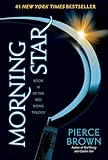
Morning Star (2016) is the revolution’s climax. Darrow, having been broken and rebuilt across the first two books, leads the war that the series has been building toward. It is the most overtly operatic of the three — large-scale space combat, political betrayals, the cost of revolution in blood and loss. It works as a trilogy conclusion. Many readers stop here and consider themselves satisfied, and this is a reasonable position. Morning Star closes the arc it opened. What comes after is not a continuation so much as a new story that inherits the wreckage.
Should You Read the Lycia Saga?
The second trilogy begins ten years after the events of Morning Star. The revolution succeeded, in the way that revolutions do: imperfectly, incompletely, with consequences that the revolutionaries did not anticipate and cannot fully control. The solar system is in political crisis. Darrow is still fighting, but the war has changed shape, and so has he.
Iron Gold (2018) introduces the multi-POV structure that defines the second trilogy. Alongside an older, harder Darrow, readers follow Lyria — a Red refugee navigating the postwar world — Ephraim, a former soldier turned criminal, and Lysander au Lune, a Gold who represents the most interesting ideological counterweight Brown has yet written. The shift from single to multiple perspectives changes the texture of the reading experience considerably.
Dark Age (2019) is discussed separately below, for reasons that warrant their own section.
Light Bringer (2023) is the payoff for the punishing second act that Dark Age represents. It is, in several ways, the best-written book in the series — tighter in structure than Iron Gold, more emotionally resolved than Dark Age, and building toward the conclusion that Red God will eventually provide.
The honest comparison: the original trilogy is tighter. It has a clear arc, a clear protagonist, and a clear ending. The Lycia Saga is more ambitious — in scope, in political complexity, in willingness to damage characters the reader has grown to love — and its full reward requires completing all three books. If you stop after Dark Age, you will feel only the punishment. Read all three, or wait until all three are available to you.
Dark Age — A Warning
Dark Age is the fifth book in the saga and the most challenging reading experience in the series. This is not a criticism. It is a description, offered so that readers know what they are entering.
Dark Age is the longest book Brown has written. It is also the darkest. Characters who have survived five books of war and revolution encounter the full cost of what the series has been building. Beloved figures die — not heroically, not meaningfully, in the way that genre fiction prefers its deaths, but with the arbitrary brutality of actual war. The violence is extreme and described without flinching. It is one of the most genuinely harrowing novels in mainstream science fiction, and it earns that description honestly rather than for shock value.
The narrative scope in Dark Age is at its widest. Multiple POV characters are separated by distance and circumstance, with no guarantee that the threads will resolve before the book ends. They do not all resolve. The final pages are widely regarded as one of the most devastating endings in recent genre fiction.
Do not read Dark Age without Light Bringer immediately available. The emotional state in which Dark Age leaves a reader is not a state designed to be sustained between publication dates. Brown knew what he was doing. Read them back to back.
The Color-Caste System Explained
New readers sometimes find the opening chapters of Red Rising disorienting because the Society’s social hierarchy is presented without explanation — Darrow knows this world; he doesn’t need to explain it to himself. A brief primer before you begin will help.
The Society divides humanity into a rigid color hierarchy. Each color corresponds to a function and a status. The system has been in place long enough that most people within it do not question it.
Golds are the ruling class — warriors, politicians, and overlords. They govern the Society and consider themselves born to rule. Physical size and augmentation mark them as distinct. The Institute that occupies most of Book 1 is a Gold institution, designed to select and shape the next generation of Gold leadership.
Reds are the lowest caste — workers, miners, laborers. They are kept deliberately ignorant of the Society’s full structure. Darrow’s community on Mars is a Red community, and the revelation that opens the series is about what Reds do not know.
Obsidians are the warrior caste — physically the largest humans in the Society, augmented for combat, and used as elite soldiers and bodyguards for Golds. They are formidable and they play an increasingly important role as the saga continues.
Silvers are financiers and merchants. Coppers are bureaucrats and administrators. Whites are priests and judges. Violets are artists and creatives. Pinks are pleasure workers. The remaining colors fill industrial and functional roles throughout the Society.
What matters for the first book: the Gold-Red axis is the central conflict. Everything else builds from there.
What Makes Red Rising Different
Pierce Brown is drawing on a specific set of sources that most SF writers don’t touch: Roman history, Roman political theory, and the literature of empire. The Gold houses are Roman in organization, in naming conventions, in their relationship to honor and power. The Institute is modeled on the Roman conception of elite military education. The political conflicts of the later books map directly onto the late Republic and the transition to Empire — the tension between the Senate and the Imperator, between collective governance and the strongman who promises order.
This gives the series a weight and a specificity that “dystopian YA” doesn’t capture. Brown is not primarily interested in the romantic subplot or the coming-of-age arc (though both are present). He is interested in how power structures reproduce themselves, how revolutions betray their origins, and what it costs — in actual human terms, not in abstract political ones — to build something new on the ruins of something old.
Brown’s prose is operatic. It announces itself. There are readers who find this too much — the rhetoric too elevated, the tragedy too insistent. For readers who respond to it, the effect is unlike most contemporary SF. The series has more in common, tonally, with Dune or the better military space opera traditions than with the quieter literary SF of recent years.
The series’ commitment to consequences is its most important characteristic. No one is safe. Brown has demonstrated, repeatedly, that he will kill characters readers love — not as a shock tactic, but as a structural necessity. The revolution costs something. The war costs something. The books would be dishonest if they pretended otherwise. That commitment is why the Red Rising readership is as devoted as it is: readers trust that what they’re being put through is earning something.
There are six novels currently in the series. Red God will complete it. The correct way to read them is in order, from the beginning, without skipping and without stopping between Dark Age and Light Bringer. Everything else is detail.
Frequently Asked Questions
What order do you read the Red Rising books?
Publication order: Red Rising (2014) → Golden Son (2015) → Morning Star (2016) → Iron Gold (2018) → Dark Age (2019) → Light Bringer (2023). The series is one continuous narrative — you cannot start anywhere except the beginning.
Is Red Rising like The Hunger Games?
The first book shares some surface similarities with The Hunger Games — a protagonist from a lower caste competing in a survival game designed by the ruling class — but the comparison breaks down quickly. Red Rising is more violent, more politically complex, and more rooted in Roman history. By Golden Son, it is operating at a scale and register The Hunger Games never attempted. The common description is “Hunger Games meets Game of Thrones meets Dune.”
Is Red Rising like Dune?
There are meaningful similarities: both are solar-system-spanning stories about a destabilised power structure, both use a rigid social hierarchy as a setting, and both draw on a specific historical civilisation (Roman for Red Rising, Middle Eastern/Ottoman for Dune). Red Rising is significantly faster-paced than Dune and more focused on character than world-building.
How many POV characters are in the Red Rising series?
Red Rising, Golden Son, and Morning Star are all first-person from Darrow’s point of view exclusively. Iron Gold, Dark Age, and Light Bringer add multiple POVs — Lyria, Ephraim, and Lysander au Lune join Darrow as major narrators. The shift takes adjustment but the additional perspectives deepen the political complexity considerably.
Is there a Red Rising audiobook?
Yes. The audiobooks are narrated by Tim Gerard Reynolds, who is widely considered among the best audiobook narrators working today. The combination of Reynolds’s voice and Brown’s operatic prose is particularly effective — many readers consider the audiobooks superior to the print editions.
When is Red God coming out?
As of 2026, Pierce Brown has not confirmed a publication date for Red God, the saga’s seventh and final book. Given the release pattern of the Lycia Saga (2018, 2019, 2023), a release date in the mid-2020s would be consistent, but no official announcement has been made.
Books Like Red Rising
For science fiction and fantasy with Red Rising’s momentum, world-building scope, and political stakes, see our Books Like Red Rising guide.
For the Best Fantasy Books
For the definitive guide to fantasy fiction — from Tolkien and Le Guin to Brandon Sanderson and George R.R. Martin — see our Best Fantasy Books of All Time list.
For the full Pierce Brown bibliography, reviews, and biography, visit the Pierce Brown author page on Editors Reads.
Affiliate disclosure: Links on this site are affiliate links. We earn a small commission at no extra cost to you. This does not influence our editorial recommendations.
Frequently Asked Questions
What order should I read the Red Rising books?
Read all 6 books in publication order: Red Rising, Golden Son, Morning Star (the original trilogy), then Iron Gold, Dark Age, Light Bringer (the Lycia Saga trilogy). The two trilogies are one continuous story — you cannot read the second trilogy without the first.
Is Red Rising appropriate for young adults?
Red Rising is often shelved as YA but is closer to adult science fiction. The first book has some YA sensibility, but the series becomes progressively darker and more violent. Dark Age (Book 5) in particular contains extremely graphic violence and is one of the more brutal books in mainstream SF. Adult readers are the primary audience.
How does the color-caste system in Red Rising work?
The Society is organized into a rigid color hierarchy. Golds rule at the top; Reds are miners at the bottom, kept ignorant of their place in the hierarchy. Each color has a specific function: Obsidians are warriors, Silvers are financiers, Coppers are bureaucrats, and so on. The protagonist Darrow is a Red who is surgically transformed into a Gold to infiltrate and destroy the system from within.
Is Red Rising getting a film or TV adaptation?
A Red Rising TV series has been in development. As of 2026, no release date has been confirmed, though the project has had active development with multiple studios. The books' cinematic scale makes them a natural adaptation candidate.
Does Dark Age end on a cliffhanger?
Yes. Dark Age (Book 5) ends on a devastating cliffhanger that is widely considered one of the most brutal endings in modern SF. Do not read Dark Age unless you have Light Bringer immediately available. The emotional and narrative whiplash between the two books is extreme.
What is the Red Rising series about?
Red Rising follows Darrow, a miner on Mars who discovers that his people (Reds) are enslaved by a ruling caste (Golds) that controls the solar system. He is surgically transformed into a Gold and infiltrates their society to destroy it from within. The series spans six novels and two trilogies, expanding from a single planetary revolution into a solar-system-wide war with dozens of point-of-view characters.
How long is the Red Rising series?
The Red Rising saga currently consists of six novels: Red Rising (2014), Golden Son (2015), Morning Star (2016), Iron Gold (2018), Dark Age (2019), and Light Bringer (2023). A seventh and final book, Red God, has been announced but was not yet published as of 2026. The six published novels run approximately 3,500 pages combined.