Ken Follett Books in Order: Kingsbridge and Century Series Guide (2026)
The complete Ken Follett reading guide — the Kingsbridge series, the Century trilogy, and the best order to read one of historical fiction's most ambitious authors.
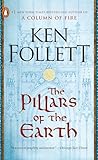
Ken Follett spent the first twenty-five years of his career writing international thrillers. Eye of the Needle (1978) and The Key to Rebecca (1980) established him as a reliable craftsman of spy fiction — commercially successful, tightly plotted, precisely the kind of books that sell well at airport bookshops and disappear quickly from memory. Then, in 1989, he published The Pillars of the Earth.
Nothing prepared readers for what it was. A thousand-page novel about the construction of a Gothic cathedral in medieval England, spanning three generations, with a cast of builders, monks, noblewomen, and villains operating across fifty years of English history. It was not what a thriller writer was supposed to write. It became one of the best-selling historical fiction novels ever published, and it changed both Follett’s career and the genre itself.
Follett now has two major series. The Kingsbridge series returns to the fictional English town across four novels, from the 12th century to the 17th. The Century trilogy follows five families from different countries across the entire 20th century, from the eve of World War I to the fall of the Berlin Wall. The two series are completely independent of each other — different centuries, different characters, different scales of ambition.
Where to start is unambiguous: begin with The Pillars of the Earth.
All Ken Follett Books at a Glance
| # | Title | Year | Series/Type |
|---|---|---|---|
| 1 | The Pillars of the Earth | 1989 | Kingsbridge #1 |
| 2 | World Without End | 2007 | Kingsbridge #2 |
| 3 | A Column of Fire | 2017 | Kingsbridge #3 |
| 4 | The Evening and the Morning | 2020 | Kingsbridge #0 (prequel) |
| 5 | Fall of Giants | 2010 | Century Trilogy #1 |
| 6 | Winter of the World | 2012 | Century Trilogy #2 |
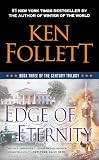
| 7 | Edge of Eternity | 2014 | Century Trilogy #3 |
Best starting point: The Pillars of the Earth — his masterwork, and the foundation of everything that follows in the Kingsbridge series.
The Kingsbridge Series Reading Order
The Kingsbridge series spans roughly 500 years of English history across four novels, each set in the same town but with entirely different casts of characters. The connection between books is the town itself, the cathedral at its centre, and the slow accumulation of history that gives later books their weight.
- The Pillars of the Earth (1989) — 12th-century England; the construction of a Gothic cathedral; Tom Builder, Jack Jackson, Prior Philip, Lady Aliena. The foundation of everything that follows.
- World Without End (2007) — 14th-century Kingsbridge, 200 years later; the Black Death and the Hundred Years War; Merthin the builder, Caris the healer. A new cast, the same cathedral.
- A Column of Fire (2017) — 16th-century Kingsbridge; the Protestant Reformation and the reign of Elizabeth I; religious persecution and espionage across Europe.
- The Evening and the Morning (2020) — A prequel set in 10th-century England, before the events of The Pillars of the Earth; the foundations of Kingsbridge itself.
The time jumps between books are substantial — 200 years between the first and second novel, another 200 between the second and third. No character appears in more than one book. The series rewards reading in order not because of plot continuity but because of cumulative resonance: by the time you reach A Column of Fire, the cathedral these characters walk past every day carries three novels’ worth of human history.
The Pillars of the Earth
The Pillars of the Earth is set in the fictional English town of Kingsbridge during the civil war known as the Anarchy — the period from roughly 1135 to 1154 when King Stephen and Empress Maud fought for the English throne. Against this backdrop of political chaos, a monk named Prior Philip dreams of building a great cathedral, a master builder named Tom Builder arrives in Kingsbridge with his family and a desperate need for work, and a nobleman’s daughter named Lady Aliena is stripped of everything she owns and has to rebuild her life entirely.
The novel spans fifty years. Tom Builder’s illegitimate son Jack Jackson becomes the master builder who shapes the cathedral in the second half of the book. Aliena becomes a wool merchant and one of the most fully realised women in popular historical fiction. Prior Philip fights the church hierarchy, the local nobility, and his own limitations to keep the building project alive. The villain, Bishop Waleran, is among the most satisfying antagonists Follett ever created — intelligent, patient, genuinely dangerous.
The cathedral itself is the novel’s central metaphor. It is a structure that requires more than one lifetime to build, that demands collaboration between people who will never see it finished, that embodies the slow and difficult work of creating something permanent in a world defined by violence and impermanence. Follett researched Gothic architecture extensively, and the descriptions of how medieval builders solved structural problems — the flying buttress, the pointed arch, the management of weight and thrust — are genuinely illuminating without ever stalling the narrative.
The length requires acknowledgment: one thousand pages is a serious commitment. The book earns it. Follett’s pacing across that length is one of his great technical achievements — the novel never drags, because each section introduces new complications and new characters while advancing the construction of the cathedral by another generation. By the end, readers who started with mild curiosity about medieval stonemasons often report that they found themselves genuinely moved. The scope justifies the scale.
World Without End
World Without End returns to Kingsbridge 200 years after the events of The Pillars of the Earth. The cathedral Tom Builder and Jack Jackson gave their lives to build is now the oldest structure in town, a permanent presence in a world that has changed entirely.
The novel is set in the 14th century, and Follett chooses the bleakest possible moment: the arrival of the Black Death in England (1348), against the background of the Hundred Years War with France and the ongoing power struggle between the town’s merchants and its priory. The central characters are Merthin, a brilliant builder who cannot get the guild to accept his innovative designs, and Caris, an intelligent woman who is drawn to medicine in a century that will not permit women to practice it. Their relationship — complicated by ambition, circumstance, and the fundamental incompatibility of their respective freedoms — is the emotional spine of the novel.
Where The Pillars of the Earth is about building, World Without End is about knowledge — specifically, about what it costs to know things that the institutions around you refuse to accept. Caris’s medical discoveries are correct, and the reader knows it, and watching her work within a system designed to prevent her from implementing them creates a sustained, low-grade frustration that Follett manages brilliantly. The Black Death sequences are among the most affecting in his work.
The novel stands alone as a reading experience. The characters have no blood connection to the characters of The Pillars of the Earth, and the plot requires no prior knowledge. But readers who know the earlier book bring something to it: they know the cathedral these characters take for granted, they know what it cost to build it, and that knowledge changes what the building means when it appears in scenes of plague and war.
Fall of Giants and the Century Trilogy
Fall of Giants is the first volume of the Century trilogy, and it represents the most ambitious project Follett has undertaken. The premise: five families from five countries — Welsh, English, Russian, German, and American — whose lives intersect across the defining events of the 20th century. Each volume covers roughly twenty years. The trilogy, taken together, is a 3,000-page panorama of the century.
Fall of Giants covers 1911 to 1924. The decade it centres on — the buildup to World War I, the war itself, the Russian Revolution, the Paris Peace Conference — was arguably the most consequential in modern history, and Follett handles it at full scale. The Welsh characters are miners; their working conditions and the early Labour movement give the novel its social grounding. The English characters include an aristocratic family navigating the end of their class’s dominance. The Russian characters are caught in the Revolution from both sides — one a Bolshevik, one a member of the nobility. The German characters are soldiers who discover that the war they were told would be brief and glorious is neither.
At 985 pages, Fall of Giants is nearly as long as The Pillars of the Earth, and it earns its length by the same method: the scale of what it is covering genuinely requires space. The suffragette movement, the trenches of the Western Front, the collapse of the Tsar’s government, Woodrow Wilson’s failed attempt to create a lasting peace — these are not subjects that can be handled adequately in a short book. Follett keeps the family threads moving even when the historical events around them are demanding all the attention.
The Century trilogy must be read in order. Unlike the Kingsbridge series, the families here carry their histories forward across all three volumes — the children and grandchildren of the characters in Fall of Giants appear in the later books, and understanding who they are depends on knowing what happened to their parents. Winter of the World (2012) covers World War II; Edge of Eternity (2014) covers the Cold War from the Berlin Wall to its fall. Neither is currently in this catalogue, but both are essential completions of the project.
Follett vs. Other Historical Fiction
The most useful comparisons position Follett not as the best historical fiction writer but as a specific kind — the most panoramic.
Hilary Mantel’s Wolf Hall trilogy focuses on a single decade at the English court with forensic psychological depth. Mantel gives you one man’s interiority — Thomas Cromwell’s — rendered with extraordinary precision. Follett gives you five families across a century, rendered with enough depth to follow but calibrated for breadth rather than intimacy. These are different projects and should be judged as such. Mantel is the finer literary stylist; Follett covers more ground.
Bernard Cornwell builds adventure series — the Sharpe novels, the Saxon Stories — that are tightly plotted, driven by a single protagonist’s experience of historical events. His books are consistently excellent at the level of action and narrative momentum. Follett’s books sacrifice some of that momentum for structural ambition: he is building civilizations, tracking how societies change across generations, using fiction to make historical processes visible. The result is occasionally slower than Cornwell, and consistently larger in scope.
Where Follett is genuinely without peer is in the combination of popular accessibility and historical scale. No other writer working in mainstream historical fiction has attempted to cover as much ground as the Century trilogy and kept the books readable. The achievement is architectural, in the same sense the cathedral in The Pillars of the Earth is architectural: the structure is the point.
The TV Adaptations
Both of the first two Kingsbridge novels have been adapted for television, and both adaptations are worth watching after reading the books.
The Pillars of the Earth was adapted as an eight-part miniseries in 2010, produced under Ridley Scott’s banner and starring Ian McShane as Bishop Waleran, Matthew Macfadyen as Tom Builder, Eddie Redmayne as Jack Jackson, and Hayley Atwell as Aliena. The series compresses the novel’s fifty years into eight hours with reasonable fidelity to the major plot lines. McShane’s performance as Waleran is the series’ standout element; the production design renders the cathedral construction sequences with genuine care.
World Without End followed as an eight-part miniseries in 2012, with Cynthia Nixon as Caris and Tom Wlaschiha as Merthin. It covers the novel’s central narrative — the Black Death, Caris’s medical work, the builder’s guild conflict — with some simplification of the supporting cast. Both series are available on streaming platforms in most territories.
Fall of Giants has no confirmed screen adaptation as of this writing. The scale of the Century trilogy — five families, three countries of primary focus, 65 years of history in the first volume alone — presents production challenges that have apparently not yet found a satisfactory solution.
As with any adaptation, the books come first. Follett’s novels work at a length that television cannot fully replicate; what gets compressed is usually the historical texture that makes the personal stories meaningful.
For the Best Historical Fiction
For the definitive guide to historical fiction — from Ken Follett and Hilary Mantel to Kristin Hannah and Anthony Doerr — see our Best Historical Fiction Books list.
More Historical Fiction Reading Guides
- Wolf Hall Books in Order: Hilary Mantel’s Cromwell Trilogy
- Shōgun: The Book Behind the Emmy-Winning FX Series
Also Recommended
For the full Ken Follett bibliography, reviews, and biography, visit the Ken Follett author page on Editors Reads.
Affiliate disclosure: Links on this site are affiliate links. We earn a small commission at no extra cost to you. This does not influence our editorial recommendations.
Frequently Asked Questions
What order should I read Ken Follett books?
For the Kingsbridge series: The Pillars of the Earth first (it's the foundation), then World Without End, then A Column of Fire and The Evening and the Morning (not in this catalog). For the Century trilogy: Fall of Giants, Winter of the World, Edge of Eternity — in order. The two series are completely independent.
Do I need to read The Pillars of the Earth before World Without End?
They are set in the same town (Kingsbridge) but 200 years apart with entirely different characters. World Without End works as a standalone. However, reading The Pillars of the Earth first enriches the experience — you know the cathedral these characters live with, the legacy of the builders.
How long is The Pillars of the Earth?
The Pillars of the Earth is approximately 1,000 pages — one of the longest popular historical fiction novels. It covers 50 years of cathedral construction in medieval England. The length is earned: it is one of the most immersive reading experiences in the genre.
What is the Century trilogy about?
The Century trilogy follows five families from different countries across the 20th century — from the buildup to World War I through the fall of the Berlin Wall. Fall of Giants covers WWI; Winter of the World covers WWII; Edge of Eternity covers the Cold War. The trilogy connects families across generations and continents.
Are Ken Follett books appropriate for younger readers?
The Pillars of the Earth and World Without End contain explicit violence (including sexual violence) and adult content consistent with their medieval settings. The Century trilogy contains wartime violence and adult content throughout. Both series are for adult readers.