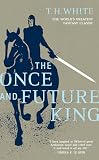
Editors Reads Verdict
White's four-part Arthurian retelling is the twentieth century's definitive version of the legend — humane, funny, melancholy, and ultimately among the most moving meditations on idealism, power, and the impossibility of perfect justice ever written.
What We Loved
- The Sword in the Stone section, in which Merlin educates young Arthur by turning him into various animals, is among the most original and delightful sequences in all of fantasy
- The novel's emotional range is extraordinary: it is genuinely funny, genuinely sad, and genuinely wise
- White's Lancelot — the greatest knight who is also the greatest sinner — is the most psychologically complex character in Arthurian literature
Minor Drawbacks
- The four books are uneven in tone and length; some readers find the later, darker sections difficult after the lightness of The Sword in the Stone
- White's digressions — on hawking, on medieval weaponry, on political philosophy — interrupt the narrative with a frequency that some readers find charming and others find frustrating
- The tragic arc of the later books requires investment in characters whose doom is apparent long before it arrives
Key Takeaways
- → Might for Right — Arthur's attempt to make power serve justice — is a noble ideal that real human nature may be unable to sustain
- → The Round Table fails not because the idea was wrong but because the people were human
- → Merlin's backwards life — he knows the future because he has already lived it — is one of literature's most poignant treatments of foreknowledge and helplessness
| Author | T.H. White |
|---|---|
| Publisher | Ace Books |
| Pages | 639 |
| Published | May 1, 1987 |
| Language | English |
| Genre | Fantasy, Historical Fiction, Literary Fiction |
| Difficulty | Intermediate |
| Best For | Readers of fantasy and literary fiction; those who love the Arthurian legends and want the finest twentieth-century treatment; fans of Jonathan Strange & Mr Norrell or Piranesi who want something epic in scope. |
How The Once and Future King Compares
The Once and Future King at a glance against 3 similar books readers weigh alongside it.
| Book | Author | Rating | Best for |
|---|---|---|---|
| The Once and Future King (this book) | T.H. White | ★ 4.3 | Readers of fantasy and literary fiction |
| Circe | Madeline Miller | ★ 4.5 | Readers who love Greek mythology, feminist literary fiction, beautiful prose, |
| Jonathan Strange and Mr Norrell | Susanna Clarke | ★ 4.2 | Literary fiction readers willing to engage with fantasy on its own terms, |
| The Lord of the Rings | J.R.R. Tolkien | ★ 4.9 | Fantasy readers of all kinds, Peter Jackson film fans ready to experience the |
The Sword in the Stone: Merlin’s Education
The first book begins in a minor English castle where a boy called Wart — Arthur, though he does not know who he is yet — lives as the foster brother of Kay, the son of a minor knight. Wart is cheerful, unpretentious, curious about everything, and largely ignored by the adults around him. Then Merlin arrives, backward-living, chaotic, genuinely ancient, and takes on the boy’s education. Merlin’s method is transformation: he turns Wart into a series of animals — a perch in a castle moat, a merlin (the hawk), an ant, a wild goose, a badger — each experience designed to teach something that books cannot. The fish-world reveals the nature of absolute power, cold and indifferent. The ant colony reveals the horror of a society organized entirely around war and efficiency, with no room for individual thought. The geese, migrating without borders or flags, suggest what a world without nationalism might feel like. Each transformation is both an adventure and a lesson, and White renders them with a naturalist’s precision and a comic novelist’s timing.
What makes the section extraordinary, beyond the animal sequences, is White’s invention of an anachronistic England — a medieval world in which Merlin quotes Freud, worries about things that haven’t been invented yet, and carries the knowledge of all history in his backwards-experienced mind. The comedy this produces (Merlin cannot remember which century he is in) coexists with its melancholy implication: he knows exactly what is going to happen to Arthur and cannot prevent any of it. When Wart pulls the sword from the stone, it is not a moment of triumph. He does it by accident, searching for a sword for Kay before a tournament, not knowing what the stone is. It is the most humanizing version of the scene in all Arthurian literature.
The Round Table and Its Failure
Arthur’s great idea, as king, is simple to state and impossible to achieve: to replace Might Makes Right with Might for Right — to take the violence that is the natural condition of knighthood and harness it in the service of justice rather than mere power. The Round Table is the institutional expression of this idea, a community of knights bound to use their strength to protect the weak rather than to prey on them. For a time, it works. The roads become safer. The barons are brought to heel. England is, imperfectly, governed.
Into this comes Lancelot: the greatest knight in the world, and White’s most remarkable creation. Lancelot is great not despite his self-hatred but because of it. He believes himself ugly and sinful, and this conviction drives him to achieve things that a man comfortable with himself would never attempt. He is capable of miracles — literally, in White’s telling — because he needs the grace those miracles represent more than any comfortable man needs anything. His love for Guinevere is both the most human thing about him and the source of his greatest sin: it means he cannot be what his greatness requires, cannot remain in the state of grace that allows him to perform the impossible. White refuses to simplify this into villainy. The Round Table does not fail because Lancelot and Guinevere are bad people. It fails because they are human, and because the institutional structure Arthur built could not accommodate human passion without cracking.
The Candle in the Wind
The final section finds Arthur old, Camelot collapsing around him, Mordred’s conspiracy successful and the last battle unavoidable. Lancelot is in France. Guinevere is in a convent. The Round Table that was the twentieth century’s best idea — White’s Arthur is unmistakably a twentieth-century figure, responding to the wars White himself had lived through — is finished. On the eve of what will be his last battle, Arthur encounters a young page named Tom of Newbold Revell, and they talk through the night.
Tom is Thomas Malory, who will grow up to write Le Morte d’Arthur from prison, and Arthur knows this, or senses it. He sends the boy away before the battle begins: go home, he says, and remember. Remember the Round Table, the attempt, the idea that force might be made to serve justice rather than merely the strong. The ending is White’s most profound invention. Arthur does not go to battle believing he will win. He goes knowing he will not. But the idea — the candle he has lit in a dark time — will outlast him, and the novel itself, in your hands, is the vehicle through which it has outlasted him. The title’s meaning crystallizes: the legend that Arthur did not die but sleeps beneath a hill, to return when Britain needs him, is not a fairy tale about resurrection. It is a statement about ideas: they do not die with the people who hold them.
White’s Strange and Solitary Genius
T.H. White wrote The Once and Future King across more than two decades, and the seams of that long composition are part of what makes it singular. The Sword in the Stone appeared first, in 1938, as an apparently self-contained children’s book, and its lightness and comic invention reflect that origin; White revised it substantially when he folded it into the larger work, darkening its anachronistic jokes about war and tyranny as the shadow of the actual war he was living through fell across the project. The later books — The Queen of Air and Darkness, The Ill-Made Knight, and The Candle in the Wind — grow progressively graver, and the four together were finally published as a single volume in 1958. A fifth book, The Book of Merlyn, written during the war but rejected by his publisher, appeared only posthumously in 1977 and makes the pacifist argument latent in the rest explicit.
White himself was an eccentric and frequently unhappy man — a schoolmaster turned recluse, a passionate falconer and fisherman whose enthusiasms saturate the novel’s loving digressions, and a writer who poured his own loneliness and his horror of human cruelty into the Arthurian material. Knowing something of him helps explain why the book is unlike any other treatment of the legend: its tenderness toward damaged people, its hatred of organised violence, and its conviction that the only cure for “Force” is education are all deeply personal. He drew his framework from Sir Thomas Malory’s fifteenth-century Le Morte d’Arthur, but he read Malory the way a novelist reads a beloved predecessor, filling the silences with psychology Malory never supplied.
A Foundational Influence on Modern Fantasy
The reach of The Once and Future King through later culture is hard to overstate. It supplied the basis for two very different popular works: Disney’s 1963 animated film The Sword in the Stone, which took the comic first book to a mass audience, and the Lerner and Loewe musical Camelot, which dramatised the tragic later material and lent its name, through President Kennedy’s admirers, to an entire mythology of his administration. Beyond the adaptations, White’s humane, melancholy, ironising approach to myth became one of the templates by which the twentieth century reimagined legend, and generations of fantasy writers — including J.K. Rowling, whose debt to White’s wise, exasperating Merlyn and to the schoolboy-Arthur of the early book is frequently noted — absorbed its lessons. It is one of the books that taught the genre that a fantasy could be funny and devastating at once, and that the old stories were worth retelling only if the retelling had something true to say about power.
How to Read It Today
A first-time reader should know what kind of journey the four books constitute. The Sword in the Stone is a delight that can be handed to a child; the volumes that follow are increasingly adult, increasingly sorrowful, and demand patience with White’s habit of pausing the narrative for an essay on hawking, heraldry, or the philosophy of war. Readers who come expecting the brisk plotting of contemporary fantasy may find the digressions trying; readers willing to move at White’s pace will find them among the book’s chief pleasures. The reward for staying the course is one of literature’s most moving meditations on idealism and its limits — a Camelot that fails not because its founder was foolish but because human beings are human. It rewards the reader who loves character and idea above incident, and it pairs naturally with other ambitious, melancholy fantasies that treat magic as a vehicle for moral seriousness rather than mere spectacle.
Our rating: 4.3/5 — The twentieth century’s definitive Arthurian retelling, and one of the most humane novels in all of fantasy literature.
Frequently Asked Questions
What is "The Once and Future King" about?
T.H. White's retelling of the Arthurian legends follows Arthur from his education by the wizard Merlin — who lives backwards through time — through the founding of the Round Table, the love triangle with Lancelot and Guinevere, and the final destruction of Camelot.
Who should read "The Once and Future King"?
Readers of fantasy and literary fiction; those who love the Arthurian legends and want the finest twentieth-century treatment; fans of Jonathan Strange & Mr Norrell or Piranesi who want something epic in scope.
What are the key takeaways from "The Once and Future King"?
Might for Right — Arthur's attempt to make power serve justice — is a noble ideal that real human nature may be unable to sustain The Round Table fails not because the idea was wrong but because the people were human Merlin's backwards life — he knows the future because he has already lived it — is one of literature's most poignant treatments of foreknowledge and helplessness
Is "The Once and Future King" worth reading?
White's four-part Arthurian retelling is the twentieth century's definitive version of the legend — humane, funny, melancholy, and ultimately among the most moving meditations on idealism, power, and the impossibility of perfect justice ever written.
Ready to Read The Once and Future King?
Check the current price on Amazon.
Check Price on Amazon (paid link)Prices and availability are subject to change. See Amazon for current price.
Review last updated: