Where to Start with Simon Sinek: A Reading Guide
Where to start with Simon Sinek — whether to begin with Start With Why or Leaders Eat Last. A complete reading guide to the leadership thinker and bestselling author.
By Marcus Webb

Simon Sinek (born 1973) is the British-American author, speaker, and organisational consultant who — with Start With Why (2009) and the accompanying TED talk ‘How Great Leaders Inspire Action’ — introduced the Golden Circle framework to a global business audience and became one of the most influential leadership thinkers of his generation. His talk is among the top five most-watched TED talks of all time; his books have sold over four million copies worldwide. He is the founder of The Optimism Company and is primarily known for his argument that purpose-driven leadership and organisational culture produce better outcomes than performance-driven approaches.
Where to Start: Start With Why (2009)
The essential Sinek — and the book that introduced the Golden Circle to popular business thinking. The question Sinek asks is deceptively simple: why do some organisations inspire loyalty and others don’t? Why can Apple sell a computer, a phone, a music player, and a tablet and have customers queue for each one, while perfectly competent competitors release technically superior products that no one cares about?
Sinek’s answer is the Golden Circle: Apple communicates from the inside out — their why (‘we believe in challenging the status quo and thinking differently’) produces a how (‘beautifully designed and intuitive products’) and a what (‘computers, phones, music players’). Most companies communicate from the outside in: here’s what we make, here’s how we make it, here is, occasionally, why. The neurological argument: the outer ring of the circle corresponds to the neocortex (rational analysis); the inner rings correspond to the limbic system (emotion, trust, decision-making). Purpose-led communication bypasses rational objection and creates genuine belief.
Sinek applies the framework to Martin Luther King’s civil rights leadership, the Wright Brothers versus Samuel Langley (who had more funding and better technical resources), and Sinek’s own career. The argument is clear, the examples are vivid, and the TED talk provides a free preview of the central concept in eighteen minutes.
Leaders Eat Last (2014)
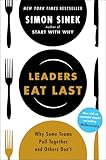
Sinek’s organisational culture book — the Golden Circle applied to what great leaders actually do, rather than what they believe. The title comes from a practice in the Marine Corps where officers eat after the enlisted, a small but significant signal of priorities. The argument: the most effective organisations are those where people feel safe — where they are protected by the hierarchy rather than threatened by it, where collaboration and risk-taking are rewarded rather than punished. The neuroscience of trust, loyalty, and collaboration provides the framework; case studies from the military, business, and politics provide the illustration.
Best read after Start With Why; it extends and deepens the earlier argument.
Why Start With Why Is the Ideal First Book
For a reader new to Simon Sinek, Start With Why is the ideal first book because it is his breakthrough work and the fullest expression of his influential central idea, the power of purpose in leadership and success. Start With Why presents Sinek’s famous argument that the most inspiring and successful leaders and organizations start not with what they do or how they do it but with why, with a clear sense of purpose and belief that inspires others to follow. As an entry point, it is ideal because it lays out this influential and clarifying idea directly and compellingly, offering a powerful framework for understanding leadership, inspiration, and lasting success. It welcomes the newcomer with its clear central principle, its compelling examples, and its inspiring message, challenging the reader to clarify their own why. It is his best-known book and the one that best represents his thinking, so that the new reader encounters Sinek’s central idea from the first. For the newcomer, then, Start With Why is the natural and ideal starting point, the influential book that teaches the power of purpose.
What to Expect as a New Reader
As a new reader, you can expect Start With Why to be a clear, compelling, and influential book on leadership and purpose, built around a single powerful idea. You can expect Sinek’s central idea, captured in his famous framework, that the most inspiring and successful leaders and organizations start with why, with a clear sense of purpose and belief, rather than with what they do or how they do it. You can expect a clarifying argument, for Sinek argues that purpose, the why, is the source of genuine inspiration, loyalty, and lasting success, and that starting with why distinguishes the truly inspiring from the merely competent. You can expect compelling examples, for Sinek illustrates his idea with vivid cases of leaders and organizations that have inspired through purpose. You can expect an inspiring and motivating message about the power of purpose and belief. Expect, in short, a clear, compelling, and influential book on leadership and purpose, an inspiring introduction to Sinek’s idea of starting with why.
Going Deeper After Your First Book
Once Start With Why has introduced you to Sinek’s idea of purpose, the reader who wishes to go deeper can explore his other work, which extends his thinking on leadership, trust, and what makes organizations and people thrive. His other books address such subjects as the leadership that creates trust and safety and inspires people to give their best, and the mindset of playing the long game in business and life, building on his foundational concern with purpose and inspiration. Reading these after Start With Why deepens your engagement with Sinek’s thinking on leadership, purpose, trust, and lasting success. His characteristic concern with purpose, inspiration, and what makes people and organizations thrive runs through his work, and the reader who has found Start With Why clarifying will find the same thinking in his other books. Building your reading journey through Sinek’s work is a matter of following his thinking on leadership and purpose from his foundational idea into his further work. The reader who begins with Start With Why and continues through his work will find a consistent and inspiring guide to leadership, purpose, and what makes people and organizations thrive.
Reading Simon Sinek
Sinek’s books are best understood as accessible frameworks for thinking about leadership, purpose, and culture — entry-level resources for readers new to organisational psychology and leadership thinking, illustrated through vivid examples rather than academic research. Begin with Start With Why for the foundational concept; read the TED talk first if you want a free, brief introduction. Move to Leaders Eat Last for the practical application to organisational culture.
Frequently Asked Questions
Where should I start with Simon Sinek?
Start With Why (2009) is the essential starting point — Sinek's foundational book and the argument that organisations that articulate their purpose clearly (their 'why') attract more loyal customers, employees, and partners than those that communicate primarily through features and pricing. The argument is built around the Golden Circle framework (why, how, what), illustrated through the example of Apple, and draws on neuroscience to explain why purpose-led communication is more neurologically compelling than feature-led communication. Leaders Eat Last is the best follow-up, extending the argument into organisational culture and leadership responsibility.
What is the Golden Circle?
The Golden Circle is Sinek's central framework, introduced in Start With Why: three concentric circles representing 'why' (the innermost, representing purpose or cause), 'how' (the middle, representing the specific approach that enables the why), and 'what' (the outermost, representing the actual products or services). Most organisations communicate from the outside in — what they do, then how, rarely why. The most inspiring organisations and leaders communicate from the inside out — starting with why, then how, then what. Sinek argues that this order resonates with the limbic brain (responsible for emotion and decision-making) rather than the neocortex (responsible for rational analysis), making purpose-led communication inherently more persuasive.
What is Leaders Eat Last about?
Leaders Eat Last (2014) extends Sinek's purpose framework into organisational culture and leadership responsibility. The title comes from a Marine Corps practice: officers eat last, after the troops. The argument: great leaders create environments where people feel safe, where they are willing to take risks and collaborate, and where the organisation functions as a social unit rather than a collection of self-interested individuals. Sinek draws on anthropology, neuroscience, and organisational case studies to argue that the most effective leadership is fundamentally about creating the conditions for others to do their best work, not about personal performance.
Are Sinek's books accessible without business background?
Sinek's books are explicitly designed for a general leadership and management audience, not academic specialists. Start With Why is written for anyone who leads or wants to understand leadership — it requires no business education and uses consumer examples (Apple, Southwest Airlines, Martin Luther King Jr.) that general readers recognise. Leaders Eat Last is slightly more oriented toward managers and executives but is equally readable for non-specialists. Sinek's TED talk 'How Great Leaders Inspire Action', based on Start With Why, is among the most-watched TED talks in history and provides a free 18-minute introduction to the central argument.