Where to Start with Mike Michalowicz: A Reading Guide
Where to start with Mike Michalowicz — how to approach Profit First, his cash management system for small businesses that reverses the accounting formula to force profitability. A complete reading guide.
By Marcus Webb
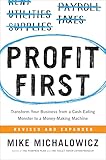
Mike Michalowicz is an American entrepreneur and business author who built and sold two companies before going broke — an outcome that led him to examine why so many business owners who appear successful on paper consistently run out of cash. Profit First: Transform Your Business from a Cash-Eating Monster to a Money-Making Machine was first published in 2014, substantially revised in 2017, and has since become one of the most widely implemented cash management systems for small businesses in North America.
Where to Start: Profit First (2014)
The essential Mike Michalowicz — and the most practically actionable business finance book for small business owners. Profit First begins with a diagnosis that most business owners recognise immediately: the business makes money, but there is never any cash. Revenue goes up; the bank account stays empty or goes down. Expenses find a way to absorb every dollar of additional revenue. Profit, if it appears at all, appears as an afterthought — the residual after everything else has been paid.
Michalowicz’s explanation draws on Parkinson’s Law: expenses expand to fill the resources available for them. If you have $100,000 available for operating expenses, your operating expenses will grow to consume $100,000. If you have $80,000 available, they will find a way to cost $80,000. This is not a failure of discipline — it is a consistent and predictable human and organisational tendency. Systems that rely on willpower to resist this tendency fail; systems that change the structure of what is available succeed.
The formula reversal is the book’s central mechanism. Standard accounting teaches:
Sales − Expenses = Profit
In this formula, profit is whatever remains after all expenses have been paid. Since Parkinson’s Law ensures expenses expand to consume available resources, what remains is usually nothing — or a number too small to matter.
Michalowicz replaces this with:
Sales − Profit = Expenses
In this formula, profit is the first allocation from any deposit, taken immediately before expenses are paid. The remaining amount — sales minus the predetermined profit percentage — is all that is available for operating expenses. This constraint forces efficiency rather than hoping for it.
The implementation uses five bank accounts:
Income is where all revenue lands. Nothing is spent from this account — it is a holding account only. On pre-determined transfer dates (typically twice a month), deposits are allocated from Income to the other four accounts.
Profit receives a percentage of each income deposit — starting small (even 1%) and increasing over time. This account is not an operating reserve; it is off-limits except for a quarterly distribution. The discipline of not touching it is the system’s core commitment.
Owner’s Pay covers the owner’s salary. Many small business owners pay themselves irregularly and from whatever is available — a practice that makes it impossible to measure business profitability accurately.
Tax reserves the owner’s tax liability. Michalowicz recommends allocating 15–30% of profit for taxes, held separately to prevent the shock of a tax bill that must be paid from operating funds.
Operating Expenses receives the remainder — all that is available to run the business. The Parkinson’s Law mechanism works in reverse here: with less available, the business finds ways to operate on less.
The target allocation percentages Michalowicz provides are calibrated by revenue level and are meant to be moved toward over time rather than implemented immediately. A business generating $250,000 in annual revenue has different target percentages than one generating $2 million.
The system is immediately actionable. Unlike structural business changes that require months to implement, Profit First can be set up in a single afternoon — open the accounts, configure the allocations, commit to the twice-monthly transfer discipline. The results take months to fully manifest but begin immediately.
Why Profit First Is the Ideal First Book
For a reader new to Mike Michalowicz, Profit First is the ideal first book because it is his most popular work and the fullest expression of his distinctive contribution, a simple, behavior-based system for making a business consistently profitable. Profit First presents Michalowicz’s method of taking profit first, allocating money to profit before expenses rather than hoping for what is left over, using a system of accounts to build profitability into the business. As an entry point it is ideal, for it is his best-known book and a clear statement of his system. It welcomes the newcomer with its memorable central idea, its practical system, and its accessible style, drawing the reader into a new way of managing business finances. It is his most important work and the one that best represents his thinking, so the new reader encounters Michalowicz’s system directly. For the newcomer running a business, then, Profit First is the natural and ideal starting point.
What to Expect as a New Reader
As a new reader, you can expect Profit First to be a practical, behavior-based, and accessible guide to business profitability. You can expect a memorable central idea, taking profit first, allocating money to profit before expenses rather than hoping for what remains. You can expect a system of accounts, for Michalowicz lays out a method of dividing money into separate accounts to build profitability into the business. You can expect a behavioral approach, for the system is designed to work with human psychology and habits. You can expect practical, actionable guidance for small-business owners. You can expect an accessible, engaging, and motivating style. You can expect a focus on making a business consistently profitable. Expect, in short, a practical, behavior-based, and accessible guide to business profitability, a fine introduction to Michalowicz’s system.
Going Deeper After Your First Book
Once Profit First has introduced you to Michalowicz’s system, the reader who wishes to go deeper can explore his other books, which apply the same practical, behavior-based, accessible approach to further aspects of building and running a business. His other works address subjects such as systematizing a business so it can run without the owner, finding the one key metric that drives a business, marketing, and the entrepreneurial journey, each marked by his memorable frameworks and his accessible style. Reading these after Profit First deepens your engagement with Michalowicz’s distinctive contribution, the practical, behavior-based systems for building a better business. His characteristic approach runs through his work, and the reader who has valued Profit First will find it across his books. Building your reading journey from Profit First is a matter of following his systems into his other books. The reader who begins here will have a practical foundation for building a profitable, well-run business.
Reading Mike Michalowicz
Profit First is Michalowicz’s most widely implemented and practically transformative book. It stands alone and requires no prior financial accounting knowledge.
For the full Mike Michalowicz bibliography, reviews, and biography, visit the Mike Michalowicz author page on Editors Reads.
Affiliate disclosure: Links to Amazon on this page are affiliate links. We earn a small commission at no extra cost to you.
Frequently Asked Questions
Where should I start with Mike Michalowicz?
Profit First: Transform Your Business from a Cash-Eating Monster to a Money-Making Machine (2014, revised 2017) is Michalowicz's essential book — a cash management system built on a single insight: profit cannot be what remains after expenses because expenses will always expand to consume whatever remains. Profit must be the first allocation from revenue, taken before expenses are paid. The most practically transformative business finance book for small business owners.
What is Profit First about?
Profit First reverses the standard accounting formula from Sales − Expenses = Profit to Sales − Profit = Expenses. In practice, this means setting up five bank accounts (Income, Profit, Owner's Pay, Tax, Operating Expenses) and allocating percentages from each deposit to each account before any operating expenses are paid. By constraining the operating account, owners are forced to cut expenses and improve efficiency rather than using available cash as an excuse for continued unprofitability.
Is Profit First suitable for all business types?
Profit First works best for service businesses with relatively direct revenue-to-cash conversion. Product businesses with significant inventory, cost of goods sold, and manufacturing complexity require adaptation — the allocation percentages and account structure need adjustment to account for cash tied up in inventory. Michalowicz acknowledges this and provides guidance for different business models, but the system requires more customisation for product businesses than for service businesses.
What should I read after Profit First?
After Profit First, Michael Gerber's The E-Myth Revisited addresses the structural reasons small businesses fail — the distinction between working in your business and working on it — that underlies many of the cash flow problems Profit First solves. Gino Wickman's Traction covers the Entrepreneurial Operating System, a comprehensive framework for running a small business that complements Profit First's financial focus with operational and leadership structure.