Where to Start with Michael E. Gerber: A Reading Guide
Where to start with Michael E. Gerber — how to approach The E-Myth Revisited, his classic diagnosis of why most small businesses fail and how to build a business that works without depending entirely on its owner. A complete reading guide.
By Marcus Webb
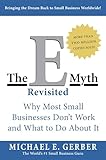
Michael E. Gerber (born 1936) is an American small-business consultant, speaker, and author who spent decades working with entrepreneurs across virtually every industry before writing The E-Myth Revisited (1995). The book is a diagnosis based on that consulting experience: a systematic account of why most small businesses fail, built around a conceptual framework that identifies the core problem most business owners share regardless of their industry or the quality of their technical skills. It has sold over four million copies and remains the most widely read book on the structural challenges of small business ownership.
Where to Start: The E-Myth Revisited (1995)
The essential Michael E. Gerber — and the most important book a small business owner can read before making the most common and costly mistakes. The E-Myth Revisited opens with a story that most readers who have started or considered starting a business will recognise immediately: a person who is very good at something — baking, accounting, plumbing, consulting — decides to start a business doing it. They believe that being excellent at the work qualifies them to run the business. They are wrong.
The E-Myth is Gerber’s name for this belief: the Entrepreneurial Myth, the assumption that technical skill at a craft and entrepreneurial skill at building a business are the same thing. They are not. The skills that make a baker excellent at baking — attention to ingredients, technique, sensory precision — are entirely different from the skills required to run a bakery: hiring, training, managing cash flow, systematising operations, marketing, and building processes that produce consistent results regardless of which staff member is on duty. The talented baker who opens a bakery often discovers, within a year, that they have traded a job they loved for a job they hate, working longer hours for less money with no one to blame.
The three-role framework is the book’s most useful analytical tool. Gerber argues that every business owner must perform three distinct functions, which he personifies as the Technician (who does the work), the Manager (who creates order and manages systems), and the Entrepreneur (who envisions possibilities and builds the future). Most small business owners are Technicians first and last — they started the business to do the work they are good at, and they spend their days doing it, while the management and strategic functions that would allow the business to grow are left undone or done badly.
The franchise prototype is Gerber’s prescription: build your business as if you intended to replicate it exactly — not because you intend to franchise, but because this discipline forces the right kind of thinking. When Gerber’s clients ask themselves “if a thousand identical businesses were built on this model, would each one produce consistent results?”, they must document processes, define standards, create training systems, and build operations that do not depend on any single individual’s knowledge or presence. This is not the intuitive way most business owners work. It is the way that produces a business rather than a job.
The book is written as a parable — following Gerber’s consulting relationship with a baker named Sarah — which makes the conceptual framework concrete and the prose unusually readable for a business book. The narrative structure is occasionally criticised for slowing the pace, but for most readers it is what makes the ideas stick.
Why The E-Myth Revisited Is the Ideal First Book
For a reader new to Michael E. Gerber, The E-Myth Revisited is the ideal and essential first book because it is his landmark work, a classic of small business, and the fullest expression of his distinctive, influential ideas about why most small businesses fail and how to build one that works. The E-Myth Revisited argues that most small businesses fail because their owners work in their business rather than on it, and offers a systematic approach to building a business that can run without depending entirely on the owner. As an entry point it is essential, for it is his defining book and the comprehensive statement of his philosophy. It welcomes the newcomer with its memorable central insight, its practical guidance, and its accessible style, drawing the reader into a new way of thinking about small business. It is his most important work and the one that best represents his thinking, so the new reader encounters Gerber’s approach directly. For the newcomer building or running a small business, then, The E-Myth Revisited is the natural and ideal starting point.
What to Expect as a New Reader
As a new reader, you can expect The E-Myth Revisited to be a clear, practical, and influential book about building a small business that works. You can expect a central insight, that most small businesses fail because their owners work in the business, doing the technical work, rather than on the business, building it as a system. You can expect the entrepreneurial myth, the e-myth itself, that most businesses are started by entrepreneurs, when in fact many are started by technicians who underestimate what running a business requires. You can expect a systematic approach, for Gerber advocates building a business that can run on consistent systems rather than depending entirely on the owner. You can expect practical guidance and a memorable framework. You can expect an accessible, story-driven style. Expect, in short, a clear, practical, and influential book about building a small business that works, the essential introduction to Gerber’s ideas.
Going Deeper After Your First Book
Once The E-Myth Revisited has introduced you to Gerber’s ideas, the reader who wishes to go deeper can explore his other books, which apply his e-myth philosophy and his systematic approach to particular kinds of business and to further aspects of building a company. His many follow-up works extend his framework to specific professions and industries and to further dimensions of entrepreneurship and business-building, continuing his practical, systematic approach. The reader can also explore the wider literature of small business and entrepreneurship that his work helped shape. Reading more widely deepens your engagement with Gerber’s distinctive ideas, the focus on working on the business and building it as a system. His characteristic framework runs through his work, and the reader who has valued The E-Myth Revisited will find it across his books. Building your reading journey from The E-Myth Revisited is a matter of following its ideas into his other books and the wider small-business literature. The reader who begins here will have an influential and practical foundation for building a small business that works.
Reading Michael E. Gerber
The E-Myth Revisited is Gerber’s essential and most widely read book. It stands alone. Readers who want to continue should seek out The E-Myth Enterprise and Awakening the Entrepreneur Within, which extend the framework to specific business contexts.
For the full Michael E. Gerber bibliography, reviews, and biography, visit the Michael E. Gerber author page on Editors Reads.
Affiliate disclosure: Links to Amazon on this page are affiliate links. We earn a small commission at no extra cost to you.
Frequently Asked Questions
Where should I start with Michael E. Gerber?
The E-Myth Revisited: Why Most Small Businesses Don't Work and What to Do About It (1995) is Gerber's essential book — a diagnosis of the central problem facing small business owners, written after decades of consulting with entrepreneurs across industries. The E-Myth (Entrepreneurial Myth) is the belief that technical skill at a craft qualifies someone to run a business built on that craft. A brilliant baker, a gifted accountant, a skilled contractor — all face the same problem: the skills that make them excellent at their work have almost nothing to do with the skills required to build a successful business.
What is The E-Myth Revisited about?
The book argues that every small business owner must balance three fundamentally different roles: the Technician (the skilled doer), the Manager (who builds systems and maintains order), and the Entrepreneur (who envisions and builds the future). Most business owners are primarily Technicians who, after having an 'entrepreneurial seizure' — the belief that they can do what their employer does, only better — find themselves working longer hours for less reward than they did as employees. Gerber's solution is the franchise prototype: build your business as if you intend to replicate it a thousand times, documenting processes and creating systems that work without depending on specific individuals.
Is The E-Myth Revisited relevant for businesses that aren't planning to franchise?
Yes — the franchise prototype is a mental model, not a business plan. Gerber uses McDonald's as the paradigmatic example not because he is advising small bakeries to become franchises but because the McDonald's model illustrates the discipline of systematising operations: consistent results through documented processes rather than through individual heroism. The principle applies to any business of any size. The question it asks — can your business produce consistent results without depending on you specifically — is relevant to every small business owner, whether they intend to scale or simply want their business to require less of their daily attention.
What should I read after The E-Myth Revisited?
After The E-Myth Revisited, Traction by Gino Wickman provides the most systematic operating system for implementing Gerber's principles — a complete framework for setting goals, defining roles, and running a business through documented processes rather than heroic effort. Ben Horowitz's The Hard Thing About Hard Things provides the complementary account of what building a technology business actually feels like from the inside. For the sales systems that businesses built on Gerber's principles need, Chet Holmes's The Ultimate Sales Machine covers the operational side of growth.