Where to Start with Frank Herbert: A Reading Guide
Where to start with Frank Herbert — how to begin with Dune, whether to continue into the sequels, and what to read in the Dune series. A complete reading guide.
Frank Herbert (1920–1986) was the American science fiction writer who published Dune in 1965 — the best-selling science fiction novel of all time and the most ambitious work of world-building in the genre’s history. Herbert spent years researching ecology, religion, politics, and economics before writing it, and the result is a novel that operates simultaneously on multiple levels: adventure story, political thriller, ecological parable, and philosophical investigation of what happens when a superior individual is placed in a situation that demands he become a god. The novel and its sequels constitute one of science fiction’s most sustained attempts to think seriously about power, religion, and the long-term consequences of messianic leadership.
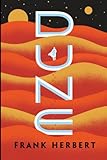
Where to Start: Dune (1965)
The only starting point — and one of the half-dozen most important novels in the history of science fiction. Paul Atreides is the son of Duke Leto, head of a noble house in an interstellar feudal empire. When the Atreides family is sent to administer Arrakis — the desert planet and sole source of spice, the most valuable substance in the universe — it is a trap, engineered by their political enemies. Paul and his mother Lady Jessica escape into the desert and take refuge among the Fremen, the desert people who have learned to survive the killing ecology of Arrakis.
The world Herbert built is unmatched in its depth: the ecology of the desert planet, the political structure of the interstellar empire, the religion and culture of the Fremen, the economics of spice — all interlocking with complete coherence. The novel is also a meditation on the dangers of the messiah figure: Herbert spent years studying history’s charismatic leaders and was suspicious of all of them. Dune is, in part, a warning about what happens when you give a genuinely superior person the tools of a god.
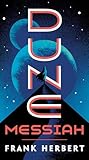
Dune Messiah (1969)
The direct sequel — and a necessary companion to the first book. Twelve years after the events of Dune, Paul Atreides rules as Emperor, his forces have swept across the known universe in a jihad that has killed billions in his name, and he is trapped inside the legend he has become. Dune Messiah is Herbert’s deconstruction of the messiah mythology he constructed in the first novel: Paul pays the full cost of the choices he made.
Shorter and darker than Dune, and better read immediately after it. The two books form a complete unit that is richer than either alone.
Children of Dune (1976)
The story continues with Paul’s children, Leto II and Ghanima, who are born with access to all the memories of their ancestors — a condition that makes them simultaneously ancient and dangerous. The novel follows the political and religious struggle surrounding the children and prepares the way for Herbert’s most extraordinary conceptual leap in the following book.
A satisfying conclusion to the immediate Paul Atreides narrative; many readers stop here.
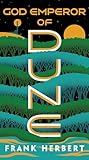
God Emperor of Dune (1981)
Herbert’s most philosophically ambitious and most unusual book — set 3,500 years after Children of Dune, in which Leto II has become a hybrid human-sandworm and has ruled the empire for 3,500 years with absolute power, conducting an experiment in human civilisation whose purpose only he understands. The novel is almost entirely dialogue and meditation; it contains almost no action.
A profound and strange book that rewards readers willing to follow Herbert into genuinely original philosophical territory. Not for everyone; essential for those who want to understand Herbert’s full argument about power and history.
Why Dune Is the Ideal First Book
For a reader new to Frank Herbert, Dune is the ideal first book because it is his masterpiece, one of the greatest science-fiction novels ever written, and the fullest expression of his distinctive gifts, the immense world-building, the political and ecological depth, and the epic, visionary storytelling. Dune is set on the desert planet Arrakis, the only source of a substance vital to the galaxy, and follows a young heir drawn into a struggle for power, survival, and destiny. As an entry point it is the natural place to begin, for it launches the Dune saga and a perfect introduction to his ambitious, immersive science fiction. It welcomes the newcomer with its immense world, its political and ecological depth, and its epic scope, drawing the reader into one of the most celebrated works of science fiction. It begins his greatest work, so the new reader meets the saga where it begins. For the newcomer, then, Dune is the natural and ideal starting point.
What to Expect as a New Reader
As a new reader, you can expect Dune to be an immense, immersive, and visionary work of science fiction. You can expect immense world-building, for Herbert creates a richly detailed universe with its own politics, religions, ecology, and history. You can expect a desert setting, for the planet Arrakis, its harsh ecology, and the substance vital to the galaxy are central to the story. You can expect political depth, for the novel is a complex tale of power, intrigue, and dynastic struggle. You can expect ecological depth, for the relationship between people and their environment is a central theme. You can expect epic, visionary storytelling, following a young heir drawn into destiny. You can expect rich themes of religion, power, and prophecy. You should expect a dense, ambitious novel that rewards immersion. Expect, in short, an immense, immersive, and visionary work of science fiction, a superb introduction to Herbert’s gifts.
Going Deeper After Your First Book
Once Dune has drawn you into its universe, the natural next step is to continue the Dune saga, following the story through its subsequent novels as the world, the politics, and the themes deepen and evolve across the series. The saga is best read in order, for it tells a sweeping, building story across its volumes, growing more ambitious and philosophical as it goes. Herbert wrote several sequels, and the universe was later expanded by other writers, though Herbert’s original novels are the heart of the saga. Beyond Dune, the reader who has enjoyed Herbert’s gifts can explore his other science fiction, which displays his interest in ecology, power, and ideas. His characteristic strengths, the immense world-building, the political and ecological depth, and the epic storytelling, run through his work. Building your reading journey through Herbert is a matter of continuing the Dune saga and exploring his wider fiction. The reader who begins here will find one of the greatest sagas in science fiction to immerse themselves in.
Reading Frank Herbert
Herbert’s Dune sequence constitutes science fiction’s most sustained philosophical meditation on power, religion, and the dangers of messianic leadership. His argument — that charismatic leaders, however brilliant, create dependencies that ultimately destroy the civilisations they build — runs through all six of his Dune novels with increasing clarity and increasing abstraction. Begin with Dune; it is one of the essential novels of the twentieth century. Read Dune Messiah immediately after. Decide then whether to continue further.
Frequently Asked Questions
Where should I start with Frank Herbert?
Dune (1965) is the only starting point — the best-selling science fiction novel of all time, the most ambitious work of world-building in the genre's history, and a book that repays re-reading indefinitely. Paul Atreides, son of the Duke of House Atreides, must navigate political intrigue, ecological disaster, and prophetic destiny on the desert planet Arrakis, the only source in the universe of spice melange — the substance that enables interstellar travel and extends human life. Dune is a complete work in itself; the sequels are for committed readers who want to follow Herbert's increasingly ambitious philosophical and political argument further.
What is Dune about?
Dune (1965) follows Paul Atreides, the teenage son of Duke Leto, as his family is sent to administer the desert planet Arrakis — the only source of spice, the most valuable substance in the universe. The posting is a trap by their political enemies; the Duke is killed and Paul and his mother Lady Jessica must take refuge among the Fremen, the desert people who have learned to survive the planet's killing ecology and who have been waiting for a messiah. The novel is simultaneously an adventure story, a political thriller, a meditation on ecology and religion, and a complex examination of what happens when a superior individual is placed in a situation that demands he become a god.
Should I read the Dune sequels?
Dune stands completely alone and is satisfying without the sequels. Dune Messiah (1969) is a direct and necessary sequel — it takes apart the messiah mythology that Dune constructed and shows Paul the consequences of the legend he has become. Children of Dune (1976) continues the story of Paul's children and is the last of the immediate sequels. God Emperor of Dune (1981), set 3,500 years later, is Herbert's most philosophically ambitious book and his most unusual: a 500-page meditation on power, religion, and history with almost no action. Many readers stop after Dune or Dune Messiah; both conclusions are legitimate.
Is Dune difficult to read?
Dune requires patience in its first 100 pages — Herbert builds an entire civilisation (ecology, politics, religion, economics, technology) and the reader must assimilate a great deal of invented terminology and political context before the story fully opens up. Persevering through the opening is necessary and worth it: by the midpoint, most readers find the world so fully realised that they cannot leave it. The sequels are progressively more demanding as Herbert's philosophical ambitions outpace his narrative ones. The two Villeneuve films are an excellent introduction to the visual world of Dune, but the book delivers depth that no film can match.