Where to Start with Chris Voss: A Reading Guide
Where to start with Chris Voss — how to approach Never Split the Difference, his essential book on FBI hostage negotiation techniques. A complete reading guide.
By Marcus Webb
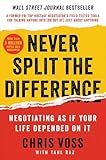
Chris Voss is a former FBI lead international kidnapping negotiator who spent twenty-four years at the Bureau, including as lead negotiator in some of the most high-profile international hostage cases of the 1990s and 2000s. After retiring from the FBI, he founded the Black Swan Group, a negotiation training consultancy, and wrote Never Split the Difference (2016) with writer Tahl Raz — a book that has become, in a crowded field, the most widely recommended negotiation text of its decade.
Where to Start: Never Split the Difference (2016)
The essential Voss — and the best negotiation book published in recent years. The central argument is a direct challenge to the dominant paradigm in negotiation theory: the Harvard Negotiation Project’s principled negotiation approach assumes rational actors who, presented with objective criteria and mutual interests, will reach optimal outcomes. Voss’s hostage negotiation experience taught him that humans are not rational actors — they are emotional, irrational, and frequently unaware of what they actually need — and that any negotiation framework built on rationality will fail as soon as genuine stakes are involved.
The alternative Voss constructs is built on tactical empathy: the ability to accurately understand the other party’s emotional state and perspective, demonstrate that understanding, and use it to move the negotiation forward. This is not manipulation but precision: if you understand what someone needs (safety, respect, control, acknowledgment) you can address that need directly rather than arguing about positions.
The specific techniques are concrete and learnable:
Mirroring — repeating the last three words of what someone says, with an upward inflection — encourages the other party to continue talking without you having to frame a question. People will fill silence; the mirror gives them room to fill it with information you need.
Labelling emotions — “It seems like you’re frustrated by this situation” — acknowledges the emotional reality before addressing the logical content. Emotions labelled become less reactive; emotions ignored become louder.
Calibrated questions — “How am I supposed to do that?” or “What would you need to see from me?” — give the other party the illusion of control while actually directing the negotiation. “Why” questions are accusatory; “how” and “what” questions are collaborative.
The power of “no” is Voss’s most counterintuitive point. Where most negotiators are trained to get the other party to say “yes” repeatedly, Voss argues that “no” is a more psychologically satisfying word — it creates a sense of safety and control, and a “no” followed by “what would you need?” is often more productive than a yes that doesn’t hold.
The hostage negotiation examples are vivid and instructive without being gratuitous. More useful are the business applications: salary negotiations, deal closings, difficult colleagues, and the specific situations where these techniques save the most money and the most relationships.
Why Never Split the Difference Is the Ideal First Book
For a reader new to Chris Voss, Never Split the Difference is the ideal and essential first book because it is his singular major work, an influential and widely read guide to negotiation, and the fullest expression of his distinctive approach. A former FBI hostage negotiator, Voss presents in Never Split the Difference the negotiation techniques he developed in high-stakes situations and translates them into practical guidance for negotiations in business and everyday life. As an entry point, it is the natural and essential place to begin, for it is Voss’s defining work, the comprehensive and practical account of his negotiation approach. It welcomes the newcomer with its compelling premise, its practical techniques, and its engaging real-world stories, drawing the reader into a practical and effective guide to negotiation. It is his singular major book and the fullest expression of his approach, so that the new reader encounters Voss’s techniques directly. For the newcomer interested in negotiation, then, Never Split the Difference is the natural and ideal starting point, the influential guide drawn from high-stakes hostage negotiation.
What to Expect as a New Reader
As a new reader, you can expect Never Split the Difference to be a practical, engaging, and effective guide to negotiation, drawn from high-stakes hostage negotiation and applied to everyday life. You can expect practical techniques, for Voss presents the negotiation methods he developed as an FBI hostage negotiator and translates them into actionable guidance for negotiations in business and life. You can expect a distinctive approach, for Voss emphasizes emotional intelligence, tactical empathy, and psychological insight over the conventional focus on rational compromise, arguing against simply splitting the difference. You can expect engaging real-world stories, for Voss illustrates his techniques with gripping accounts of high-stakes hostage negotiations and other examples. You can expect actionable methods, such as specific techniques for building rapport, gathering information, and influencing the other side. You can expect an accessible and engaging style. Expect, in short, a practical, engaging, and effective guide to negotiation drawn from high-stakes experience, a compelling introduction to Voss’s approach.
Going Deeper After Your First Book
Once Never Split the Difference has introduced you to Voss’s negotiation approach, the reader who wishes to go deeper can explore the wider literature on negotiation, influence, and communication to which his work contributes, as well as his ongoing teaching and resources, applying the techniques that his book provides. The themes of Never Split the Difference, tactical empathy, emotional intelligence, and the psychology of negotiation, connect to a broad field of negotiation, influence, and communication, and the reader drawn to these questions can pursue them further. Reading more deeply and practicing further deepens your engagement with the art of negotiation. Voss’s distinctive approach, grounded in emotional intelligence and tactical empathy, offers a powerful framework, and the reader who has absorbed it is well equipped to negotiate more effectively and to explore the wider literature. Building your reading journey from Never Split the Difference is a matter of applying its techniques and pursuing its themes through the wider literature on negotiation and influence. The reader who begins with Never Split the Difference will have a practical and effective foundation for negotiation in business and life.
Reading Chris Voss
Never Split the Difference is Voss’s only major published book. It stands alone and requires no prior reading; no negotiation background is necessary.
For the full Chris Voss bibliography, reviews, and biography, visit the Chris Voss author page on Editors Reads.
Affiliate disclosure: Links to Amazon on this page are affiliate links. We earn a small commission at no extra cost to you.
Frequently Asked Questions
Where should I start with Chris Voss?
Never Split the Difference (2016) is Voss's only widely available book and the essential starting point — the former FBI lead hostage negotiator's guide to negotiation techniques built not on the assumption of rational actors but on the emotional reality of how humans actually make decisions. The best negotiation book of the past decade; the techniques are immediately transferable.
What is Never Split the Difference about?
Never Split the Difference argues that most negotiation advice — the Harvard Negotiation Project's 'principled negotiation,' splitting the difference, seeking compromise — fails because it assumes rational actors. Voss's FBI hostage negotiation training was built on the opposite premise: humans are emotional and irrational, so effective negotiation works through tactical empathy, active listening, and understanding what the other party actually needs (which is often not what they say they want).
Do you need business or negotiation experience to benefit from Never Split the Difference?
Never Split the Difference is one of the most accessible books in the negotiation genre — Voss writes in clear narrative prose with specific examples from hostage situations and business dealings, and the techniques (mirroring, labelling emotions, calibrated questions, the late-night FM DJ voice) are explained concretely enough to apply immediately. No prior negotiation training is required; the book is deliberately written for readers who find academic negotiation theory abstract.
What should I read after Never Split the Difference?
After Never Split the Difference, Getting to Yes by Roger Fisher and William Ury provides the Harvard Negotiation Project framework that Voss is implicitly arguing against — worth reading both to understand the contrast. Robert Cialdini's Influence covers the psychological principles underlying many of Voss's techniques in more academic depth. Daniel Kahneman's Thinking, Fast and Slow is the foundational text for understanding the irrational decision-making that Voss's techniques work with rather than against.