John Updike Books in Order: Complete Bibliography & Best Starting Points
John Updike's complete bibliography in order — from Rabbit, Run and The Witches of Eastwick to Rabbit Is Rich. Best starting points and Rabbit series reading order.

John Updike is one of the central figures of postwar American fiction — the chronicler of the suburban middle class, the Protestant tradition in American life, and the experience of male sexuality and mortality. His Rabbit tetralogy is the most sustained fictional portrait of American life across four decades, and his prose style is the most sensuous and precise in American literature after Nabokov.
Born in Reading, Pennsylvania in 1932, he grew up in a small town (the Shillington that appears in all his fiction), attended Harvard, and spent most of his working life in New England. He was the most prolific of the major American novelists of his generation, publishing twenty-three novels, thirteen short story collections, and extensive criticism. He died in 2009.
Where to Start
Rabbit, Run (1960)
The essential starting point — Harry Angstrom’s first escape attempt, his affair with Ruth, and the tragedy of Janice’s baby. Updike’s prose is at its most controlled here, and the portrait of Harry (who is neither hero nor villain, who wants something he cannot name and damages everyone around him in his search for it) is the most complex characterisation in the series. The novel that established Updike’s reputation.
The Witches of Eastwick (1984)
The most immediately accessible of Updike’s novels — three divorcées in a small Rhode Island town (Alexandra, Jane, and Sukie) who have developed witchcraft, and the arrival of Darryl Van Horne, who draws them into a triangular relationship that disrupts the community. Updike’s satire of suburban sexual politics and his fantasy of female power are at their most comic and most pointed.
The Rabbit Series (Read in Order)
Rabbit, Run (1960)
Harry Angstrom at twenty-six, escaping and returning. The founding volume.
Rabbit Is Rich (1981)
Harry at forty-six, running a Toyota dealership in the Carter-era energy crisis. Won the Pulitzer Prize. The most comfortable volume — Harry has money and status — and the darkest in its account of what comfort actually feels like.
Complete Bibliography (Major Works)
| Title | Year | Note |
|---|---|---|
| The Poorhouse Fair | 1959 | First novel; dystopian; near-future |
| Rabbit, Run | 1960 | Best starting point; Rabbit I |
| The Centaur | 1963 | Mythological; Pennsylvania |
| Of the Farm | 1965 | Son; mother; brief |
| Couples | 1968 | Suburban infidelity; controversial |
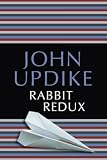
| Rabbit Redux | 1971 | Rabbit II; 1969; race |
| Rabbit Is Rich | 1981 | Rabbit III; Pulitzer |
| The Witches of Eastwick | 1984 | Witchcraft; Rhode Island |
| Roger’s Version | 1986 | Theology; computers |
| Rabbit at Rest | 1990 | Rabbit IV; Pulitzer; death |
| In the Beauty of the Lilies | 1996 | Four generations; American faith |
The Poet of American Middle-Class Life
John Updike was the great chronicler and poet of American middle-class life, a writer whose lyrical and precise fiction rendered the textures, longings, and discontents of ordinary suburban existence with an extraordinary attention and beauty. Updike devoted his fiction to the ordinary realities of American middle-class life, the suburban world of work, marriage, family, sex, and mortality, and he rendered these ordinary realities with a lyrical precision and an extraordinary attention that elevated the commonplace into art. His fiction attends to the textures, longings, and discontents of ordinary suburban existence, finding in the commonplace realities of middle-class life the material for fiction of great beauty and insight. This role as the poet of American middle-class life is central to Updike’s achievement, for he rendered the textures, longings, and discontents of ordinary suburban existence with a lyrical precision and an extraordinary attention that elevated the commonplace into art. His attention to the ordinary realities of middle-class life, and his lyrical rendering of them, give his fiction its distinctive beauty and insight. For readers, Updike offers the poet of American middle-class life, the textures, longings, and discontents of ordinary suburban existence rendered with lyrical precision and extraordinary attention. The poet of American middle-class life, Updike rendered the textures, longings, and discontents of ordinary suburban existence with a lyrical and precise fiction that elevated the commonplace into art.
Lyrical Precision and the Beauty of the Ordinary
A defining quality of John Updike’s fiction is its lyrical precision, its capacity to render the ordinary world with an attention, exactness, and beauty that reveal the richness and significance of commonplace experience. Updike wrote with a lyrical precision, an exact and beautiful prose that attended closely to the textures of the ordinary world and rendered them with an attention and exactness that revealed their richness and beauty. His fiction finds in the commonplace realities of middle-class life, in the ordinary objects, moments, and experiences of suburban existence, a richness and significance that his lyrical and precise prose brings to light. This lyrical precision and beauty of the ordinary are central to Updike’s achievement, for his exact and beautiful prose rendered the ordinary world with an attention that revealed the richness and significance of commonplace experience. His capacity to find and render the beauty of the ordinary, to elevate the commonplace through his lyrical attention, is among the most distinctive features of his fiction. For readers, Updike offers lyrical precision and the beauty of the ordinary, the ordinary world rendered with an attention, exactness, and beauty that reveal the richness of commonplace experience. Lyrical precision and the beauty of the ordinary are a defining quality of Updike’s fiction, its capacity to render the ordinary world with an attention, exactness, and beauty that reveal the richness and significance of commonplace experience.
Sex, Marriage, and Mortality
A central preoccupation of John Updike’s fiction is the intertwined experience of sex, marriage, and mortality, the desires, dissatisfactions, and conflicts of married life and the awareness of aging and death that shadows the pursuit of pleasure and meaning. Updike’s fiction is deeply concerned with sex, marriage, and mortality, with the desires and dissatisfactions of his characters, the conflicts and disappointments of married life, the pursuit of pleasure and meaning, and the awareness of aging and death that shadows these pursuits. His fiction explores the longings and discontents of married and middle-class life, the restless desires and dissatisfactions of his characters, and the awareness of mortality that gives their pursuit of pleasure and meaning its poignancy and its urgency. This preoccupation with sex, marriage, and mortality is central to Updike’s fiction, for he explored the desires, dissatisfactions, and conflicts of married life and the awareness of aging and death that shadows the pursuit of pleasure and meaning. His fiction renders the intertwined experience of desire and discontent, pleasure and mortality, with an honesty and an insight that give it its depth. For readers, Updike offers a profound exploration of sex, marriage, and mortality, the desires and discontents of married life and the awareness of mortality that shadows them. Sex, marriage, and mortality are a central preoccupation of Updike’s fiction, the desires, dissatisfactions, and conflicts of married life and the awareness of aging and death that shadows the pursuit of pleasure and meaning.
Reading Order Recommendations
New to Updike: Rabbit, Run → The Witches of Eastwick → Rabbit Is Rich.
The full Rabbit series: Rabbit, Run → Rabbit Redux → Rabbit Is Rich → Rabbit at Rest.
One novel only: Rabbit, Run.
Frequently Asked Questions
What is the best John Updike novel to start with?
Rabbit, Run (1960) is the best starting point — the novel that introduced Harry 'Rabbit' Angstrom, the former high school basketball star whose adult life as a salesman offers nothing comparable to the clarity and purpose of sport. Rabbit's repeated attempts to escape his life (his marriage, his job, his community) without quite leaving constitute the most sustained portrait of American masculine dissatisfaction in twentieth-century fiction. The Witches of Eastwick (1984) is the most immediately accessible — three divorcées in a small Rhode Island town who discover they have witchcraft and use it, and the charismatic man who enters their world.
What is the Rabbit series about?
The Rabbit series follows Harry 'Rabbit' Angstrom across four novels — Rabbit, Run (1960, set in 1959), Rabbit Redux (1971, set in 1969), Rabbit Is Rich (1981, set in 1979), and Rabbit at Rest (1990, set in 1989) — plus the novella Rabbit Remembered (2001). Each novel is set approximately ten years after the previous one, and the series is simultaneously the story of one man's aging and the story of American life across thirty years: the cultural revolutions of the 1960s, the energy crisis of the 1970s, the Reagan prosperity of the 1980s. Won the Pulitzer Prize twice (Rabbit Is Rich and Rabbit at Rest).
What is Rabbit, Run about?
Rabbit, Run (1960) follows Harry Angstrom over several months in 1959 — his abandonment of his pregnant wife and young son, his affair with a prostitute named Ruth, and the tragedy that results. Updike's prose is sensuous and precise; his portrait of Harry (simultaneously sympathetic and damning) is the model for subsequent American male antiheroes. The novel was controversial on publication for its sexual frankness; it is now recognised as the most important first novel in postwar American fiction.
What is Updike's place in American literature?
Updike is one of the central figures of postwar American fiction — alongside Bellow, Roth, and Mailer — and the one most associated with the suburban middle class as a subject worthy of serious literary attention. His prose style (sensuous, precise, attentive to the physical world in a way that is simultaneously beautiful and morally charged) is the most distinctive in American fiction after Nabokov. His detractors argue that his work is too focused on the experience of white, heterosexual, middle-class American men; his advocates argue that he examined that experience with a precision and a moral seriousness that transcends its apparent limitations.