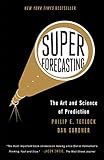
American psychologist and political scientist, co-author of Superforecasting, whose research revealed what separates expert forecasters from the rest.
Philip Tetlock is an American psychologist and political scientist at the University of Pennsylvania whose decades of research into expert prediction have fundamentally changed how we think about forecasting and judgment under uncertainty. His landmark 2005 study, which tracked the predictions of nearly three hundred experts over twenty years, found that most performed no better than chance — and that pundits were often worse than dart-throwing chimps when predicting political and economic outcomes.
Superforecasting: The Art and Science of Prediction, co-authored with journalist Dan Gardner in 2015, translates the findings of Tetlock’s Good Judgment Project into an accessible and practical guide. The project revealed that a small subset of forecasters dramatically outperforms experts, and identified the cognitive habits that distinguish them: intellectual humility, probabilistic thinking, willingness to update beliefs, and the ability to synthesize information from multiple perspectives. The book challenges the celebrity pundit model of expertise and argues that prediction is a skill that can be systematically cultivated.
Tetlock’s research has influenced intelligence agencies, policy institutions, and businesses seeking to make better decisions under uncertainty. His work bridges academic psychology, political science, and practical decision-making in ways that are both rigorous and genuinely useful. For anyone interested in improving their own reasoning or understanding why smart people get predictions so wrong, Superforecasting is essential reading.
Foxes, Hedgehogs, and the Pundit Problem
One of Tetlock’s most influential contributions to public understanding is his revival and empirical testing of a distinction borrowed from the philosopher Isaiah Berlin: the difference between the “hedgehog,” who knows one big thing and views the world through a single grand theory, and the “fox,” who knows many small things and draws on a wide range of ideas without committing to any overarching framework. Across his long-term study of expert prediction, Tetlock found that the foxes consistently outperformed the hedgehogs, because their willingness to entertain multiple perspectives, tolerate ambiguity, and hold their views provisionally made them more accurate and more responsive to new information. The hedgehogs, by contrast, tended to force events into their preferred theory and to cling to predictions even as evidence accumulated against them — yet it was precisely these confident, single-minded thinkers who made for compelling television and who dominated the punditry circuit. This finding amounted to a quiet indictment of the celebrity-expert culture, revealing that the very qualities that make a forecaster persuasive on screen are often inversely related to the qualities that make forecasts accurate. The fox-and-hedgehog framework has since become a widely cited shorthand for thinking about expertise and judgment.
The Good Judgment Project
Tetlock’s later work moved from diagnosing the failures of expert prediction to demonstrating that good forecasting is a learnable skill, and the vehicle for this was the Good Judgment Project, a large-scale research effort he led with his collaborator and wife, the psychologist Barbara Mellers. Conducted as part of a forecasting tournament sponsored by the United States intelligence community, the project recruited thousands of ordinary volunteers to predict real-world geopolitical and economic events, and its results were striking: a subset of these amateur forecasters, whom Tetlock dubbed “superforecasters,” consistently outperformed not only their peers but, in some cases, intelligence analysts with access to classified information. By studying what these superforecasters did differently, Tetlock identified a cluster of habits and dispositions that drove their success — breaking large questions into smaller tractable parts, thinking in explicit probabilities and updating them incrementally as new evidence arrived, actively seeking out disconfirming information, and maintaining a posture of intellectual humility. Crucially, the project showed that these habits could be taught and that practice with feedback measurably improved accuracy, overturning the fatalistic assumption that prediction is either innate talent or pure luck. The work transformed forecasting from a mystique into a discipline.
A Lasting Influence on How We Think About Prediction
Tetlock’s research has reshaped how scholars, governments, and organisations understand judgment and decision-making under uncertainty, and his influence extends well beyond academia. His insistence that forecasts should be specific, time-bound, and probabilistic — so that they can actually be scored and forecasters held accountable — challenged the vague, unfalsifiable pronouncements that dominate political and economic commentary, and it has inspired a broader movement toward measurement and rigour in fields where confident prediction had long gone unexamined. Intelligence agencies, policy institutions, financial firms, and the growing community of practitioners interested in rational decision-making have adopted his methods, and the practice of probabilistic forecasting and calibration has spread into business strategy and effective-altruist and rationalist circles alike. Alongside his empirical work, Tetlock has raised important questions about how societies might cultivate better collective judgment, advocating for forecasting tournaments and accountability mechanisms as tools for improving public discourse. His central message — that humility, open-mindedness, and disciplined probabilistic reasoning produce better predictions than confident expertise, and that these are skills anyone can develop — has proved both intellectually significant and practically empowering. Tetlock stands as one of the most important contemporary researchers on the psychology of judgment, and his work continues to influence anyone serious about thinking more clearly about the future.
Where to Start with Tetlock
For nearly all readers the entry point is Superforecasting: The Art and Science of Prediction, co-written with the journalist Dan Gardner, which translates decades of rigorous research into an accessible, practical, and genuinely useful guide; it lays out the habits of the best forecasters and makes the case that good prediction is a learnable skill. Readers who want the deeper scholarly foundation can turn to his earlier academic work Expert Political Judgment, the landmark long-term study that first revealed how poorly most experts predict and introduced the fox-and-hedgehog distinction, though it is more demanding than the popular book. Those interested in applying his methods can engage with the forecasting tournaments and calibration exercises his work inspired, which offer hands-on practice in probabilistic thinking. For anyone seeking to improve their own reasoning, understand why confident pundits so often get the future wrong, or cultivate the intellectual humility and open-mindedness that accurate forecasting requires, Superforecasting is the essential and most rewarding starting point, and the clearest distillation of a career’s worth of research into how to think more clearly about an uncertain world.
Reading Guides