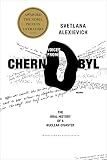
Editors Reads Verdict
The most immediately heartbreaking of Alexievich's books: the Chernobyl testimonies have a specificity that transcends political argument, because radiation is not an ideology—it simply destroys, and the voices that survive the destruction are among the most haunting in contemporary literature.
What We Loved
- The opening monologue by Lyudmilla Ignatenko is among the most devastating pieces of testimony ever written
- At 240 pages, the most concentrated and accessible of Alexievich's books
- Chernobyl as lens for understanding the entire Soviet system's relationship to truth
- Widely considered the ideal entry point to Alexievich's work
Minor Drawbacks
- The emotional intensity is nearly unbearable—not a book to read in a single sitting
- The medical specificity of radiation sickness is deeply disturbing
- Some readers want more political context than Alexievich provides
Key Takeaways
- → Radiation is invisible, odorless, and democratic—it destroys regardless of heroism or ideology
- → The Soviet state's suppression of information about Chernobyl was itself a form of violence against its citizens
- → The liquidators who cleaned up the disaster were sacrificed without being told the risk they were taking
- → Grief for the contaminated homeland is its own category of loss, unlike anything that has a name
- → Chernobyl was a symptom of the Soviet system's terminal relationship to truth
| Author | Svetlana Alexievich |
|---|---|
| Publisher | Picador |
| Pages | 240 |
| Published | April 1, 2006 |
| Language | English |
| Genre | Oral History, Literary Nonfiction, Nuclear History |
| Difficulty | Beginner |
| Best For | Anyone interested in the human cost of industrial disaster, Soviet history, or the capacity of literature to bear witness to the unbearable. The most accessible entry point to Alexievich's work. |
How Voices from Chernobyl Compares
Voices from Chernobyl at a glance against 3 similar books readers weigh alongside it.
| Book | Author | Rating | Best for |
|---|---|---|---|
| Voices from Chernobyl (this book) | Svetlana Alexievich | ★ 4.6 | Anyone interested in the human cost of industrial disaster, Soviet history, or |
| Secondhand Time: The Last of the Soviets | Svetlana Alexievich | ★ 4.5 | Readers of serious history and literary nonfiction who want to understand the |
| The Unwomanly Face of War | Svetlana Alexievich | ★ 4.5 | Readers of World War II history and feminist literature who want testimony that |
| Zinky Boys: Soviet Voices from the Afghanistan War | Svetlana Alexievich | ★ 4.3 | Readers of oral history and war literature, particularly those interested in |
The Liquidators
On April 26, 1986, the Chernobyl nuclear power plant’s Reactor Number Four exploded. The Soviet state mobilized hundreds of thousands of men—firefighters, soldiers, miners, engineers, helicopter pilots—to contain the disaster. They were called ‘liquidators,’ and they were told varying versions of the truth about what they were walking into. Many were told nothing at all.
Alexievich’s book gathers the voices of these men and the people who loved them: what they were told (often: ‘it’s safe, wear your badge, do your shift’), what they found (a landscape of a kind that had never existed before, where the ordinary rules of matter seemed suspended), and what happened to them afterward (the cancers, the organ failures, the children born with conditions that had no names yet). A miner describes crawling through tunnels under the reactor to lay cooling pipes, in temperatures above fifty degrees, understanding that whatever he was being exposed to was not something his body had ever been designed to survive. A helicopter pilot describes the flights over the open reactor, the dosimeters clicking off-scale, the senior officer telling him the readings were malfunctions.
These voices are the book’s moral center: ordinary men who were placed in an extraordinary situation by a state that needed their bodies and could not afford to acknowledge the cost. Their testimony is specific, physical, and irreducibly individual—the exact opposite of the official Soviet account, which spoke in aggregates and statistics and heroic abstractions.
The Wives
The book opens with Lyudmilla Ignatenko, whose husband Vasily was a firefighter dispatched to Chernobyl on the first night. She describes going to the hospital in Moscow where he was being treated, being told she could not touch him because his body had become radioactive, and touching him anyway. She describes what radiation sickness does to a body over fourteen days—the progression, the specific indignities, the specific moments of connection and terror—in language of such precision and love that it has been cited, by critics and by other writers, as one of the most powerful pieces of testimony in the literature of the twentieth century.
The wives and widows throughout the book share a particular grief: they lost their husbands to something invisible, something that had no face. There was no enemy to name, no battlefield to point to, no heroic narrative in which the death made sense. And then they learned that the state had known more than it told them—that the secrecy itself was a policy decision, that their husbands were sacrificed not in ignorance but in the knowledge that the sacrifice was being made.
The grief that results is a specific kind—not just loss, but the violation of having been deceived by the institution that was supposed to protect you.
Chernobyl as Symptom
Voices from Chernobyl is, among other things, a book about the Soviet state’s fundamental relationship to truth. The explosion happened partly because of design flaws that Soviet engineers knew about and concealed; it was not reported for days while the radioactive cloud drifted over Europe; the liquidators were sent in without adequate information or protection; the evacuees from Pripyat were not told why they were leaving. Secrecy was not an accident but a structural feature of Soviet governance.
Alexievich’s book appeared in 1997, six years after the Soviet Union’s collapse, and it reads as a post-mortem: Chernobyl was not just a nuclear disaster but a revelation of the system’s terminal illness. The state that sacrificed its citizens to maintain a fiction about the invulnerability of Soviet technology was the same state that had sacrificed its citizens across the previous seven decades—and Chernobyl was simply the moment when the sacrifice could not be concealed. The connection to the Soviet collapse that Secondhand Time records five years later is explicit: Chernobyl broke something in the Soviet citizen’s relationship to the state that could not be repaired.
Alexievich’s Method and Her Nobel Prize
Svetlana Alexievich, a Belarusian writer who works in Russian, has spent her career developing a form she calls the “novel of voices” — a documentary literature assembled from hundreds of interviews, edited and arranged into a polyphonic chorus that achieves the emotional depth of fiction while remaining true testimony. She does not editorialize; she selects, shapes, and sequences the voices so that meaning emerges from their accumulation rather than from any authorial argument. Voices from Chernobyl belongs to a larger cycle of books that together constitute an oral history of Soviet and post-Soviet life, alongside The Unwomanly Face of War, about women who fought in the Second World War; Zinky Boys, about the war in Afghanistan; and Secondhand Time, about the disorientation that followed the USSR’s collapse. In 2015 she received the Nobel Prize in Literature “for her polyphonic writings, a monument to suffering and courage in our time” — the first time the prize had gone to a writer working primarily in this documentary mode, a recognition that her method had created something genuinely new in literature.
Reading Chernobyl as Literature, Not Just History
What separates Voices from Chernobyl from a conventional history of the disaster is that Alexievich is not finally interested in the technical sequence of the meltdown or in apportioning blame among officials. She is interested in the interior experience of catastrophe — what it feels like to lose a homeland to invisible poison, to bury a husband whose body has become dangerous to touch, to be a child who knows the word “radiation” before the word for many ordinary things. The book asks questions that science cannot answer: how does a person grieve for contaminated soil, for a forest that must be cut down and buried, for animals that must be shot because they cannot be saved? Because radiation is invisible, odorless, and indifferent to heroism or ideology, the disaster strips away every comforting narrative and leaves only the bare human voice confronting a horror with no precedent. This is why the book is best read slowly, a few testimonies at a time; its power is cumulative and nearly unbearable, and it rewards readers who are willing to sit with discomfort rather than rushing toward resolution. For anyone seeking to understand both the human cost of nuclear disaster and the capacity of literature to bear witness, it remains the essential book, and the ideal entry point into Alexievich’s extraordinary body of work.
Our rating: 4.6/5 — The most immediately devastating of Alexievich’s books, and the ideal place to begin. The first monologue alone justifies the Nobel Prize.
Frequently Asked Questions
What is "Voices from Chernobyl" about?
1986: the Chernobyl nuclear plant explodes. The wives, widows, and liquidators speak to Alexievich about what they saw, what they lost, and what has never stopped. The firefighter's wife who held her husband's disintegrating hand. The child who grew up in the zone. The soldier who was told to bury the contaminated soil. The most moving of Alexievich's books.
Who should read "Voices from Chernobyl"?
Anyone interested in the human cost of industrial disaster, Soviet history, or the capacity of literature to bear witness to the unbearable. The most accessible entry point to Alexievich's work.
What are the key takeaways from "Voices from Chernobyl"?
Radiation is invisible, odorless, and democratic—it destroys regardless of heroism or ideology The Soviet state's suppression of information about Chernobyl was itself a form of violence against its citizens The liquidators who cleaned up the disaster were sacrificed without being told the risk they were taking Grief for the contaminated homeland is its own category of loss, unlike anything that has a name Chernobyl was a symptom of the Soviet system's terminal relationship to truth
Is "Voices from Chernobyl" worth reading?
The most immediately heartbreaking of Alexievich's books: the Chernobyl testimonies have a specificity that transcends political argument, because radiation is not an ideology—it simply destroys, and the voices that survive the destruction are among the most haunting in contemporary literature.
Ready to Read Voices from Chernobyl?
Check the current price on Amazon.
Check Price on Amazon (paid link)Prices and availability are subject to change. See Amazon for current price.
Review last updated: