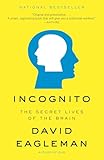
Editors Reads Verdict
A lively, accessible tour of the unconscious mind. Eagleman makes cutting-edge neuroscience genuinely fun while pressing unsettling questions about free will and responsibility. Breezy and provocative, if light on depth.
What We Loved
- Accessible, lively, and genuinely entertaining science writing
- Eye-opening examples of how much the brain does below awareness
- Provocative questions about free will, identity, and criminal justice
Minor Drawbacks
- Breezy and surface-level; light on depth and nuance
- Strong claims about free will outrun settled science
Key Takeaways
- → Most of what the brain does happens below conscious awareness
- → The conscious self is a small, often misinformed part of the whole
- → Understanding the unconscious brain has real implications for law and responsibility
| Author | David Eagleman |
|---|---|
| Publisher | Vintage |
| Pages | 304 |
| Published | January 1, 2011 |
| Language | English |
| Genre | Nonfiction, Science, Psychology |
| Difficulty | Beginner |
| Best For | Curious readers wanting an accessible, entertaining introduction to the unconscious brain and its implications. |
How Incognito Compares
Incognito at a glance against 3 similar books readers weigh alongside it.
| Book | Author | Rating | Best for |
|---|---|---|---|
| Incognito (this book) | David Eagleman | ★ 4.0 | Curious readers wanting an accessible, entertaining introduction to the |
| How the Mind Works | Steven Pinker | ★ 4.0 | Readers interested in psychology, cognitive science, and evolutionary |
| The Man Who Mistook His Wife for a Hat | Oliver Sacks | ★ 4.5 | Readers interested in neuroscience, psychology, and the philosophy of mind — |
| Thinking, Fast and Slow | Daniel Kahneman | ★ 4.6 | Investors, doctors, lawyers, managers, policymakers, and any curious person who |
The Brain Behind the Curtain
David Eagleman’s Incognito, published in 2011, is a lively, accessible, and entertaining tour of one of the most unsettling ideas in modern neuroscience: that the conscious mind — the “you” that feels like the author of your thoughts and decisions — is in fact a small, often misled passenger in a brain that does the overwhelming majority of its work below the level of awareness. Eagleman, a neuroscientist and gifted popularizer, sets out to dethrone the conscious self, marshalling a wealth of vivid examples and research to show how much of perception, decision, emotion, and behavior is governed by unconscious processes we neither control nor even notice. It is a breezy, engaging, frequently eye-opening book that succeeds wonderfully as accessible science writing, even if its provocations sometimes outrun the evidence and its treatment stays closer to the surface than the depths.
The central argument is that the brain is, in Eagleman’s phrase, “a team of rivals” — a collection of competing, largely unconscious systems whose interactions produce our behavior, with consciousness arriving late to take credit for decisions already made. He illustrates this with a parade of fascinating examples: the way we perceive without knowing how; the unconscious skills (like driving a familiar route) that operate without conscious attention; optical and cognitive illusions that reveal the brain constructing rather than recording reality; the strange effects of brain damage and disease on personality and choice; the hidden influences on our preferences, judgments, and actions. The cumulative effect is genuinely destabilizing: by the end, the comfortable sense that “I” am in charge of my own mind has been thoroughly undermined, replaced by a picture of consciousness as a thin, often misinformed layer atop a vast unconscious machinery.
Accessible and Entertaining
The great strength of Incognito is its accessibility and energy. Eagleman is a natural communicator — clear, witty, fond of the striking example and the memorable phrase — and he makes cutting-edge neuroscience not just comprehensible but genuinely fun. The book moves quickly, packed with arresting anecdotes and experiments, and it conveys the wonder and strangeness of the brain to a general audience with real flair. For readers new to the subject, it is an excellent and enjoyable introduction, the kind of science book that makes you see yourself and others differently and that sparks the desire to know more. Eagleman’s enthusiasm is infectious, and his gift for translating research into vivid, relatable terms is considerable.
The book also raises genuinely important and provocative questions, particularly in its later chapters. If so much of our behavior is driven by unconscious processes we did not choose and cannot fully control — by brain chemistry, by neural wiring shaped by genes and environment, by influences below awareness — then what becomes of free will, moral responsibility, and the foundations of our legal system? Eagleman pushes hard on the implications for criminal justice, arguing that a more sophisticated understanding of the brain should reshape how we think about culpability and punishment, moving away from blame and toward a model focused on rehabilitation and the modifiability of behavior. These are serious, consequential questions, and the book deserves credit for raising them accessibly.
Breezy by Design
The flip side of the book’s accessibility is its lack of depth. Incognito is breezy and surface-level, prioritizing entertaining illustration over rigorous argument or nuanced engagement with the science’s complexities and controversies. Eagleman moves quickly, rarely pausing to explore the uncertainties, the competing interpretations, or the limits of the research; the examples are vivid but the analysis is thin. Readers with some background in neuroscience or philosophy of mind may find the treatment frustratingly shallow, gesturing at profound questions without doing the hard work of grappling with them. This is the nature of popular science at this register — a tour rather than a deep study — but it means the book is better as a stimulating introduction than as a satisfying exploration.
More seriously, some of Eagleman’s stronger claims, particularly about free will, outrun what the science actually establishes. The relationship between unconscious brain processes and conscious agency is genuinely contested — among neuroscientists and philosophers alike — and the leap from “much of the brain operates unconsciously” to “free will is an illusion” or “responsibility must be radically rethought” is far less settled than the book’s confident tone suggests. The famous experiments often cited in this debate are subject to multiple interpretations, and the philosophical questions are far from resolved. Readers should enjoy Eagleman’s provocations while recognizing that his conclusions are arguments in an ongoing debate, not established facts.
A Stimulating Introduction
These caveats aside, Incognito is a successful and worthwhile book on its own terms. It introduces a general audience to the genuinely important and unsettling science of the unconscious brain, does so with energy and clarity, and raises real questions about selfhood, agency, and justice that are worth pondering. It is the kind of book that changes how you experience your own mind, at least for a while, and that sends curious readers toward deeper explorations.
For readers wanting an accessible, entertaining introduction to the hidden workings of the brain and their implications, it is a lively and stimulating choice — light on depth and bold in its claims, but eye-opening, provocative, and a great deal of fun.
Final Verdict
Our rating: 4.0/5 — A lively, accessible tour of the unconscious mind. Eagleman makes cutting-edge neuroscience genuinely fun while pressing unsettling questions about free will and responsibility. Breezy and surface-level, with claims that outrun the settled science, but eye-opening and stimulating.
For more on the mind and its hidden workings, see Thinking, Fast and Slow, How the Mind Works, and The Man Who Mistook His Wife for a Hat.
Frequently Asked Questions
What is "Incognito" about?
Neuroscientist David Eagleman's accessible tour of the unconscious brain. Drawing on cutting-edge research, he argues that the conscious mind is a small, often misled passenger in a brain that does most of its work below awareness — with provocative implications for selfhood, free will, and the law.
Who should read "Incognito"?
Curious readers wanting an accessible, entertaining introduction to the unconscious brain and its implications.
What are the key takeaways from "Incognito"?
Most of what the brain does happens below conscious awareness The conscious self is a small, often misinformed part of the whole Understanding the unconscious brain has real implications for law and responsibility
Is "Incognito" worth reading?
A lively, accessible tour of the unconscious mind. Eagleman makes cutting-edge neuroscience genuinely fun while pressing unsettling questions about free will and responsibility. Breezy and provocative, if light on depth.
Ready to Read Incognito?
Check the current price on Amazon.
Check Price on Amazon (paid link)Prices and availability are subject to change. See Amazon for current price.
Review last updated: