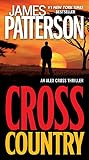
Editors Reads Verdict
Cross Country is the series' most extreme departure, hurling Alex Cross out of Washington and into the chaos of West Africa to pursue a teenage warlord and his army of child soldiers. Brutally violent and far outside the procedural comfort zone, it is the most divisive Cross novel — ambitious in scope, harrowing in content, and uneven in execution.
What We Loved
- An ambitious departure that takes the series far outside its comfort zone
- The West African setting is vivid and unsettling
- Confronts real horrors of warlords and child soldiers
- Relentless, propulsive pacing
Minor Drawbacks
- Extreme, unrelenting brutality alienates many readers
- Cross can feel out of his depth and oddly passive
- The portrayal of Africa leans on grim stereotype
Key Takeaways
- → Pulling a hero out of his element tests both character and reader
- → Some real-world horrors resist the thriller's tidy resolutions
- → Ambition and execution don't always align
- → A series can stretch its premise to the breaking point
| Author | James Patterson |
|---|---|
| Publisher | Little, Brown |
| Pages | 416 |
| Published | November 17, 2008 |
| Language | English |
| Genre | Thriller, Crime Fiction, Mystery, Fiction |
| Difficulty | Beginner |
| Best For | Alex Cross completists; readers prepared for an unusually violent, internationally set entry. |
How Cross Country Compares
Cross Country at a glance against 3 similar books readers weigh alongside it.
| Book | Author | Rating | Best for |
|---|---|---|---|
| Cross Country (this book) | James Patterson | ★ 3.6 | Alex Cross completists |
| Alex Cross's Trial | James Patterson | ★ 4.0 | Readers open to historical fiction about the Jim Crow South |
| Double Cross | James Patterson | ★ 3.8 | Alex Cross readers invested in the Kyle Craig arc |
| Mary, Mary | James Patterson | ★ 3.8 | Alex Cross readers |
Out of Washington
Cross Country, the fourteenth Alex Cross novel, is the most extreme departure in the series, and it remains its most divisive entry. It begins on familiar ground — the brutal massacre of an entire family, one Cross knew and once loved — but the investigation quickly carries him far beyond the streets of Washington, off the continent entirely, and into the war-torn chaos of West Africa. By the time the book reaches its midpoint, the series’ signature urban procedural has transformed into something closer to a harrowing action-adventure set amid civil conflict, corruption, and atrocity.
The ambition is real, and worth acknowledging. After more than a dozen novels confined to American crime, Patterson reaches for something larger and more dangerous, dropping his hero into a world where the rules he knows do not apply and the violence operates at a scale no Washington homicide could match. For readers fatigued by the series’ formula, the sheer audacity of sending Cross to Africa to hunt a warlord is a genuine jolt.
The Tiger
The antagonist is the Tiger, a young, charismatic, and monstrous warlord who commands an army of child soldiers and traffics in violence as a way of life. He is among the most frightening figures in the series precisely because he is not a lone aberration but a product of a collapsed order — a killer enabled and surrounded by other killers, many of them children weaponized by adults. The Tiger’s brand of brutality is different in kind from the serial murderers Cross usually faces, and the novel does not soften it. The horrors of child soldiering, mass killing, and lawless cruelty are rendered without flinching.
This unrelenting brutality is the book’s defining feature and its central problem. Cross Country is grim to the point of punishing, a near-continuous procession of atrocity that many readers find alienating rather than gripping. Where the series’ best entries modulate their darkness with psychology and personal stakes, this one leans on shock and scale, and the cumulative effect can be numbing rather than affecting. Readers should know going in that this is the most violent and disturbing Cross novel, and that the violence is often the point.
Cross Out of His Depth
Part of what unsettles readers about Cross Country is how out of his element Cross becomes. The detective whose great gift is reading the criminal mind finds that gift of limited use in a context where the violence is communal, political, and overwhelming. He is frequently reactive, swept along by forces he cannot control or fully understand, and at times he reads as oddly passive — less the master investigator than a man simply trying to survive. For some readers this is a realistic acknowledgment that a Washington psychologist would be lost in a war zone; for others it diminishes the hero at the center of the series.
The novel’s portrayal of Africa is its most criticized aspect, and the criticism has merit. The continent is rendered almost entirely through grim stereotype — corruption, squalor, and unrelenting savagery — with little of the texture or humanity that might have grounded the horror in a real place. The setting functions as a backdrop for atrocity rather than as a fully realized world, and that flatness undercuts the book’s ambitions. An adventurous departure deserved a more nuanced canvas than it received.
Ambition Versus Execution
Cross Country is, finally, a book whose ambition outpaces its execution. The idea — wrenching Cross out of his comfort zone and forcing him to confront a scale of evil beyond anything in the series — is bold, and the propulsive pacing keeps the pages turning. But the relentless brutality, the thinly drawn setting, and the curiously diminished hero combine into an entry that many longtime readers rank among the weakest in the run. It is the clearest example of the series stretching its premise close to the breaking point.
And yet the gamble is not without value. Cross Country demonstrates Patterson’s willingness to take risks with a reliable franchise, to push his character somewhere genuinely uncomfortable rather than running the same formula again. The result is uneven, often unpleasant, and frequently misjudged — but it is not lazy, and its failures are the failures of overreach rather than complacency.
Where It Sits in the Series
Cross Country is the fourteenth Alex Cross novel and the series’ great outlier — the moment it abandoned its procedural identity for an internationally set action-adventure. It can be read as a standalone curiosity, since its African setting and self-contained plot connect loosely to the surrounding books, and many readers treat it as a skippable detour between the more characteristic entries on either side. It precedes the historical Alex Cross’s Trial and is best approached by completists prepared for its extremity.
Among the Cross novels, this is the one most likely to divide opinion sharply: an ambitious, brutal, flawed experiment that some admire for its daring and many others regard as a misfire. Approach it knowing what it is, and what it is not.
It is telling that the series never again attempted anything quite this extreme. Cross Country seems to have marked the outer limit of how far Patterson was willing to push his hero from the world that defined him, and the books that followed retreated to more familiar ground. In that sense the novel functions almost as a cautionary experiment — proof that the Cross formula depends more than it might appear on the specific texture of American crime, on the psychological cat-and-mouse that a war zone simply does not allow. Readers who value the series for that texture will find Cross Country an alien thing; readers curious about the boundaries of a long-running franchise will find it a fascinating, if unpleasant, stress test. Either way, it stands alone in the run, for better and for worse.
Our rating: 3.6/5 — The series’ most extreme and divisive entry, sending Alex Cross to West Africa to hunt a warlord — ambitious in scope but punishing in its relentless brutality and thin in its setting.
Frequently Asked Questions
What is "Cross Country" about?
The massacre of a family Alex Cross once loved sends him chasing a brutal warlord known as the Tiger — a trail that leads off the streets of Washington and into the war-torn heart of West Africa, where Cross faces child soldiers, corruption, and a brand of violence beyond anything he has known.
Who should read "Cross Country"?
Alex Cross completists; readers prepared for an unusually violent, internationally set entry.
What are the key takeaways from "Cross Country"?
Pulling a hero out of his element tests both character and reader Some real-world horrors resist the thriller's tidy resolutions Ambition and execution don't always align A series can stretch its premise to the breaking point
Is "Cross Country" worth reading?
Cross Country is the series' most extreme departure, hurling Alex Cross out of Washington and into the chaos of West Africa to pursue a teenage warlord and his army of child soldiers. Brutally violent and far outside the procedural comfort zone, it is the most divisive Cross novel — ambitious in scope, harrowing in content, and uneven in execution.
Ready to Read Cross Country?
Check the current price on Amazon.
Check Price on Amazon (paid link)Prices and availability are subject to change. See Amazon for current price.
Review last updated: