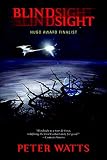
Editors Reads Verdict
Peter Watts uses first contact as a philosophical stress test, building an alien encounter that is not really about aliens at all — it is about whether awareness itself is an evolutionary mistake. Demanding, rigorously researched, and genuinely unsettling, *Blindsight* is the rare science fiction novel that leaves readers questioning the nature of their own minds.
What We Loved
- The central argument — that consciousness may be a liability rather than an advantage — is developed with genuine scientific rigor
- Siri Keeton is one of the most formally inventive narrators in science fiction, his cognitive limitations mirroring the novel's themes
- The alien design is deliberately, purposefully incomprehensible in a way that serves the ideas rather than frustrating the reader arbitrarily
- Watts's scientific background produces hard-SF grounding that goes beyond most of the genre — the 50+ pages of notes and references are a genuine resource
Minor Drawbacks
- The density of scientific and philosophical content makes this one of the most demanding reads in contemporary SF
- Readers who want character warmth or narrative momentum over ideas will find the novel cold and resistant
- The ambiguity is intentional but relentless — those who want resolution will not find it
Key Takeaways
- → Consciousness may be an expensive cognitive overhead rather than an adaptive advantage — intelligence and awareness are not the same thing
- → The most honest narrator of an experience may be someone who processes it without fully having it
- → Genuine alien intelligence, if it exists, may be so structurally different from human cognition that comprehension is not merely difficult but impossible by design
- → Scientific plausibility is not the enemy of strangeness — the most unsettling ideas in the novel are the ones most firmly grounded in actual research
| Author | Peter Watts |
|---|---|
| Publisher | Tor Books |
| Pages | 384 |
| Published | October 3, 2006 |
| Language | English |
| Genre | Hard Science Fiction, Science Fiction, Philosophical Science Fiction |
| Difficulty | Advanced |
| Best For | Readers who want science fiction that engages seriously with neuroscience, philosophy of mind, and evolutionary biology, and who are willing to sit with ideas that do not resolve neatly. |
How Blindsight Compares
Blindsight at a glance against 3 similar books readers weigh alongside it.
| Book | Author | Rating | Best for |
|---|---|---|---|
| Blindsight (this book) | Peter Watts | ★ 4.5 | Readers who want science fiction that engages seriously with neuroscience, |
| A Fire Upon the Deep | Vernor Vinge | ★ 4.5 | Readers who want space opera with genuine intellectual ambition — the kind |
| Dune | Frank Herbert | ★ 4.7 | Readers of ambitious fiction, fans of the films who want the deeper version, |
| Project Hail Mary | Andy Weir | ★ 4.8 | Science fiction readers who want accurate science without sacrificing story, |
The Consciousness-as-Liability Argument
The central provocation of Blindsight is stated plainly and then demonstrated across 384 pages: consciousness may not be an evolutionary advantage. The alien presence the crew encounters — vast, complex, and capable of behavior that requires extraordinary processing power — shows no evidence of being aware. It is intelligent without being conscious, purposeful without being a subject of experience.
Watts grounds this not in speculation but in actual scientific literature. Research on split-brain patients, blindsight (the neurological phenomenon that names the novel), and unconscious motor processing all point toward the same uncomfortable finding: a great deal of sophisticated cognition happens without awareness. Awareness may even slow things down. A batter who consciously thinks about a swing will miss; a hitter acting on trained reflex will connect. Watts extrapolates this across evolutionary time and asks what it would mean if the universe were full of intelligence that never developed the expensive, looping overhead of self-awareness.
The answer the novel arrives at is not comforting.
Siri Keeton and the Unreliable Observer
The narrator of Blindsight is Siri Keeton, who had half his brain surgically removed as a child to cure epilepsy. The surgery worked. It also left him without the normal architecture of emotional processing and self-reflection — Siri functions as a synthesist, someone trained to observe the behavior of others and translate it for audiences who cannot understand specialists. He is, professionally and neurologically, a relay rather than a participant.
This is formally extraordinary. A novel about whether consciousness is meaningful is narrated by someone whose consciousness is compromised, who cannot fully experience the events he describes, who reconstructs what happened from observation and inference rather than from felt experience. Siri is not an unreliable narrator in the conventional sense — he is not lying, not self-deceived, not emotionally distorted. He is unreliable because the machinery that generates subjective experience in most people is simply not fully present in him.
The effect is pervasive. Siri’s narration is precise and intelligent and yet consistently at a remove from the events he describes, which means the reader is always receiving the novel through a filter that raises the very questions the novel is exploring. Whether Siri’s experience of the mission is less real than a different narrator’s would have been is a question Watts leaves open, and deliberately so.
The Alien Design
Most science fiction aliens are, at bottom, people. They have motivations, they communicate, they can be negotiated with or fought. Even the most alien-seeming often resolve, on contact, into something with recognizable structure. Watts makes a different choice.
The alien entity in Blindsight — the Rorschach, the scramblers — is not designed to be understood. Its behavior is complex, responsive, and purposeful, but purposeful in the way a very sophisticated defense system is purposeful, without any implication that there is something it is like to be this thing. The scramblers are capable of learning to fake human behavior well enough to pass certain tests. They cannot pass tests that require genuine awareness of their own deception — not because they are unintelligent, but because there is, plausibly, no one home.
This deliberate design choice is the novel’s most radical formal decision. Watts refuses to give the reader an alien encounter that resolves into contact, communication, or understanding. The aliens remain genuinely, structurally other — and the horror of the novel is not that they are hostile but that hostility implies interiority they may not have.
The Vampire Element
Blindsight includes vampires. This requires some accounting for.
Watts provides it. The novel’s vampires are not supernatural but evolutionary — a subspecies of hominid that preyed on humans and went extinct due to a genetic flaw: exposure to right angles triggers fatal seizures. Right angles are vanishingly rare in nature but ubiquitous in human built environments, which is why vampires could not survive in a world of architecture. In the novel, they have been revived through genetic reconstruction and deployed as cognitive tools — their processing speed and pattern-recognition capabilities exceed normal human cognition significantly, which makes them useful crew members for exactly the kind of mission that requires rapid threat assessment and non-human decision-making.
The detail of the cross-shaped trigger is Watts at his most playful and most rigorous simultaneously. He takes a piece of folklore, finds the mechanistic explanation that would make it real, and integrates it into the novel’s larger argument: that cognitive architecture shapes the nature of consciousness, and that different architectures produce not just different abilities but different relationships to awareness itself. The vampire Jukka Sarasti is the most capable entity on the ship and arguably the least conscious of the human-or-human-derived crew. That is not a coincidence.
Our rating: 4.5/5 — The most rigorous philosophical argument in contemporary hard science fiction, built into a first-contact narrative that refuses every comforting assumption about what intelligence, consciousness, and alien life might mean.
A Bleak Vision of Consciousness
Blindsight is Peter Watts’s intellectually formidable and unsettling work of hard science fiction, a first-contact novel that uses an encounter with the alien to mount a profound and disturbing inquiry into the nature of consciousness itself. When a crew of radically augmented humans, including a linguist with multiple personalities and a resurrected vampire, is sent to investigate an alien presence at the edge of the solar system, they confront an intelligence so alien that it challenges their deepest assumptions about mind, self-awareness, and what it means to be conscious. Watts grounds his speculation in genuine neuroscience and evolutionary theory, and the novel advances the provocative and bleak argument that consciousness may be an evolutionary accident rather than an advantage. Dense, challenging, and relentlessly intelligent, Blindsight is not an easy read, but for those who relish science fiction as a vehicle for rigorous and disquieting ideas, it has become a celebrated modern classic and a touchstone of the genre’s most cerebral wing.
Reading Guides
Frequently Asked Questions
What is "Blindsight" about?
A crew of cognitively modified humans — including a man with half his brain removed and a vampire revived from extinction — is sent to make first contact with an alien presence on the edge of the solar system, and finds something that profoundly challenges the assumption that consciousness is adaptive.
Who should read "Blindsight"?
Readers who want science fiction that engages seriously with neuroscience, philosophy of mind, and evolutionary biology, and who are willing to sit with ideas that do not resolve neatly.
What are the key takeaways from "Blindsight"?
Consciousness may be an expensive cognitive overhead rather than an adaptive advantage — intelligence and awareness are not the same thing The most honest narrator of an experience may be someone who processes it without fully having it Genuine alien intelligence, if it exists, may be so structurally different from human cognition that comprehension is not merely difficult but impossible by design Scientific plausibility is not the enemy of strangeness — the most unsettling ideas in the novel are the ones most firmly grounded in actual research
Is "Blindsight" worth reading?
Peter Watts uses first contact as a philosophical stress test, building an alien encounter that is not really about aliens at all — it is about whether awareness itself is an evolutionary mistake. Demanding, rigorously researched, and genuinely unsettling, *Blindsight* is the rare science fiction novel that leaves readers questioning the nature of their own minds.
Ready to Read Blindsight?
Check the current price on Amazon.
Check Price on Amazon (paid link)Prices and availability are subject to change. See Amazon for current price.
Review last updated: