Where to Start with Shane Parrish: A Reading Guide
Where to start with Shane Parrish — how to approach Clear Thinking, his synthesis of fifteen years of Farnam Street content into a practical framework for overcoming the defaults that undermine judgment. A complete reading guide.
By Lena Fischer
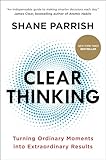
Shane Parrish (born 1981) is a Canadian author, investor, and founder of Farnam Street (fs.blog), a widely read resource on decision-making, learning, and mental models that he began writing in 2009 while working as a signals intelligence analyst for the Canadian Security Establishment. What started as anonymous notes for his own learning developed into one of the most respected intellectual resources on the internet, read by senior executives, investors, and professionals across industries. Clear Thinking (2023) is his first book — a synthesis of the decision-making framework he has developed through fifteen years of reading, writing, and consulting.
Where to Start: Clear Thinking (2023)
The essential Shane Parrish — and the most coherent single-volume presentation of the Farnam Street approach to decision-making. Clear Thinking opens with an observation that reframes the standard self-help premise: most of us believe our significant decisions are made in moments we recognize as significant — the career choice, the investment decision, the difficult conversation we have prepared for. But Parrish argues that the decisions that actually shape outcomes are usually the opposite: the ordinary moments when we are not prepared, not deliberate, and not engaged. The snap judgment in a meeting, the avoidance of an uncomfortable truth, the response to a provocation before we understand what it means — these are the decisions that compound into outcomes, and they happen precisely when we are most vulnerable to the automatic patterns Parrish calls defaults.
The four defaults are the book’s analytical core. They are not personality flaws or cognitive biases in the usual sense; they are evolutionary inheritances — patterns that served our ancestors well in environments where fast, automatic response mattered more than accurate deliberation. In modern decision-making contexts, they are usually liabilities.
The emotion default activates feelings before understanding them — responding to situations with whatever emotional state they trigger before having any information about what the situation actually is. The ego default prioritises the protection of self-image over the pursuit of accurate understanding — leading people to argue harder when wrong, dismiss unwelcome feedback, and conflate their positions with their identities. The social default defers to what the people around you are doing, calibrating behavior to social expectation rather than independent judgment. The inertia default continues present behavior regardless of whether it is producing the desired results.
The character argument is Parrish’s most distinctive contribution and the one most likely to surprise readers looking for cognitive techniques. Parrish argues explicitly that no decision-making framework survives contact with motivated reasoning and self-deception. The techniques only function for people genuinely committed to seeing clearly — and that commitment is a character attribute, not a skill that can be taught independently of it. This argument will frustrate readers who want tools they can apply without changing who they are; it will resonate with readers who recognize how often they know what the right decision is and find reasons to make a different one.
The positioning framework is the book’s most practically actionable section. Parrish argues for making decisions in advance of the high-stakes moments when they will be needed — creating rules and safeguards that trigger automatic behavior aligned with your values in the circumstances where defaults are most likely to override deliberate thinking. This pre-commitment strategy transforms decision quality without requiring willpower at the moment of decision.
Why Clear Thinking Is the Ideal First Book
For a reader new to Shane Parrish, Clear Thinking is the ideal first book because it is his major book and the fullest expression of his distinctive contribution, the cultivation of better thinking, judgment, and decision-making in everyday life. Clear Thinking offers practical wisdom for recognizing the moments that shape our lives and responding with clarity rather than reflex, drawing on the mental models, psychology, and decision-making principles Parrish is known for. As an entry point it is ideal, for it is his defining book and a clear statement of the thinking he has long explored through his writing and his popular platform. It welcomes the newcomer with its practical wisdom, its accessible insights, and its actionable guidance, drawing the reader into better thinking and decision-making. It is his most important book and a fine representation of his thinking, so the new reader encounters Parrish’s approach directly. For the newcomer interested in thinking and decision-making, then, Clear Thinking is the natural and ideal starting point.
What to Expect as a New Reader
As a new reader, you can expect Clear Thinking to be a practical, accessible, and insightful book about thinking and decision-making. You can expect a focus on everyday judgment, for Parrish is concerned with the ordinary moments that shape our lives and how we respond to them. You can expect an emphasis on responding with clarity rather than reflex, on creating space between stimulus and response. You can expect mental models and principles, for Parrish draws on the psychology, mental models, and decision-making wisdom he is known for. You can expect practical, actionable guidance for thinking and deciding better. You can expect an accessible, clear, and example-rich style. You can expect insight applicable to work and life alike. Expect, in short, a practical, accessible, and insightful book about thinking and decision-making, a fine introduction to Parrish’s approach.
Going Deeper After Your First Book
Once Clear Thinking has introduced you to Parrish’s approach, the reader who wishes to go deeper can explore his wider body of work, including his curated collections of wisdom and his popular platform devoted to mental models and better thinking. His related books gather timeless ideas and principles for thinking and living well, while his broader work, including his writing and conversations with thinkers across many fields, extends his exploration of mental models, decision-making, and wisdom. Reading more widely deepens your engagement with Parrish’s distinctive focus on clear thinking, good judgment, and decision-making. His characteristic emphasis on mental models and deliberate thinking runs through his work, and the reader who has valued Clear Thinking will find it across it. Building your reading journey from Clear Thinking is a matter of following Parrish’s approach into his other work and his wider platform. The reader who begins here will have a practical foundation for thinking and deciding more clearly.
Reading Shane Parrish
Clear Thinking is Parrish’s essential book and the natural starting point. Readers who want to continue should explore The Great Mental Models series, which covers the specific frameworks referenced throughout Clear Thinking in greater depth.
For the full Shane Parrish bibliography, reviews, and biography, visit the Shane Parrish author page on Editors Reads.
Affiliate disclosure: Links to Amazon on this page are affiliate links. We earn a small commission at no extra cost to you.
Frequently Asked Questions
Where should I start with Shane Parrish?
Clear Thinking: Turning Ordinary Moments into Extraordinary Results (2023) is Parrish's essential book — the synthesis of fifteen years of content from Farnam Street, one of the most respected decision-making and learning resources on the internet, into a coherent book-length argument. Parrish's core claim is that most poor decisions happen not in the moments we recognize as high-stakes but in ordinary moments when biological defaults — emotional, ego-driven, social, or inertia-driven — take over before deliberate thinking has a chance to engage.
What is Clear Thinking about?
Clear Thinking argues that the foundation of better decision-making is not technique but character — specifically, the commitment to seeing clearly rather than seeing what you want to see. Parrish identifies four defaults that undermine thinking in predictable ways: the emotion default (acting on feelings before understanding them), the ego default (protecting self-image over pursuing truth), the social default (conforming to what people around you are doing), and the inertia default (continuing current behavior regardless of whether it's working). The book covers how to recognise these defaults, position yourself to avoid them before high-stakes moments, and build the safeguards that prevent default behavior.
Is Clear Thinking primarily for business readers or general readers?
Both, though the examples lean toward professional and business contexts. Parrish's core framework applies to any consequential decision — personal, professional, financial, or relational — and the biological defaults he describes are universal human patterns, not specific to any domain. Regular Farnam Street readers will find much familiar material synthesized into a new structure; readers new to Parrish will find the most direct introduction to his thinking available in book form. The argument that character precedes technique is one Parrish makes more forcefully in the book than in his earlier writing.
What should I read after Clear Thinking?
After Clear Thinking, Parrish's The Great Mental Models series covers the specific mental models he references throughout the book in greater detail. Daniel Kahneman's Thinking, Fast and Slow provides the psychological research foundation for the System 1/System 2 distinction that underlies Parrish's defaults framework. Annie Duke's Thinking in Bets covers the specific application of decision-making frameworks to outcomes under uncertainty, covering ground that Clear Thinking addresses more briefly.