Where to Start with Scott Young: A Reading Guide
Where to start with Scott Young — how to approach Ultralearning, his framework for aggressive self-directed learning built on nine science-backed principles for rapid skill acquisition. A complete reading guide.
By Lena Fischer
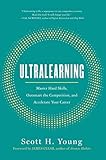
Scott Young (born 1987) is a Canadian author, blogger, and self-directed learner whose work focuses on the methodology of rapid skill acquisition. He came to public attention through a series of ambitious projects: completing MIT’s four-year computer science curriculum in twelve months through open courseware, learning four languages in a year through immersive travel, and documenting both experiments in detail. Ultralearning: Master Hard Skills, Outsmart the Competition, and Accelerate Your Career (2019) is his attempt to systematise the principles behind these experiments and the work of other high-velocity learners into a transferable framework.
Where to Start: Ultralearning (2019)
The essential Scott Young — and one of the most rigorously grounded books on self-directed learning available. Ultralearning opens with a premise that sounds simple but has significant implications: in an economy where valuable skills are changing faster than traditional education can track, the person who can reliably acquire new skills on their own terms has a fundamental advantage. The question is not whether to learn — it is how to learn with the speed and depth that makes the investment worthwhile.
Young’s framework has nine principles, but two are original contributions that deserve attention independent of the others.
Directness challenges the most common approach to learning: studying a subject in the abstract and then hoping the knowledge transfers to its real application. Young’s argument, supported by research on the specificity of skill transfer, is that this transfer is systematically weaker than learners assume. The person who learns to code through textbook exercises and the person who builds a real project from day one acquire different capabilities at the same elapsed time — and the project-builder’s capabilities are more robust. Directness means practising the skill in the context where you actually want to use it, from as early in the learning process as possible.
Drill addresses the tendency, common to all learners, to practise what they’re already competent at rather than what they’re weakest at. Deliberate work on the specific sub-skills that constitute a choke point in your overall performance is uncomfortable, progress-resistant in the short term, and far more effective than practising your strengths. Young takes this from deliberate practice research and makes it concrete: identify the sub-skill that limits your overall performance, isolate it, and work on it directly before reintegrating it.
Retrieval practice — the subject of Young’s chapter on the Retrieval principle — is one of the most replicated findings in cognitive psychology and one of the most consistently ignored in practice. Passive re-exposure to material (re-reading, highlighting, reviewing notes) produces the subjective feeling of familiarity while doing relatively little for actual retention. Testing yourself on material — without looking — forces the retrieval process that builds durable memory. The research on this is robust and the practical implication is clear: most study habits are inefficient in a way that is easily corrected.
The case studies throughout the book are carefully chosen and honestly presented. Young uses his own MIT experiment and language projects alongside historical examples — Benjamin Franklin’s deliberate writing practice, Richard Feynman’s problem-solving methods, chess prodigies’ training regimes — to illustrate principles without overgeneralising from any single case. He is explicit about what ultralearning requires: significant time, discomfort, and self-discipline. He is not selling a shortcut. He is describing a methodology that produces better results than conventional approaches when applied with appropriate commitment.
Why Ultralearning Is the Ideal First Book
For a reader new to Scott Young, Ultralearning is the ideal first book because it is his best-known work and the fullest expression of his distinctive contribution, a strategy for rapid, self-directed, intensive learning. Ultralearning presents Young’s approach to learning hard skills quickly and deeply through aggressive, self-directed projects, drawing on his own experiments and on research and examples of remarkable learners. As an entry point it is ideal, for it is his defining book and a clear statement of his method. It welcomes the newcomer with its compelling approach, its practical principles, and its accessible style, drawing the reader into a powerful way of learning. It is his most important work and the one that best represents his thinking, so the new reader encounters Young’s approach directly. For the newcomer interested in learning more effectively, then, Ultralearning is the natural and ideal starting point.
What to Expect as a New Reader
As a new reader, you can expect Ultralearning to be a practical, principle-driven, and motivating guide to intensive self-directed learning. You can expect a central idea, ultralearning, a strategy for learning hard skills quickly and deeply through aggressive, self-directed projects. You can expect principles, for Young distills his approach into clear principles such as directness, drilling weaknesses, and active retrieval. You can expect examples, drawn from his own learning experiments and from remarkable learners. You can expect grounding in research on learning and skill acquisition. You can expect practical guidance for planning and executing your own learning projects. You can expect an accessible, motivating style. Expect, in short, a practical, principle-driven, and motivating guide to intensive self-directed learning, a fine introduction to Young’s approach.
Going Deeper After Your First Book
Once Ultralearning has introduced you to Young’s approach, the reader who wishes to go deeper can explore his other work and the wider literature on learning, skill, and productivity to which his method connects. His later writing extends his thinking on learning, performance, and getting better at hard things, while his broader work, including his popular writing on self-education and learning projects, develops his ideas further. The broad field of writing on learning, expertise, and skill acquisition offers many further perspectives the reader is well prepared to explore. Reading more widely deepens your engagement with Young’s distinctive contribution, the strategy for rapid, self-directed, intensive learning. His characteristic emphasis on deliberate, project-based learning runs through his work. Building your reading journey from Ultralearning is a matter of following its method into his other work and the wider learning literature. The reader who begins here will have a powerful and practical foundation for learning hard skills.
Reading Scott Young
Ultralearning is Young’s essential and most widely read book. It stands alone. Readers who want to explore the underlying science should continue with Anders Ericsson’s Peak, which is the foundational academic account of deliberate practice that Young draws on throughout.
For the full Scott Young bibliography, reviews, and biography, visit the Scott Young author page on Editors Reads.
Affiliate disclosure: Links to Amazon on this page are affiliate links. We earn a small commission at no extra cost to you.
Frequently Asked Questions
Where should I start with Scott Young?
Ultralearning: Master Hard Skills, Outsmart the Competition, and Accelerate Your Career (2019) is Young's essential book — a framework for intensive self-directed learning built on nine principles drawn from learning science and illustrated with case studies of people who acquired skills at remarkable speed. Young developed the framework from his own projects — completing MIT's four-year computer science curriculum in twelve months through open courseware, learning four languages in a year — and from studying others who had achieved similar results.
What is Ultralearning about?
Ultralearning argues that in a world where skills determine careers and careers change rapidly, the ability to learn quickly and deeply is among the most valuable things a person can develop. Young identifies nine principles that high-velocity learners share: Metalearning (mapping the territory before starting), Focus, Directness (practising the skill in the context you want to use it), Drill (targeting your weakest sub-skills), Retrieval (testing yourself rather than re-reading), Feedback, Retention, Intuition, and Experimentation. The book is organised around these principles with case studies and practical guidance for each.
What are the most important principles in Ultralearning?
Directness and Retrieval are Young's most practically impactful contributions. Directness challenges the common approach of learning abstractions before application — Young argues that practising the skill in its real context from the start dramatically outperforms learning it in a classroom and hoping the knowledge transfers. Retrieval practice — testing yourself on material rather than re-reading it — is one of the most replicated findings in learning science and one of the most consistently ignored in actual study habits. Both principles are immediately actionable and produce measurable improvement.
What should I read after Ultralearning?
After Ultralearning, Cal Newport's Deep Work covers the concentrated attention that ultralearning requires and the modern conditions that undermine it. Anders Ericsson's Peak is the foundational academic account of deliberate practice — the research tradition that Young draws on throughout Ultralearning. For the specific sub-skill of learning languages, Gabriel Wyner's Fluent Forever provides the most operational implementation of the retrieval and directness principles for language acquisition.