Where to Start with Samin Nosrat: A Reading Guide
Where to start with Samin Nosrat — how to approach Salt, Fat, Acid, Heat, the James Beard Award-winning cookbook that teaches the four universal elements of great cooking. A complete reading guide.
By Priya Anand
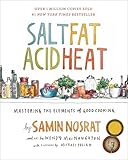
Samin Nosrat is an Iranian-American chef and food writer who trained under Alice Waters at Chez Panisse in Berkeley. She spent years teaching cooking to groups of home cooks and noticed that most of the confusion, failure, and success in their kitchens traced back to four variables. Salt, Fat, Acid, Heat: Mastering the Elements of Good Cooking (2017) was published by Simon & Schuster, won both the James Beard Award (General Cooking) and the National Book Critics Circle Award — a combination unprecedented for a cookbook — and became one of the most widely recommended culinary books of the decade.
Where to Start: Salt, Fat, Acid, Heat (2017)
The essential Samin Nosrat — and the most important book about cooking to appear in a generation. Most cookbooks operate as collections of instructions: combine these ingredients in this sequence using this technique. Salt, Fat, Acid, Heat makes a different argument: there are four fundamental elements that determine whether food tastes delicious, and if you understand those elements, you can cook anything from any cuisine with confidence, with or without a recipe.
Salt is the element most home cooks misunderstand. The common error is to treat salt as a finishing agent — something added at the end to taste — rather than as an active ingredient used throughout the cooking process to shape flavour and texture. Nosrat explains how salt draws moisture, disrupts protein structure, and penetrates meat and vegetables in ways that change the final result. Salting a chicken 24 hours before roasting produces fundamentally different skin and flesh than salting immediately before cooking. Salting pasta water properly seasons the pasta itself, not just the sauce. Most home cooking tastes flat not because of any complex deficiency but because of insufficient salt, applied too late.
Fat carries flavour. This is more than a cliché — fat-soluble flavour compounds are activated and concentrated in the presence of fat, and the type of fat used shapes the taste of the dish. Olive oil imparts one set of flavours; butter another; rendered duck fat another still. Nosrat distinguishes between fats used for cooking (which withstand heat), fats used for dressing (which contribute flavour raw), and fats used for enriching (added at the end to provide body and richness). Understanding these different roles allows a cook to choose fats deliberately rather than reflexively.
Acid is the element most home cooks forget and professional cooks rely on most. A squeeze of lemon juice, a splash of white wine vinegar, a spoonful of yoghurt — acid brightens flat dishes, cuts richness, and creates the contrast between notes that makes food compelling rather than merely edible. Nosrat teaches acid as a seasoning, as important as salt, to be adjusted throughout cooking rather than added as an afterthought.
Heat is the most complex element because it drives the physical and chemical transformations that produce cooked food. The Maillard reaction (the browning of proteins and sugars that creates crust, depth, and flavour) requires temperatures above 140°C and cannot happen in the presence of surface moisture — which is why patting meat dry before searing matters. Caramelisation affects sugars and occurs at different temperatures. Collagen converts to gelatin during long, slow cooking. Understanding what you are trying to achieve with heat — and what happens to food at different temperatures — is the difference between cooking deliberately and cooking by accident.
The book’s design contributes substantially to its usefulness. Wendy MacNaughton’s illustrations replace the standard food photography with drawings that explain technique rather than merely depict ingredients. The visual language makes the four elements immediately intuitive, and the book remains a pleasure to look at and handle in a kitchen where photographs would smear and warp.
That it won the National Book Critics Circle Award alongside the James Beard Award signals something unusual: this is also excellent writing. Nosrat’s prose is warm, patient, and precisely calibrated to build confidence rather than intimidate — rare in food writing at any level of technical depth.
Why Salt, Fat, Acid, Heat Is the Essential First Book
For a reader new to Samin Nosrat, Salt, Fat, Acid, Heat is the essential first book because it is her landmark, beloved work and the fullest expression of her distinctive contribution, the teaching of cooking through the mastery of four fundamental elements. Salt, Fat, Acid, Heat presents Nosrat’s approach to cooking through the understanding of its four essential elements, empowering cooks to cook well by feel and understanding rather than by slavishly following recipes. As an entry point it is both natural and essential, for it is her defining book and a clear, inspiring statement of her approach. It welcomes the newcomer with its illuminating framework, its warm and encouraging voice, and its empowering approach, drawing the reader into a deeper understanding of cooking. It is her most famous work and the one that best represents her contribution, so the new reader encounters Nosrat’s approach directly. For the newcomer who wants to cook better, then, Salt, Fat, Acid, Heat is the natural and essential starting point.
What to Expect as a New Reader
As a new reader, you can expect Salt, Fat, Acid, Heat to be an illuminating, empowering, and warm guide to cooking. You can expect a central framework, the four elements of salt, fat, acid, and heat, which Nosrat presents as the keys to good cooking. You can expect an emphasis on understanding, for the book teaches cooks to understand how these elements work so they can cook well by feel rather than by rote. You can expect an empowering approach, for the goal is to free cooks from dependence on recipes. You can expect a warm, encouraging, and accessible voice. You can expect both explanation and recipes, with delightful illustrations. You can expect a book that aims to make you a better, more confident cook. Expect, in short, an illuminating, empowering, and warm guide to cooking, the essential introduction to Nosrat’s approach.
Going Deeper After Your First Book
Once Salt, Fat, Acid, Heat has introduced you to Nosrat’s approach, the reader who wishes to go deeper can carry its framework into the wider world of cooking and culinary writing, applying her elements to any recipe or cuisine. Since Salt, Fat, Acid, Heat is her major book, the natural next step is to use its understanding to explore the broad world of cookbooks and cooking with new confidence, while her broader work, including her cooking show and her writing, extends her warm, illuminating teaching. The reader can also explore the wider literature on the fundamentals and the science of cooking that complements her approach. Reading and cooking more widely builds on the understanding her book provides. Nosrat’s framework equips the home cook to cook well across cuisines and recipes. Building your reading journey from Salt, Fat, Acid, Heat is a matter of carrying its framework into the wider world of cooking. The reader who begins here will have an empowering, lasting foundation for cooking well.
Reading Samin Nosrat
Salt, Fat, Acid, Heat is Nosrat’s essential and most influential book. It stands alone and requires no prior cooking knowledge.
For the full Samin Nosrat bibliography, reviews, and biography, visit the Samin Nosrat author page on Editors Reads.
Affiliate disclosure: Links to Amazon on this page are affiliate links. We earn a small commission at no extra cost to you.
Frequently Asked Questions
Where should I start with Samin Nosrat?
Salt, Fat, Acid, Heat: Mastering the Elements of Good Cooking (2017) is Nosrat's essential book — a James Beard Award and National Book Critics Circle Award winner that teaches the four universal elements of delicious food rather than a collection of recipes to follow. The most important book for anyone who wants to actually learn to cook rather than merely execute instructions.
What is Salt, Fat, Acid, Heat about?
Salt, Fat, Acid, Heat argues that every delicious dish — regardless of cuisine or complexity — is the result of mastering four elements: salt (which enhances all flavour), fat (which carries flavour and provides texture), acid (which brightens and balances), and heat (which transforms raw ingredients). Nosrat teaches each element as a principle that applies to any cuisine, so that readers can cook with understanding rather than recipe dependence.
Is Salt, Fat, Acid, Heat suitable for beginners?
Salt, Fat, Acid, Heat is described as beginner-friendly, but its real value is at the intermediate level — for cooks who already follow recipes but want to understand why they work and feel confident improvising. True beginners will find it enormously useful, but they may not fully appreciate its depth until they've cooked from it repeatedly. It is the book that turns a competent recipe-follower into an actual cook.
What should I read after Salt, Fat, Acid, Heat?
After Salt, Fat, Acid, Heat, J. Kenji López-Alt's The Food Lab provides the scientific grounding for the same principles — why each element works at the molecular level, with hundreds of tested recipes built on the understanding. Julia Child's Mastering the Art of French Cooking extends the technique approach to classical French cuisine, applying Nosrat's framework to one of the world's great culinary traditions.