Where to Start with Robert M. Sapolsky: A Reading Guide
Where to start with Robert M. Sapolsky — how to approach Behave, his landmark synthesis of biology, neuroscience, and evolution as a unified explanation of human behaviour. A complete reading guide.
By Elena Marsh
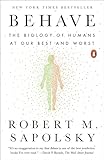
Robert M. Sapolsky is an American neuroendocrinologist and professor of biology, neurology, and neurological sciences at Stanford University. He has spent decades studying stress biology in baboons in the Serengeti and applying those findings to human behaviour. Behave: The Biology of Humans at Our Best and Worst (2017) was published by Penguin Press and represents the culmination of his career-long effort to understand what biological forces drive human beings toward violence and toward extraordinary kindness, sometimes within the same hour.
Where to Start: Behave (2017)
The essential Robert M. Sapolsky — and one of the most ambitious science books of the past decade. Behave begins with a deceptively simple question: why did a person just do that? Whatever “that” was — an act of aggression, an act of compassion, a split-second tribalistic judgment, a moment of extraordinary self-sacrifice — Sapolsky proposes to explain it. All of it. At every level simultaneously.
The temporal framework is the book’s central organising achievement. Before any behaviour occurs, Sapolsky asks us to consider what was happening:
One second before — the activity of neurons in specific brain regions, particularly the prefrontal cortex (deliberation, impulse control), the amygdala (threat detection, fear, aggression), and the interactions between them. The prefrontal cortex’s job is to regulate the amygdala; much of human moral behaviour is this regulation working, or failing to work.
One minute before — sensory triggers that primed those neural states: a smell, a face, a sound, a word. Environmental inputs operate on neural circuits before conscious awareness.
Hours before — hormonal context. Testosterone does not create aggression but amplifies the propensity toward status-seeking and the willingness to use aggression in service of it. Cortisol (stress hormone) makes the amygdala hyperreactive and suppresses prefrontal function. Oxytocin increases trust and cooperation within groups while simultaneously increasing hostility toward outsiders.
Days to weeks before — what the person learned, experienced, and was sensitised to. Neural circuits are modified by experience in ways that shape subsequent responses.
Years before — developmental history: childhood, adolescence, the quality of attachment, chronic stress during sensitive periods. The adolescent brain is a distinct neurological state, not simply an immature adult brain. The prefrontal cortex is the last brain region to fully mature — not complete until the mid-twenties — which is not an excuse for adolescent behaviour but is a biological explanation with significant implications for how societies should think about moral and legal responsibility.
Decades before birth — genes. But not in the way popular genetics often suggests. Genes do not specify behaviour; they specify the structure of proteins that influence neural development in ways that interact with every level above. Gene-environment interaction is the mechanism, not genetic determinism.
Thousands to millions of years before — evolution. Why does the amygdala categorise faces as in-group or out-group within milliseconds, before conscious thought? Because that discrimination had survival value for most of human evolutionary history, and the architecture it produced is what we inherit. The biology of us-versus-them runs extraordinarily deep.
The us/them chapter is among the book’s most important. Humans are obligately tribal — we categorise people into in-group and out-group automatically, rapidly, and beneath the threshold of awareness. The amygdala responds to out-group faces faster than to in-group faces. Oxytocin, the “bonding” hormone, reliably increases hostility toward outsiders while increasing trust within the group. The neural circuitry underlying cooperation and the neural circuitry underlying tribal violence are not opposed systems — they are aspects of the same system.
Sapolsky ends Behave with a chapter on free will and biological determinism that is among the more intellectually honest treatments in popular science. If behaviour emerges from cascading biological causes at every level — neural, hormonal, developmental, genetic, evolutionary — what remains of free will? Sapolsky’s answer is that nothing remains, in the traditional libertarian sense, and that we need to rethink the moral and legal frameworks built on that assumption. He is not advocating nihilism — he argues for a more compassionate framework for understanding human failure, one grounded in what the biology actually says rather than in what would be convenient for systems of punishment.
At 800 pages, Behave demands time and engagement. It is not light reading. It is also the most complete account of why human beings do what they do that exists in accessible form.
Why Behave Is an Ideal First Book
For a reader new to Robert M. Sapolsky, Behave is an ideal first book because it is his magnum opus and the fullest expression of his distinctive gifts, the magisterial scope, the scientific rigor, and the wit and clarity that make difficult science engaging. Behave is a sweeping exploration of the biology of human behavior, asking why we do the things we do, and tracing the causes of our actions from the split-second before through our evolutionary history. As an entry point it is ideal, for it is his most ambitious and comprehensive work and a perfect example of his rigorous, witty, wide-ranging science writing. It welcomes the newcomer with its fascinating subject, its scientific depth, and its engaging wit, drawing the reader into the science of human behavior. It is among his major works and a fine representation of his gifts, so the new reader encounters Sapolsky at his most ambitious. For the newcomer, then, Behave is an excellent, if substantial, starting point.
What to Expect as a New Reader
As a new reader, you can expect Behave to be a magisterial, rigorous, and engaging exploration of the biology of human behavior. You can expect a sweeping scope, for the book asks why we do the things we do and traces the causes of our actions across many timescales. You can expect a distinctive structure, for Sapolsky works backward from the moment of an action through the brain, hormones, development, and evolution. You can expect scientific rigor, for Sapolsky draws deeply on neuroscience, biology, and psychology. You can expect wit and clarity, for Sapolsky writes with humor and an engaging voice that makes difficult science approachable. You can expect a substantial, ambitious, and wide-ranging book. You can expect insight into the roots of both our best and worst behavior. Expect, in short, a magisterial, rigorous, and engaging exploration of the biology of human behavior, a fine introduction to Sapolsky’s gifts.
Going Deeper After Your First Book
Once Behave has introduced you to Sapolsky’s gifts, the reader who wishes to go deeper can explore his other books, which continue his rigorous, witty, engaging science writing on the brain, the body, and human behavior. His provocative later book argues against the existence of free will, extending the deterministic implications of the science in Behave, while his classic, witty book on stress and its effects on the body, and his other writing, display his gift for making difficult science engaging. Reading these after Behave deepens your appreciation of Sapolsky’s distinctive gifts, the scientific rigor, the wit and clarity, and the wide-ranging exploration of human behavior. His characteristic strengths run through his work, and the reader who has enjoyed Behave will find them across his books. Building your reading journey through Sapolsky is a matter of following his science writing from Behave into his other books. The reader who begins here and continues will find one of the most rigorous, witty, and engaging writers on the biology of human behavior to follow.
Reading Robert M. Sapolsky
Behave is Sapolsky’s essential and most comprehensive work. It stands alone and requires no prior scientific background, though readers will find it more accessible with some familiarity with basic neuroscience or evolutionary biology.
For the full Robert M. Sapolsky bibliography, reviews, and biography, visit the Robert M. Sapolsky author page on Editors Reads.
Affiliate disclosure: Links to Amazon on this page are affiliate links. We earn a small commission at no extra cost to you.
Frequently Asked Questions
Where should I start with Robert M. Sapolsky?
Behave: The Biology of Humans at Our Best and Worst (2017) is Sapolsky's magnum opus — an 800-page synthesis of neuroscience, endocrinology, evolutionary biology, and social psychology organised around a single question: what causes a human being to act the way they do? Demanding but rewards the effort with a more complete understanding of human behaviour than any other single book provides.
What is Behave about?
Behave asks what biological forces drive human behaviour — from aggression to altruism, tribalism to cooperation. Sapolsky's organising device is temporal: before any act, what was happening one second before (neuroscience), one minute before (hormones), one hour before (sensory triggers), one week before (learning and experience), years before (development), and then back through evolution. The result is a layered, cumulative account of behaviour that no single discipline alone could produce.
How does Behave's approach differ from typical popular neuroscience books?
Most popular neuroscience books explain behaviour through a single lens — the brain, or genes, or evolution. Behave insists that no single level of explanation is sufficient. A violent act has causes in neural firing, hormonal states, prior experience, developmental history, and evolutionary inheritance simultaneously. Sapolsky holds all these levels in view at once and shows how they interact. It is harder than a single-lens book, and significantly more honest about how complex behaviour actually is.
What should I read after Behave?
After Behave, Richard Dawkins's The Selfish Gene covers the evolutionary layer of Sapolsky's argument in the depth it deserves. Daniel Kahneman's Thinking, Fast and Slow covers the psychological mechanisms of decision-making with complementary depth. Frans de Waal's Mama's Last Hug examines the emotional and social continuity between primates and humans from a field rather than laboratory perspective.