Where to Start with John Sandford: A Reading Guide
Where to start with John Sandford — whether to begin with Rules of Prey, Field of Prey, or Ocean Prey. A complete reading guide to the Lucas Davenport crime series.

John Sandford is the pen name of John Roswell Camp (born 1944), the American journalist and Pulitzer Prize-winning reporter whose Prey series — beginning with Rules of Prey (1989) and running to over thirty volumes — has made him one of the most commercially successful crime fiction authors in America. The series follows Lucas Davenport, a Minneapolis detective of formidable intelligence and unconventional methods, through major criminal cases rendered with the procedural accuracy of a journalist and the psychological depth of a novelist who takes his villains seriously. Sandford writes crime fiction in which the criminal is as fully characterised as the detective; his antagonists are genuinely frightening because they are comprehensible rather than cartoonish.
Where to Start: Rules of Prey (1989)
The essential Sandford — and one of the finest crime fiction debuts of the 1980s. Lucas Davenport is a homicide detective with the Minneapolis Police Department who also, somewhat improbably, makes a second income designing video games. He is tall, darkly handsome, well-dressed, and possessed of an intellect that makes the standard police bureaucracy chafe. He hunts a killer — the Maddog — who has left a list of rules at each crime scene, taunting investigators with his methodology.
What Sandford understood from the beginning was that the most gripping crime fiction creates genuine tension not just about whether the detective will catch the killer, but about whether the killer has the measure of the detective. The Maddog is intelligent, careful, and contemptuous; watching Davenport work out the pattern before the next murder gives the novel the specific suspense of a game being played by two equally capable players.
The Minneapolis setting is rendered with genuine specificity — the weather, the city’s geography, the institutional world of the police department. Sandford draws on his career as a Minneapolis journalist; the procedural details feel observed rather than researched. Rules of Prey is a long series but it starts here, and the character of Davenport is established with sufficient clarity that every subsequent entry builds on a solid foundation.
Field of Prey (2014)
One of the strongest mid-series entries — book 24, which can be read independently as a complete standalone crime investigation. A series of bodies found in a rural Minnesota field; a killer who has been operating undetected for years; a small-town community that has unknowingly sheltered him. Sandford’s use of rural Minnesota setting distinguishes this from the Minneapolis-centred earlier entries.
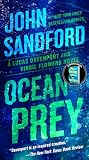
Ocean Prey (2021)
A crossover entry (book 31) featuring both Davenport and Virgil Flowers investigating a drug smuggling operation off the Florida coast. One of the best examples of Sandford’s dual-protagonist dynamic; the Florida setting provides a change from the characteristic Minnesota backdrop.
Why Rules of Prey Is the Ideal First Book
For a reader new to John Sandford, Rules of Prey is the ideal first book because it introduces Lucas Davenport, his most famous character, and launches the long-running Prey series, the fullest expression of his distinctive gifts, the propulsive pace, the sharp characterization, and the gripping cat-and-mouse plotting. Rules of Prey introduces Davenport, a tough, intelligent, and unconventional investigator, as he hunts a methodical killer, in a tense thriller that began one of the most successful series in crime fiction. As an entry point it is ideal, for it is the start of the Prey series, the natural place to meet Davenport, and a fine example of Sandford’s page-turning style. It welcomes the newcomer with its compelling detective, its propulsive plot, and its sharp suspense, drawing the reader into the world of his signature character. It begins his best-known series and best represents his gifts, so the new reader meets Sandford at his most characteristic. For the newcomer, then, Rules of Prey is the natural and ideal starting point.
What to Expect as a New Reader
As a new reader, you can expect Rules of Prey to be a fast-paced, suspenseful, and sharply characterized crime thriller. You can expect a compelling protagonist, for it introduces Lucas Davenport, a tough, smart, wealthy, and unconventional investigator whose personality anchors the long series. You can expect propulsive pace, for Sandford keeps the tension high and the plot moving. You can expect a gripping cat-and-mouse structure, as Davenport pursues a cunning and dangerous killer. You can expect sharp characterization and crackling dialogue, for Sandford draws his investigators and adversaries with vivid specificity. You can expect a procedural realism grounded in police work, combined with thriller momentum. You can expect the launch of a long-running and beloved series. You should be prepared for some violent and dark material. Expect, in short, a fast-paced, suspenseful, and sharply characterized crime thriller, a gripping introduction to Sandford’s gifts.
Going Deeper After Your First Book
Once Rules of Prey has introduced you to Lucas Davenport, the natural next step is to continue the Prey series, which follows Davenport across many further thrillers, best read roughly in order to follow his career and life, though each delivers a self-contained case. Beyond the Prey novels, the reader who has enjoyed Sandford’s gifts can explore his related series, including the books featuring Virgil Flowers, a character who emerges from the Davenport world, as well as his other crime fiction. His characteristic strengths, the propulsive pace, the sharp characterization, and the gripping plotting, run through his work, and the reader hooked by Rules of Prey will find them across his books. Sandford’s large bibliography offers extensive reading for those who enjoy his style. Building your reading journey through Sandford is a matter of continuing the Prey series and branching into his related fiction. The reader who begins with Rules of Prey will find one of the most reliable and popular thriller writers to follow.
Reading John Sandford
Begin with Rules of Prey — it is the essential Davenport introduction and the foundation for everything that follows. Mid-series entries like Field of Prey work as standalone procedurals for readers who want to sample the series. Read the Flowers novels alongside the Prey series for the companion view of the same BCA world.
John Sandford Books in Order →
For the full John Sandford bibliography, reviews, and biography, visit the John Sandford author page on Editors Reads.
Affiliate disclosure: Links to Amazon on this page are affiliate links. We earn a small commission at no extra cost to you.
Frequently Asked Questions
Where should I start with John Sandford?
Rules of Prey (1989) is the essential starting point — the first Lucas Davenport novel, introducing the Minneapolis detective who is brilliant, unorthodox, wealthy from his video game business, and absolutely committed to catching a serial killer who is following his own elaborate rules. The Prey series is Sandford's defining achievement and one of the longest-running and most consistently excellent police procedural series in American crime fiction. Rules of Prey establishes the character and the Minneapolis world that sustain over thirty subsequent novels.
What is the Prey series about?
The Prey series follows Lucas Davenport — originally a Minneapolis homicide detective, later a Minnesota Bureau of Criminal Apprehension investigator, and eventually a US Marshal — through a series of major criminal cases that are typically more complex and more psychologically sophisticated than the standard police procedural. Sandford (the pen name of journalist John Camp) writes with a journalist's attention to institutional detail and a thriller writer's instinct for pacing; his villains are often as carefully characterised as his protagonist. The series has run to over thirty volumes published between 1989 and the present.
Can you read the Prey series out of order?
Individual Prey novels work as standalones — each book is a complete investigation with a distinct crime and a resolved plot. However, Davenport's personal life (his relationships, career changes, family) develops across the series, and readers who start in the middle miss the context for his character. Rules of Prey is the best starting point; later books can be sampled independently, though the experience is richer for readers who have followed Davenport from the beginning.
Who is Virgil Flowers?
Virgil Flowers is the protagonist of Sandford's companion Flowers series — a BCA investigator who works for Davenport and appears in Prey novels as a supporting character before starring in his own series beginning with Dark of the Moon (2007). Flowers is deliberately drawn as a foil to Davenport: where Davenport is wealthy, urban, and driven by intensity, Flowers is folksy, rural, and driven by a different kind of stubbornness. Ocean Prey is a crossover entry featuring both characters.